D-Day Radio Stories
RiR #85, Season 13, Episode 06, June 16, 2025
A World War II documentary sound collage
Re-Imagined Radio combines multiple "eye witness" radio news reports for this part documentary, part sound collage of stories about D-Day, the invasion of Europe by Allied military forces to repel German invaders and end World War II, June 6, 1944. "D-Day Radio Stories" provides a different storyline for this World War II turning point, and we hope, a worthy tribute to the Allied invading forces and those correspondents who went with them to tell the rest of us what they saw and heard.
Download Links
Download episode to your
device→
Download episode media
kit→
Download episode script

Background
Re-Imagined Radio presents "D-Day Radio Stories" to commemorate the 81st Anniversary of the invasion of Europe by Allied military forces to repel German invaders and end World War II. The landings of Allied Forces at Utah, Omaha, Gold, Juno, and Sword beaches of Normandy, France, began on June 6, 1944, "D-Day," a military term used to designate the start date of an attack or invasion.
In 1944, the world is without television, streaming media, the Internet, the 24/7 news cycle. Radio is the primary news medium and people around the world listen throughout the day for news of Allied troops invading Europe. When that news comes through the air to radio sets it is miraculous. Not only is it timely, it is eye witness and includes, for the first time, the actual sounds of conflict.
With this episode, Re-Imagined Radio combines multiple reports by radio news correspondents who used portable recording equipment or filed their reports using shortwave radios while embedded with air, land, or sea Allied forces. Part documentary, part sound collage, "D-Day Radio Stories" provides a different account of this turning point in World War II.
It is also, we hope, a worthy tribute to the Allied invading forces and those embedded correspondents who told the world what they saw and heard. LISTEN to reports from multiple correspondents.
EXTRA
Our research prompts these Re-Imagined Radio EXTRA bits of information and sound files.
Early Use of Recorded Material for News Reports
D-Day is one of the earliest instances of using RECORDED material for news reports, "actualities" as
they were, and still are, called. This allows listeners to experience events as if they were actually
happening. Edward R. Murrow pioneers this approach during the London Blitz when he broadcast live the
daily German bombings in his reports back to America. Re-Imagined Radio explores his efforts in an
episode entitled Proximity Effect.
D-Day Is Part of a Larger Counter Invasion of Europe
The counter invasion of Nazi occupied Europe is planned in three parts.
First
First, the Allies conduct campaigns in the North African countries of Libya, Egypt, Tunisia, Algeria, and Morocco, from 1940 to 1943. The objective is to secure the Suez Canal, oil supplies, and a launching point for future campaigns against Italy and Germany, the Axis Powers.
Second
The second part is the invasion of Italy, from the Mediterranean Ocean, September 3, 1943. On June 5,
1944, Rome is liberated by Allied forces. Godfrey Talbot, BBC correspondent, is there and files this
report.
Transcription: BBC, SAMPLE, REPORT BY GODFREY TALBOT, "ROME TAKEN BY ALLIES," JUNE 5, 1944, 1:16 LENGTH.
This is Godfrey Talbot speaking from Rome. I'm standing in the middle of the Piazza Venezia on this
day of our occupation and at this moment the windows of the balcony of the Palazzo Venezia from
which Mussolini was to make his speeches, the windows have been opened and has come out onto the
balcony, not Mussolini, who incidentally has never made any appearance on that balcony since July of
last year, not Mussolini, but three Allied soldiers with their steel helmets on and their rifles in
their hands. Beside them, two Romans, two people who've gone up from this square, two of the Italian
people, and those four are standing there and they're waving the Italian and the Allied flags. A
vastly different scene from the ones which that balcony has staged in the past.
Third
The third part of the invasion of Europe, is through Normandy, in Western France. This invasion is scheduled for June 5, 1944, but bad weather forces a 24-hour delay until June 6. "Bad weather" is an understatement. The worst weather in 50 years caused the setback. A break in the storms allowed D-Day to proceed on June 6.
The Atlantic Wall
The Atlantic Wall was a 1,670-mile-long string of fortifications ordered by Furer Adolph Hitler, to be built by local, hired, volunteer, and enslaved labor, along the coasts of Finland, Denmark, and France to provide defenses for Nazi occupied Europe during World War II. The planned fortifications included 547 coastal guns and other artillery placements, to be protected by 15,000 concrete bunkers. Under construction December 1941 to 1944, The Atlantic Wall was never completed. Just before the D-Day invasion, only 5,000 bunkers were completed. Only 299 protected artillery placements.
The Atlantic Wall was frequently featured in Nazi Germany propaganda, including radio broadcasts. This
one, titled "Calling Invasion Forces," from German radio RSH, Hamburg, featured vocalists singing "The
Atlantic Wall," and headline news.
Transcription
(MUSIC AND FEMALE VOCALIST)
Duty calls and Germany:
We are looking forward to your landing days!
Germany is calling you: Everything will be perfect in every way!
You will all be welcomed at the Atlantic Wall!
Yet in bonny Stalags you like it the most!
When duty calls, when duty calls:
Don't forget that we are waiting for you!
(ANNOUNCER)
Headline news . . .
Heavy German bombers directed a large-scale attack against Portsmith [England].
"The new German blitz attacks are more nerve-racking than the bombardments of 1940 and 1941," writes
Newsweek.
Field Marshal Rommel is again on the French West Coast on a tour of inspection.
The Sphere [London, England] states that the man in the street doubts the results of the
British and American air raids.
Field Marshal Ironside indicated that in the event of an invasion, Germany would be in a position to
deal out heavy counter-blows.
The annual conference of the British Labour Party has been postponed owing to the traffic situation.
The Soviet General [Alexander Alexandrovich] Zhuravlev points out that Germany could never be conquered
by means of bombing raids.
It was stated before the Canadian Parliament that no bridgehead could be created on the coast of the
European fortress without terrible losses.
The French paper Le Nouveau Temps writes that the Anglo-American air raids are directed
against France more than against the German army.
General Martin declared that the Allied air forces could not eliminate the German supply routes. Only
local fighting took place, on the Lower Dniester and in the Carpathian foothills.
The Moscow Patriarch Sergius, who was appointed by Stalin, has died a natural death.
The Metropolitan of Vilna in Lithuania, Sergius [Voskresensky, sent from Moscow], was murdered by
Bolsheviks the fortnight ago.
After embittered fighting south of Krasino [Russia], a few high positions were lost to the enemy.
Strong German bomber formations carried out effective attacks in the Italian battle area.
The Daily Herald stresses that the German defense system in southern Italy is stronger than
anything the Allies have hitherto encountered in this war.
The Swiss President stated that Switzerland will energetically defend her vital rights to national
existence.
The London announcement that industry would not be taxed additionally has led to general increases in
prices.
(UPBEAT MUSIC AND MALE VOCALIST)
The mines are bursting, it seems on land and on the sea!
Along the towering Atlantic Wall
they play their game for me.
My weapon is brand new,
and magic is for you:
The magic of the Atlantic Wall
that'll be a hot surprise for you!
If a thousand planes are roaring over my head,
they will drop in vain their bombs on my concrete shed,
as soon as engines roar
and heavy guns galore!
Of those who approach the Atlantic Wall
there will be no one living left ashore!
(MUSIC FADES OUT)
Works Cited
"Calling Invasion Forces," 17 April 1944, We Are Waiting For You, Headline News, Atlantic Wall, 4'38" in Bergmeier, Horst J.P. and Rainer E. Lotz. Hitler's Airwaves: The Inside Story of Nazi Radio Broadcasting and Propaganda Swing. Yale University Press, 1997, pp. 341-342.
Notes
Plymouth Hosted
BBC correspondent Frank Gilliard reports "On the Build Up to D-Day," and ends by saying he saw troops
"having a quiet knock-up game of cricket. They made me think of Francis Drake and Plymouth Hoe."
Gillard refers to the popular legend of Captain Sir Frances Drake playing bowls at Plymouth Hoe while waiting for the Spanish Armada in 1588. The name "Plymouth Hoe" derives from an Anglo Saxon word describing a landmass in the shape of an inverted human heel and foot. According to legend, when the Spanish ships are sighted, Drake calmly finishes his game before departing Plymouth with his ships and defeating the invaders in an historic sea battle.
Field Marshall Montgomery
We include a portion of a speech Field Marshall Bernard Law Montgomery, nicknamed "Monty," delivered to
Allied troops at the onset of D-Day. Montgomery is noted for his leadership in the earlier North African
Campaign. After D-Day he leads Allied troops to victory in Northwest Europe.
Guy Byam
BBC correspondent Guy Byam parachutes into France with British paratroops and reports his experiences.
We include a sample of his report in this episode. After parachuting into France, Byam's journalism
career continues until February 1945 when the plane on which he iss reporting, Rose of York, is shot
down over Berlin during a daylight bombing raid. Byam and Kent Stevenson are the two BBC reporters
killed during World War II.
Anonymous Correspondent Identified
We include a sample from a report by an "anonymous correspondent" who spent time aboard a US Naval
Torpedo Patrol Boat in the English Channel. Further research allows us to identify this correspondent as
Stanley Richardson, formerly with the Associated Press, who in 1942, becomes director of NBC's London
Bureau (The Fourth Chime 148). The US Navy PT torpedo boat on which he is an observer provides mine
sweeping and protection for the convoy of ships but returns to England before the bombardment begins.
Reporting from the Advanced Allied Command Post, near Southwick House, north of Portsmouth, England,
after his return, 7:45-8:45 AM, Richardson gives an eyewitness account of naval activity leading up to
the opening phase of the D-Day invasion. Later, Richardson is the first radio reporter embedded on an
RAF bomber raid over Berlin (147).
Here is the sample from Richardson's report included in this episode.
And here is Richardson's complete report.
Transcription: CBS, REPORT BY STANLEY RICHARDSON, "ABOARD A PATROL TORPEDO BOAT," JUNE 6, 1944, 5:16
LENGTH.
This is the advance allied command post, American war correspondent Stanley Richardson has just returned
from the second front beachhead with the first naval eyewitness of the operations. Mr. Richardson.
I've just returned from the channel approaches to the coast of France where I was privileged to watch the opening phases of the largest scale military invasion operation in history. My ringside seat was the heaving deck of a United States Naval patrol torpedo boat, on which I traveled across the channel with the first contingents of a Naval Task Force. This force was composed mostly of American units. From the time we left the British coast until we were within a short two or three miles of the French shore, our naval units encountered no enemy opposition whatsoever. That perhaps is the outstanding fact that I brought back with me.
Altogether, my squadron of PT boats was in the channel for about 20 hours. We covered scores of square miles of rolling, choppy sea. We were patrolling and acting as escorts for literally hundreds of slow-moving vessels of all descriptions. Many of them had been at sea longer than we had, but the Germans either were taken completely by surprise or just were afraid to come out and challenge us. Not a recognizable enemy plane appeared over here. At least no bombs were dropped at or on any of the ships in our area. No low-flying fighters came over to scrape us with machine-gun fire, and no enemy vessels, not even one of their vaunted E-boats, came out to the attack.
The officers and men with whom I rode wondered searchingly about this. They had been keyed up by some real German opposition, both from the air and the sea. Their trigger-fingers were itching for a scrap and they were a very disappointed lot at not getting it. If the Germans weren't just too timid to come out, the only other ready explanation that could be advanced was that they were too busily engaged in coping with the Allied air attacks made on their shore establishments as a prelude to the actual landing of troops.
In the area we covered, we could see hundreds of bombers and fighters shuttling back and forth, dropping their bomb loads and returning to England for more explosives to blast the enemy, and we could see the big two-engine American transport planes, also in the hundreds, returning to their bases in the United Kingdom after dropping their airborne troops in France. Yes, Jerry had a lot to keep him busy last night and early today, but as far as the naval phase of our activity was concerned, not a shot was exchanged with the enemy while I was on the scene. For that preliminary phase of the show, at any rate, it was all too incredibly easy.
We left our patrol torpedo boat base in daylight, to accompany the slower-moving light advanced guard of ships, which had to pave the way for the actual landing. One of our missions was to protect the Allied minesweepers, which cleared a wide channel straight to the enemy shore for our troop transports and supply ships. Long lines of ships of every description were discernible on the skyline. Literally miles of craft in even columns converging upon the area in the channel marked for the concentration point for the actual invasion. Huge transports, tank landing ships, smaller troop landing craft, tankers and supply vessels of every kind plodded doggedly along under lowering skies and laboring over heavy seas.
You people at home would have been thrilled to the bone to have seen all these American men, American ships, and American supplies sailing calmly into the action for which they had been prepared and trained for so many months. It was estimated that there were more than 4,000 ships of all kinds in the channel for this combined operation.
By nightfall we were nearing the French coast and our watch tightened, but nothing happened. Even when a full near moon appearing fitfully from behind the clouds gave our position away clearly to any enemy who may have been lying in wait for us. Then the fast and heavy combat ships moved up into position. All aligned themselves in the bombardment area to lose a hail of high explosives to protect the troops moving into the beaches on their landing craft. The warships started laying their smoke screens, preparatory to shooting their guns.
It was within only a few minutes of H-Hour of the long-awaited D-Day, and right there was where I got the biggest disappointment of my life. We turned around and headed back at high speed for the English coast. Our PT squadron was under orders to return to base and refuel for another mission as soon as its first operation was completed. So I didn't even hear the bombardments begin. But I can tell you that if things are going as well now as they looked to be going at the time I left the scene it won't be long before our troops have a firm foothold.
Works Cited
The
Fourth Chime→. National Broadcasting Company, 1944.
Production
Contents
This episode includes samples from multiple radio reports by British and American radio news correspondents embedded with the D-Day Allied Expeditionary Forces during the run up to and the initial landings on the beaches of Normandy, France, at the beginning of the D-Day invasion of Europe, June 6, 1944.
Of the five hundred American correspondents in London, England, before D-Day, only twenty-eight were chosen to accompany the invading forces (Cloud and Olson 202). Five worked for CBS Radio (Columbia Broadcasting System). Larry LeSueur landed with the U.S. Infantry. Bill Downs was with the British troops. Charles Collingwood and Bill Shadel went with the Navy. Dick Hottelet, the Ninth Air Force.
Samples from reports filed by Collingwood and Hottelet are included in this episode.
George Hicks, 38-year old correspondent for the National Broadcasting Company (NBC) Blue Network, also made a recording, beginning about 11:55 PM, June 6, aboard a US Navy ship just off the Normandy coast. Not heard until 24 hours later, Hicks' report is perhaps the most famous D-Day report. D-Day: George Hicks brings the sound of battle into your living room.
Credits
Written, Produced, and Hosted by John F. Barber
Sound Design, Music, and Post Production by Marc Rose
Promotional Graphics by Holly Slocum with Claire Leyden
Social Media and announcing by Rylan Eisenhauer
Significance
Many of the samples included in this episode were recorded in the air, on the land, and at sea, both before and during D-Day. They are some of the earliest instances of using RECORDED material in radio news broadcasts. These reports create a sense of "eye witness" presence that allows millions of eager listeners to experience events as if they were actually happening, and, in many cases, provide stories behind the stories.
Edward R. Murrow pioneered this approach during the London Blitz when he broadcast live the daily German bombings in his reports back to America. Re-Imagined Radio explored his efforts in an earlier episode titled Proximity Effect.
Reporting the events and results of D-Day, June 6, 1944, the invasion of Europe by way of Normandy, France, to repel German military invaders and change the course of World War II, posed many challenges. No challenge, however, was greater than reporting "live" from active combat scenarios in the air, on land, or at sea.
There were no global communication satellites. No Internet. No mobile telephones. Only "portable" recording machines weighing forty pounds, and shortwave radio links back to London, England, and from there, to New York, in the United States.
The newly developed recording machines were bulky. They were designed to be set up in rugged situations, but not carried about while being used. Recordings were made on 10-inch metal disks with capacity for about 3 minutes of content on each side. Recorded disks had to be physically transported back to London before they could be broadcast to radio listeners.
Shortwave radio sets were also bulky, and required operators, and transmission schedules. Still, using a shortwave radio, a correspondent could describe the scene live to listeners around the world, thus dramatically increasing the speed with which their reports could be heard.
Despite these challenges, the radio news correspondents featured in this episode provided compelling radio stories for their listeners. Today, more than eighty years after D-Day, their stories still bring us into the airplanes, the ships, and onto the beaches. We are present at the locations of their stories. Radio storytelling puts us there.
Comments
I just wanted to say that I really enjoyed the Re-Imagined Radio D-Day episode. I had always wondered
what some of the original radio broadcasts sounded like, so this episode definitely fulfilled some
childhood curiosity. Thanks!
— Carol
Producer's Notes
The intention with this episode is to provide a documentary radio listening experience. In 1944 news comes through the radio. When it arrives it is miraculous, timely, eye witness, and includes, the actual sounds of conflict.
Edward R. Murrow pioneered this type of recording. We examined his efforts in an earlier episode, Proximity Effect.
The listener above, Carol, who provided a comment about our artifact is exactly the sort of listener we
wanted to reach with this episode, wanting to HEAR the sounds of the story. It feels good to have this
sense of success. Thank you for listening.
— John F. Barber
Promotion
Press
Graphics
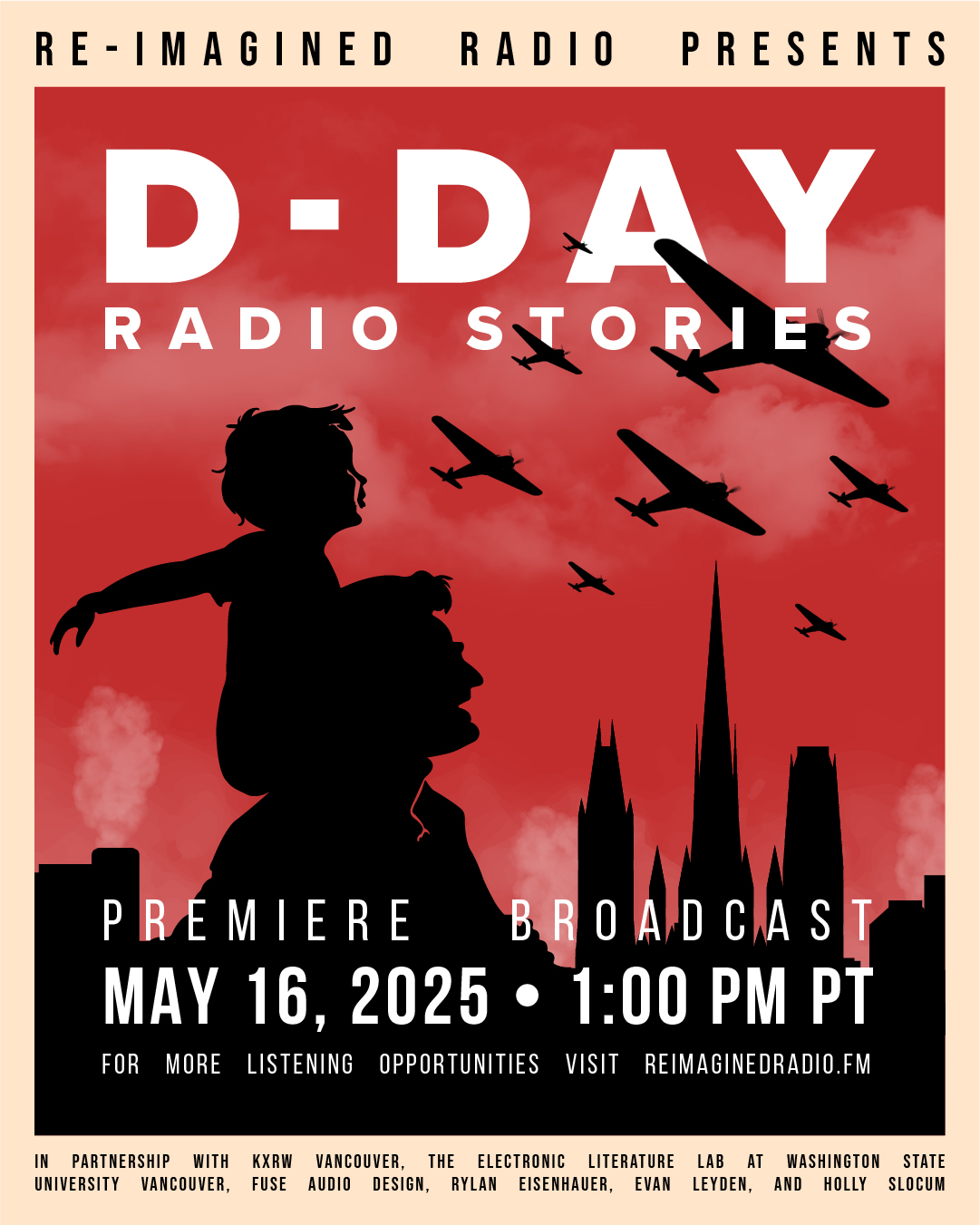
Looking for other graphics to promote this episode?