The Fall of the City and R.U.R.
RiR #08, Season 03, Episode 03, October 7, 2015
Recording not available. Apologies.
Two experimental radio dramas
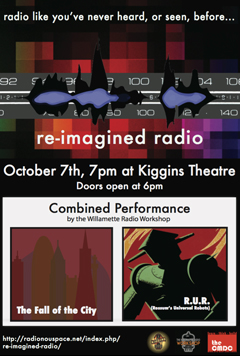
Re-Imagined Radio presents Willamette Radio Workshop performing "The Fall of the City" and "R.U.R." at Kiggins Theatre, Vancouver, WA. Our tribute to Columbia Workshop and its mission to explore and present new forms of radio storytelling.
Download Links
Download episode to your device
The "The Fall of the City - R.U.R" (2015) recording is currently not available. Apologies.
Download episode media
kit→
Download episode script
The "The Fall of the City - R.U.R" (2015) script is currently not available. Apologies.
Background
Re-Imagined Radio pays tribute to Columbia Workshop and its mission to explore and present new forms of radio storytelling.
Learn more about Columbia Workshop.
"The Fall of the City"
Episode 35, April 11, 1937
First broadcast by the Columbia Broadcast System (CBS) as part of the Columbia Workshop
radio series. Written by Archibald MacLeish. Orson Welles and Burgess Meredith starred. Irving Reis
directed. The 30-minute broadcast originated from the Seventh Regiment Armory, New York, a location
large enough to accommodate the hundreds of extra actors required for the crowd scenes.
The cast included . . .
House Jameson (Studio director)
Orson Welles (Announcer)
Adelaide Klein (Dead Woman)
Carleton Young (1st Messenger; Later played Philip Gault, in the OTR crime series The Whisperer)
Burgess Meredith (Orator)
Dwight Weist (2nd Messenger)
Edgar Stehli (Priest)
William Pringle (General)
Guy Repp, Brandon Peters, Karl Swenson, Dan Davies, Kenneth Delmar (Antiphonal Chorus)
A second broadcast, September 28, 1939 (episode 156), originated in the Hollywood Bowl, Los Angeles, California. The cast featured Myron McCormick, Burgess Meredith, Dorothy Meredith, Ted Osborne, and Earl Ross.
Listen to Columbia Workshop performance of "The Fall of the City," April 11, 1937.
Archibald MacLeish
Archibald MacLeish submitted his
script for "The Fall of the City" in response to a call from Irving Reis, director of
Columbia Workshop radio series for experimental work. MacLeish promoted Orson Welles for
the leading role as "Announcer." Featuring Welles, "The Fall of the City" episode, first broadcast April
11, 1937, is the first American verse play for radio and is often praised for its stylistic innovation
and social power, and as an illustration of the artistic potential of radio broadcasting.
Sources
"The Fall of the City" focuses on the collapse of a city under an unnamed dictator. MacLeish drew from
two sources. The first was his 1932 long poem "Conquistador" with its descriptions of the uncontested
conquest of the Aztec city Tenochtitlan (tã-nóch-tët-län, now Mexico City) by
Hernán Cortéz of Spain in 1521. MacLeish visited Tenochtitlan in 1929, specifically the
Zocalo, the great square at the center of the city, where he learned the Aztec legend of a woman who
returned from the dead to prophesize the fall of Tenochtitlan just days before its conquest (Drabeck,
Bernard A. and Helen E. Ellis, eds. Archibald
MacLeish: Reflections. Amherst, The University of Massachusetts Press, 1986, pp.
106-112). MacLeish won a Pulitzer Prize for "Conquistador" in 1933, his first of three.
The second inspiration was Anschluss, the takeover of Austria by Nazi Germany, 12 March 1938 when German troops marched across the border unopposed by the Austrian military. On 10 April, Germany forced Austrian citizens to vote for the annexation of Austria by Germany. Those who voted against annexation could have lost their jobs, or their lives.
Theme
MacLeish said the theme of "The Fall of the City" was "the proneness of men to accept their own
conqueror, accept the loss of their rights because it will in some way solve their problems or simplify
their lives" (Drabeck, Bernard A. and Helen E. Ellis, eds. Archibald
MacLeish: Reflections. Amherst, The University of Massachusetts Press, 1986, pp.
107).
Critics have suggested "The Fall of the City" is not about the conqueror, but rather about the way people lose or sustain the burden of freedom. We want freedom but we also like order and structure, even if that order and structure is imposed upon us. How much freedom and liberty are we willing to sacrifice to enjoy convenience and comfort, order and structure? Because of this ambiguity, we both fear and welcome the conqueror. While we vacillate, the Conqueror approaches slowly. Often unnoticed. Unbelieved. Until it is too late.
Plot
A radio announcer, voiced by Orson Welles, reports from the plaza of a nameless city, where a crowd
awaits the appearance of a woman who has risen from her grave for the previous three nights. She appears
and predicts
The city of masterless men will take a master.
There will be shouting then: Blood after!
The first messenger brings news of a conqueror's arrival. He says those conquered live in terror. A pacifist orator argues for non-violent acceptance of the coming conqueror. Reason and appeasement and scorn will eventually conquer the conqueror, he says.
A second messenger arrives and reports the conquered peoples have embraced the conqueror. The priests of the city then advise the people of the city to "turn to your gods" and almost instigate the sacrifice of a citizen before they are interrupted by a general who calls for resistance. The citizens have already given up, however, their will broken by the hope that their loss of freedom will solve their problems or simplify their lives.
The conqueror arrives and ascends to the podium. He raises his metal visor. Only the radio announcer can
see that the suit of armor is empty. He concludes
People invent their oppressors. The city is fallen.
Reception of "The Fall of the City" was positive. The writing, use of sound effects, and radio production techniques were all noted as opening a new era for radio drama. Read a review in Time magazine (Theatre: Fall of the City, 19 April 1937).
"R.U.R."
"R.U.R. (Rossum's Universal Robots)" is significant as the first appearance of the term "robot" in
English and the origin of discussions in science fiction regarding the fundamental tension between
humans and robots, androids, cyborgs, and lately, genetic modification and artificial intelligence. With
regard to robots, we want them to be workers who make our lives easier, but if those robots have the
ability to think independently are they actually slaves that should have rights? And, if they can think
for themselves, would they possibly overthrow humans?
Czechoslovakian writer Karel Capek (1890-1938) wrote novels, stories, and plays. [1] He is best known for his play R.U.R. (Rossum's Universal Robots), which premiered January 26, 1921 at the National Theater, in Prague, former Czechoslovakia.
Capek derived the term "robot" from robota meaning "drudgery" in Czech and "labor" in Slovak. The origin of both the Czech and the Slovak word is the Old Church Slavonic rabota "servitude." Robot, as used by Kapek, represented someone or something that exercises labor.
Capek credits his older brother, Josef, the cubist painter and writer, with the actual creation of the word "robot." Explaining his story idea to Josef, Karel remarked that he did not know what to call the artificial workers. Josef suggested calling them "robots."
"R. U. R." asks the question that haunts science fiction: How does the creation of artificial life affect the fate of humankind? Capek's answer has contributed to resistance to artificial life ever since.
Listen to Columbia Workshop performance of "R.U.R," 18 April 1937.
Plot
Rossum's Universal Robots manufactures artificial humans, called "Robots" (always capitalized), in
quantity. Assembled from organic materials kneaded in large vats, Rossum's Robots behave exactly like
living matter. But, they are designed to work as slaves for humans, and so have no feelings.
Helena Glory, the plant manager's wife, pities the Robots and persuades the head scientist at R. U. R., Alquist, to give them feelings. Subsequent Robots created with feelings resent their subservience to humans and revolt.
Robots kill all humans on Earth save one, Alquist, who is known to work with his hands, a noble trait to the Robots. The Robots cannot continue replicating themselves, however, because Helena destroyed the formula for Rossum's organic substance. Alquist sees that one pair of Robots have fallen in love and blesses them, implying they will found a new race. Script available here.
R.U.R. Timeline
1921: Premier performance at the National Theater, Prague, former Czechoslovakia.
1923: Translated into English by Paul Selver as R.U.R.: A Fantastic Melodrama (New York:
Samuel French). Read the play as
originally written in Czech
9 October 1922-February 1923: Performed at The Garrick Theater, New York City. Produced by The Theater
Guild, directed by Phillip Moeller and Agnes Morgan, "R.U.R." ran for a total of 184 performances.
1923: Published in English (New York: Doubleday). Soon, the word "robot" was known in every language
around the world.
27 November 1933: Allegedly broadcast by National Broadcasting Network (NBC Blue network) as a 60-minute
episode of the Radio Guild series, 14 July 1929-*** 1940. [2]
18 April 1937: Broadcast by Columbia Workshop (Episode #36); thirty minute radio drama adaptation.
1938: Broadcast on BBC Television, a thirty minute adaptation, one of the earliest examples of televised
science fiction.
1941: Broadcast as a BBC radio adaptation.
1948: Broadcast in its entirety as a ninety minute adaptation on BBC Television.
Notes
[1] Capek is also noted as the author of The Absolute at Large (1922), and War with
Newts (1937). The Absolute at Large a satire in which an atomic device, the
Karburator, produces power through the conversion of energy. The device releases the essence of God,
causing miracles and other effects, and ultimately, a religious war. In War with Newts, a
sea-dwelling race of "newts" is enslaved by humans. The newts overthrow their masters and humanity is
doomed. In the end, the novel functions as a chilling drama of class struggle and social injustice, as
well as a prediction of the end of Czechoslovakia two years later.
[2] The Radio Guild offered adaptations
of works by William Shakespeare and other classic drama from college reading lists around the
country and original radio dramas. Schools used these radio dramas to augment classroom studies.
Radio Guild also offered performances of experimental, original radio drama. Only two
episodes are thought to survive,
"The Man Who Was Tomorrow" (14 May 1939; written by Ranald R. MacDougall)
and, "The Ineffable Essence of Nothing" (13 April 1940; written by Ranald R. MacDougall).
Great Plays, also broadcast on the NBC Blue network, performed drama classics from 1938-1942, and succeeded Radio Guild. It is easy to confuse these two, different, series.
Production
Contents
Live performances of two radio plays produced and broadcast by Columbia Workshop, "The Fall of the City," broadcast April 11, 1937, and "R.U.R.," broadcast a week later, April 18, 1937.
Credits
Performed by Willamette Radio Workshop
Directed by Sam A. Mowry
Produced and Hosted by John F. Barber
Significance
Columbia Workshop is noted for its mission to explore and present new forms of radio storytelling. Both "The Fall of the City" and "R.U.R" are considered experimental radio dramas of the highest caliber by contemporary radio critics and historians.
"The Fall of the City" by Archibald MacLeish is the first American verse play for radio and is often praised for its stylistic innovation and social power, and as an illustration of the artistic potential of radio broadcasting.
"R.U.R." introduces the term "robot" into the English language.
Promotion
Press
Hewitt, Scott. Bits 'n' Pieces: Radio Plays Scare up Some Chills at Kiggins.→ The Columbian, 3 Oct. 2015, pp. D6-D7.
Graphics
Looking for other graphics to promote this episode?