Joe Frank Tribute
RiR #48, Season 10, Episode 07, August 15, 2022
Iconic radio monologist and storyteller
Re-Imagined Radio pays tribute to Joe Frank, whose monologues, radio dramas, and talk radio about human experience were heard by thousands of listeners, 1978-2018. We sample from "Jewish Blues" (1978), "Memories" (1990), "Green Cadillac" (1993), "Reality Check" (2013), and "A Life Well Lived" (2013) to showcase his career.
Download Links
Download episode to your
device→
Download episode media
kit→
Download episode script

Background
Early Life and Career
Joe Frank (1938-2018), writer, performer, and iconic late night radio monologist and storyteller, was born Joseph Langermann in Strasbourg, France, near its border with Germany, to Polish parents. The family fled to New York City to avoid German Nazi persecution. His father died when Joe was five. His mother remarried, and Joe took the surname of his step-father, Theodore Frank.
Education
Frank attended Walton School in New York. He studied at Hofsta University, where he earned an English
degree and the Iowa Writers' Workshop, but left before completing a graduate degree.
Teaching, 1964-1975
Frank taught five grades of English at the Sands Point Academy for Gifted Children in Sands Point, NY,
in 1964. From 1965 to 1975, Joe taught English and Russian literature and philosophy at the Dalton
School, an elite private school in Manhattan, New York.
Music Producer, 1976-1977
From 1976-1977 Frank produced music concerts for the Academy of Music in Northampton, Massachusetts. He
spent many hours driving between Northampton and New York, where he continued to live. For company he
listened to the radio, talk shows, baseball games.
Radio Career
WBAI, New York (1977-1978)
In 1977, realizing the power of radio, he said from listening to radio baseball announcers telling side
stories, Frank volunteered at WBAI, the legendary, free-form radio station in New York. "The idea of
speaking into a microphone and having your voice come out of the speakers of radios all over people's
apartments and cars was somehow magical to me. You're hidden, and by virtue of being hidden, there's a
power in that" (Emerling, Susan. Public Radio's
Bad Dream. Salon, 7 Mar. 2000).
He was given his own show, 4:00-5:00 AM, Tuesday mornings. Frank talked, played music, and directed actors in improvizations based on stories he found in the tabloids, trying to produce a radio show that sounded real despite the absurdity of the material (Emerlling).
"I figured nobody was listening at that hour so I felt free to do whatever I wanted, and that was the beginning of the idea of telling stories on the radio. The show was well-received, so they moved me up to Saturday night" (McKenna, Kristine. Joe Frank: Off the Radio. LA Weekly, 17 Sep. 2008). The Saturday time slot was "In the Dark," midnight to 5:00 AM. Frank continued experimenting with live freeform monologues and actor improvisations, and live music as part of his radio storytelling (Roderick, Kevin. LA Observed Notes: RIP Joe Frank . . .. LA Observed, 16 Jan. 2018). The increased complexity of his productions and stories brought Frank to the attention of a dedicated audience.
NPR (1978-1986)
In 1978, Frank moved to Washington, DC, invited by National Public Radio (NPR) to co-host Weekend
All Things Considered. At the end of each episode, he delivered a five-minute essay. "They’d
heard my show on WBAI and thought I’d be an interesting host, but as soon as I’d done a few shows they
decided they wanted it to be a news show" ((McKenna).
"I was in way over my head. The kinds of questions I was interested in ['All Things Considered'] didn't answer. Why are we here? What is the nature of God? If nature is bred with tooth and claw, is human compassion just an anomaly?" (Emerling).
Although this was his first paying radio job, Frank was not interested in journalism. NPR was not interested in his experimental and exploratory monologues. "I had a one-year contract so they took me off All Things Considered and gave me my own show [NPR Options: A Radio Experience], and at that point I began doing my highly produced radio programs. My contract wasn’t renewed, so I spent the next eight years producing three or four radio dramas a year independently and selling them to NPR Playhouse" (McKenna).
NPR Options and NPR Playhouse, 1978-1986
Frank's contributions to NPR Options: A Radio Experience and NPR Playhouse are
documented here. Allegedly,
Frank directed, performed, and/or produced 18 radio dramas for the NPR Playhouse series
where he continued using a noir radio form to process personal, idiosyncratic traumas and intellectual
insecurities.
"What I was doing then really was groundbreaking. I'd take actors into a studio, tell them what a scene required and have them improvise, then I'd edit the best of what we'd produced into a show that also incorporated music and monologues of me speaking. The shows raised serious questions, often in an amusing way, and the listener never knew what the show would be like from one week to the next because there was no format. It was unreal, yet real, and people didn't know what to make of it" (McKenna).
Joe Frank won several awards for his work with NPR Playhouse . . .
Broadcast Media Award from San Francisco University, 1982
Radio Program Award from the Corporation For Public Broadcasting, 1983
Gold Award from the International Radio Festival of New York, 1983
Gold Award from the International Radio Festival of New York (second), 1984
American Nomination to the Prix Italia, 1984
Special Commendation from the Berlin Prix Futura, 1985
KCRW, Santa Monica (1986-2002)
Frank's productions for NPR Playhouse brought him serious attention throughout the NPR
network. In 1986, Frank was invited to write, produce, and perform his own weekly hour-long radio
program at KCRW, the NPR affiliate radio station in Santa Monica, California. There his often
philosophical, humorous, surrealist, and sometimes absurd monologues and radio dramas was produced in
series. First was "Work in Progress," then "In The Dark," followed by "Somewhere Out There", and "The
Other Side."
At KCRW, Frank became famous. In 1988, with his show heard in San Francisco, Los Angeles, Chicago, Philadelphia, and New York, The Wall Street Journal called Frank, "radio's prince of darkness" (Hughes, Kathleen A. Radio's Prince of Darkness Rules the Freeways. The Wall Street Journal, Arts and Leisure section, vol. 2, 15 Mar. 1988, p. 32:1). In 1989, the rock music magazine Spin said of Frank's angst-ridden introspection, "Sartre would have called it nausea; Frank makes it art" (Carpenter, David. Talk Radio. Spin, vol. 5, no. 6, Sep. 1989, p. 24).
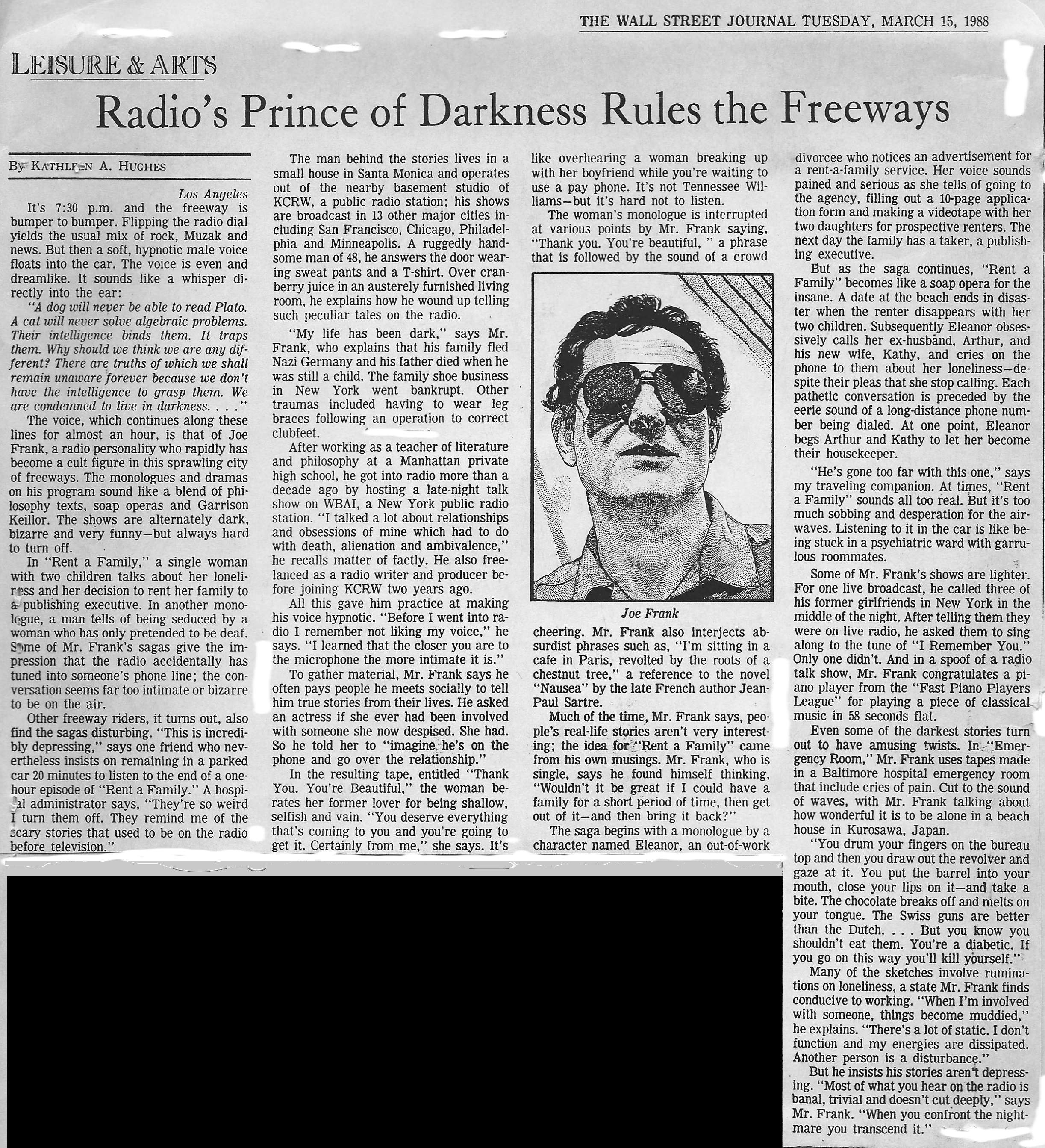
Noted for his husky, insomniac voice and sincere delivery, Frank's radio stories were often surrealistic, even absurd. He was much appreciated for his efforts. As one listener noted, "The first time I heard Joe Frank was in the 1980s on KCRW. It was what you dreamed radio could be. You stumbled upon a voice, a story, and you were compelled to listen, uninterrupted. The most brilliant radio I've ever heard, still. An inspiration."
Joe Frank won several awards for his work with Work in Progress while at KCRW . . .
National Radio Broadcasters Association Major Armstrong Awards For Excellence and Originality in Radio
Programming, "Joe Frank: Work in Progress," 1988
Corporation for Public Broadcasting Program Award, 1988
The George Foster Peabody
Award, broadcasting's highest honor, "For creating radio of style, substance and imagination . .
.," for Joe Frank: A Work in Progress series, 1991
Guggenheim Fellowship for Radio Art, 1993
Independent Producer (2002-2018)
Exhausted from his production schedule at KCRW, Joe Frank became an independent producer in 2002. He
continued producing radio shows which he released to subscribers through his web site. He performed
monologues at venues around the country.
In 2012, Frank began producing periodic half-hour shows for KCRW's UnFictional series. More UnFictional episodes here. He continued to produce episodes for the series until months before his death in 2018. As an obituary for Joe Frank, the producer of UnFictional, Frank Carlson, wrote, "I created my own program UnFictional with a foundation of knowledge and inspiration gained from my years as a fan and colleague of Joe Frank. He was extremely conscientious about every detail of his program, he wanted it to be perfect; weird and well written, emotionally riveting and hilarious, and unlike anything you’ve heard. I am honored that Joe was able to produce some of his final work for UnFictional. And I’m especially gratified to hear from people discovering Joe for the first time, who are now ready to dig deep into his vast archive of unforgettable stories" (Carlson, Frank. On Joe Frank's Hallucinogenic Journeys. KCRW, 16 Jan. 2018).
Joe Frank won significant awards for his work during this period . . .
An Emmy Award for "Joe Frank: Storyteller" featured on public television station KCET, 1990.
The Lifetime Achievement Award from Third Coast International Audio Festival, 2003.
Other Works
Joe Frank adapted some of his radio performances for theatre:
"The Decline Of Spengler, "New Directions 48, New York
"A Tour Of The City," Tanam Press, New York. Translated to French and produced by Theatre Anima at
Hangar #9 in the Old Port, Montreal, Canada, in 1990, directed by Jordan Deitcher, included performers
from Cirque du Soleil.
"Rent-a-Family" by Stages Trilingual Theatre in Los Angeles.
"Jerry’s World Onstage" by Infernal Bridegroom Productions, Houston, Texas.
Short films and television
Joe Frank wrote four short films for television based on his radio shows. They were directed by Paul
Rachman and produced by Propaganda Films in Los Angeles, CA.
"Memories," a 10-minute short film featuring monologues by Joe Frank detailing surreal events of his
life, was submitted to CBS Television as a pilot for a series that never materialized. Original music by
Jerry Summers. First broadcast 14 September 1990 (McKenna, Kristine. "A New Arena for Radio's Joe Frank:
Television: His Short Film 'Memories' Airs Tonight on CBS. The Actor-Dramatist Hopes the Oddly Moving
Montage Will Lead To A Series." LA Times, 14 Sep. 1990.)
"The Hitchhiker"
"The Perfect Woman"
and
"Jilted Lover" were produced in 1993(?) for the series "Inside Out," The Playboy Channel.
"Joe Frank: Storyteller" featured on public television station KCET, 1990.
Coma and Eleanor directed by Todd Downing
Three short films by Chel White using material from Joe Frank's radio shows . . .
Dirt (1998), from "The Dictator"
Soulmate, (2000), from "Emerald Isle"
Magda (2004), from "The Dictator"
Anonymous. Joe
Frank: Somewhere Out There. PBS Wisconsin, 15 June 2021.
A short article about the coming premier of the Director's Cut of this documentary by Dave P. Carlson,
18 June 2021. Features a short trailer. The original feature length documentary was released in 2019. Also available on YouTube. Also available on
YouTube is the full 1.2 hour film.
Frank published two books . . .
The Queen of Puerto Rico: And Other Stories
William Morrow & Co., 1993
Collects on paper several of Frank's radio monologues and stories that despite their apparent bleakness
provide recognition and involvement. Includes "Tell Me What To Do," "Fat Man," "Night," "Date,"
"Walter," "The Queen of Puerto Rico," and "The Decline of Spengler." ISBN 0-688-08765-5
Ascent
Fantagraphics, 2013
Collects six stories by Frank, each illustrated in comic form by Jason Novak
"Goldfield"
"K-2"
"Archeologist"
"Tatoo"
"Dreamer"
"Old Fisherman"
See also Brechtman another story by Frank illustrated by Novak (Novak, Jason and Joe Frank. "Brechtman." The Paris Review, 1 June 2017).
Radio Style and Legacy
Frank's radio style is distinctive . . . A resonant voice providing sincere delivery of ideas and
stories that were believable enough to be real, but often hinting of absurdity. Subject matter included
religion, life's meaning, death, and relationships with women. His stories frequently mixed
autobiography, fantasy, memoir, and others peoples' lives. It wasn't for everyone, but thousands of
listeners tuned in and still listen to recordings of Joe Frank.
Frank's radio stories frequently included music, often repetitive or looped, and drones which mixed well with his dry, announcer-like delivery. He frequently included recorded phone calls or live, slow burning conversations with actors and friends like Larry Block, Debi Mae West, and Arthur Miller. These were broken into segments throughout the hour-long episodes. Frank's series "The Other Side" included excerpts from Buddhist teacher Jack Kornfield's Dharma talks at Spirit Rock Meditation Center. Frank and Kornfield never met or talked, but Kornfield said he was fine with this use of his lectures as it brought him students.
Listening
Joe Frank and his sonic surrealism are acquired tastes. He isn't for everyone, except those who
understood what he was trying to do; invent new rules for radio storytelling. His productions included
conversations with friends, improvisations, scripted drama, stunt phone calls, and monologues, often
with looped music. They were philosophical, humorous, surrealistic, and sometimes absurd, but always
keenly drawn observations of his consistent themes: religion, life's meaning, relationships with women,
and death. Stories by Joe Frank are not background music. They tell of alternate universes where the
human condition seems the same but is just slightly different. They require suspension of disbelief from
listeners. They require attention. Some say they are best listened to alone . . . after your ex-partner
has left you for the last time . . . when reality shows itself as a cruel joke.
Interviews and Discussions
David Sedaris and Ira Glass Discuss Joe Frank
Terry Gross Interviews Joe Frank, Fresh Air, October 2003
Legacy
Joe Frank's iconic voice and approach to storytelling lives on. Ira Glass (This American
Life),
Jad Abumrad (RadioLab, listen to the tribute podcast he produced The Voice in Your Head: A
Tribute to Joe Frank), David Sedaris, Francis Ford Coppola, Michael Mann, and Martin Scorsese
all
credit Frank for inspiring their own work.
Susan Emerling sums up Frank and his work nicely. "For an artist obsessed with mortality and the meaning of life, Frank has chosen the most ephemeral of media. It is fortunate for him that the Web came along, providing a sense of longevity to radio. But as important as his show's digital afterlife may be, nothing compares to the live broadcast, while the audience has temporarily suspended their lives to listen together. Frank tells me he used to sit in his car with a former girlfriend, parked overlooking the ocean, listening to the program as it aired. He sat there imagining his audience in their own cars and living rooms, somewhere out there, in the dark, on the other side of the radio, listening to his life's work-in-progress" (Emerling).
References
Anonymous. Joe Frank (1938-2018).
Hearing
Voices.
A photo-audio-video obituary/essay/tribute for Joe Frank. In 2011 Hearing Voices offered
"God
and Girls" by Joe Frank. Listen here.
Of
personal note, this program was produced by Barrett Golding with whom I volunteered at KGLT (Montana
State
University) and worked at another, commercial, now defunct radio station in Bozeman, MT. I rememember
distinctly Barrett telling me, "Radio is going to be my life." I'm glad it worked out that way.
Emerling, Susan. Public Radio's Bad Dream. Salon, 7 Mar. 2000.
JoeFrank.com
"The Official Website." Lots of content. Lots of listening opportunities. Requires account registration.
Joe Frank--Frequently Asked Questions
Provided by WFMU Radio
Joe Frank Wiki
An accessible knowledge base for many things Joe Frank.
Gladstone, Brooke. Joe Frank: The Known-Unknown. WYNC, 18 Jan. 2018.
Gross, Terry. Public Radio
Pioneer
Joe Frank. Fresh Air, 24 Oct. 2003.
Includes a 1990 interview with Joe Frank.
Kalish, Jon. Fans of Joe Frank Remember the Storyteller's Dark Sonic Magic. Current, 19 Jan. 2018.
Leland, Andrew. The Radio Auteur: Joe Frank, Ira Glass and Narrative Radio. The New York Review, 29 Sep. 2018.
McKenna, Kristine. Joe Frank: Off the Radio. LA Weekly, 17 Sep. 2008.
Oppenheimer, Mark. Joe Frank
Signs
Off. Slate, 19 Jan. 2018.
Joe Frank's last interview before his death.
Priazzi, Chris. The Joe Frank Index
A very useful tool for finding information about Joe Frank's radio programs and more.
Roderick, Kevin. LA Observed Notes: RIP Joe Frank, Tara Finestone Upped at CBS LA, More Newspaper Turmoil. LA Observed, 16 Jan. 2018.
Smith, Harrison. Joe Frank, Boundary-Pushing Storyteller Whose Medium Was Radio, Dies at 79. The Washington Post, 17 Jan. 2018.
Wilson, Drew. On Air: Joe Frank's Radio Makes Waves. The Chicago Reader, 4 Aug. 1988.
Production
Contents
From 1978 to 2018, Joe Frank entertained thousands of listeners with his radio productions. He is credited with 250. We sample from several to showcase his work, early to near the end of his career.
"Jewish Blues" (1978) is one of the earliest known recordings of Joe Frank hosting his late night program "In the Dark" at WBAI radio in New York. It included a fictional interview with a Jewish blues guitarist, interspersed with dramatic scenes from his life. We sample Frank and his friends Arthur Miller, Eric Sears, and Timothy Jerome answering live telephone calls from listeners.
"Memories" (1990) is a 10-minute short film directed by Paul Rachman, made for CBS Television, featuring monologues by Joe Frank detailing surreal events of his life. We sample a part where Frank tells of a strange dream involving a horizontal elevator and a call to his father.
"Green Cadillac" (1993) demonstrates Frank developing his distinctive radio style—a resonant voice providing sincere delivery of ideas and stories that were often obviously absurd. We sample one of Frank's monologues where he describes his misadventures and eventual friendship with a car thief.
"Reality Check" (2013) was broadcast by KCRW as part of the "UnFictional" series. Joe Frank addresses vexing questions concerning evil, madness, suffering, death, and the human condition in a resigned, yet high-spirited way that many listeners found heartening and uplifting.
"A Life Well Lived" (2013) was also produced for KCRW's "UnFictional" series. By 2013, Frank had confronted a number of medical problems. Our sampling features Frank talking about the hardships of love and personal fragmentation.
Credits
Curated, Produced, and Hosted by John F. Barber
Sound Design and Music Composition by Marc Rose
Social Media by Regina Carol Social Media Management
Promotional Graphics by Kathryn Klaus
Producer's Notes
This tribute celebrates the extraordinary career of Joe Frank, whose experimental approach to radio
storytelling pushed boundaries and inspired generations of audio artists. His work remains a
testament
to the power of radio as an art form.
— John F. Barber
Promotion
Press
Graphics

Looking for other graphics to promote this episode?