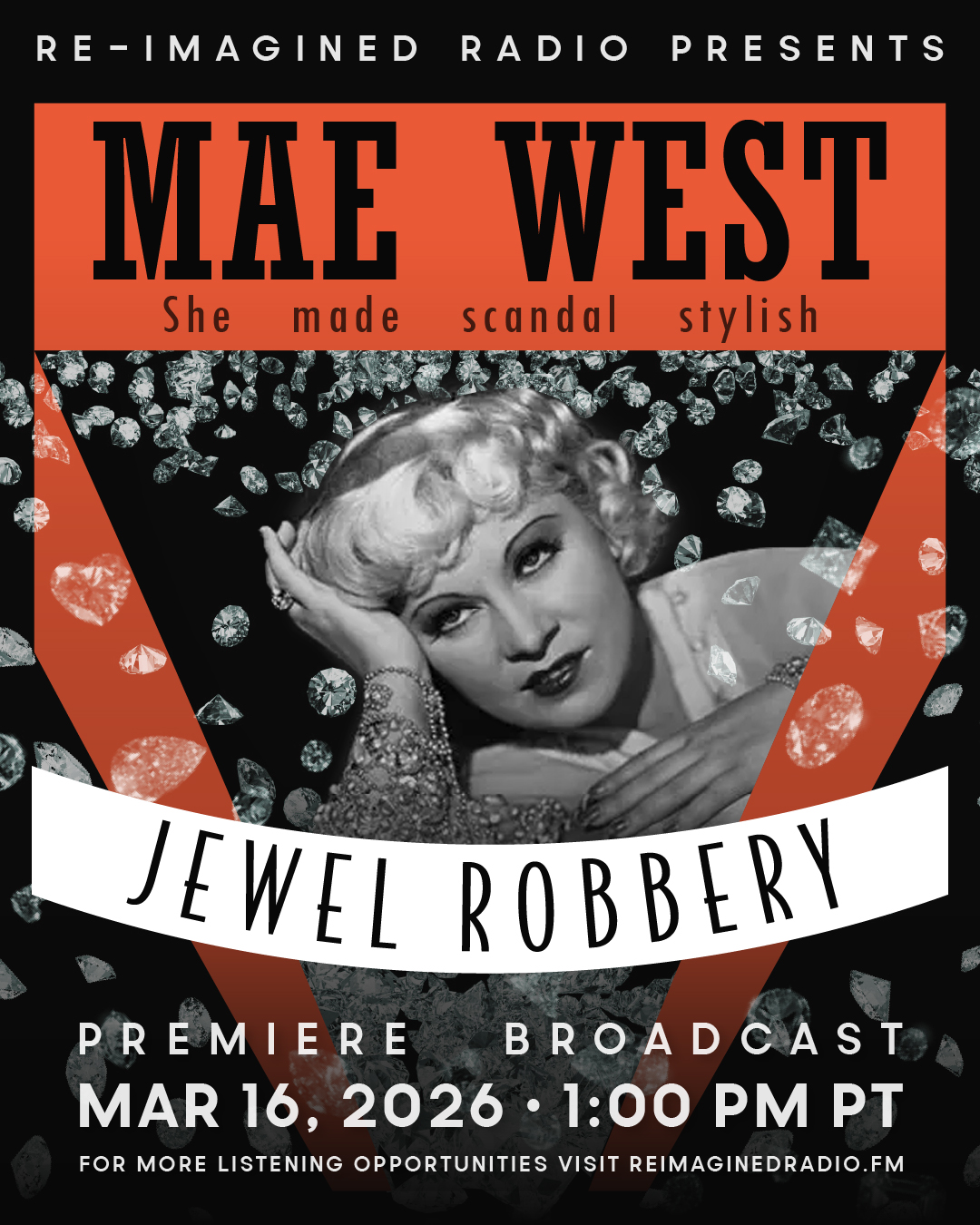
Mae West Jewel Robbery
RiR #95, Season 14, Episode 03, March 16, 2026
She made scandal stylish
"Mmm, yeah, I used to be Snow White, but then I drifted."
— Mae West
Re-Imagined Radio presents "Mae West Jewel Robbery," a tribute to Womens' History Month and Mae West as an advocate for women's rights, liberation, and equality. We sample from West's early stage and screen career, a dramatized robbery, and two rare radio appearances to demonstrate West's imitable way of making scandal stylish.
West was outspoken, controversial. Throughout her career, she challenged how the status quo thought women should act. Attempts to censor and silence Mae West only increased her status as an international icon and a model for Jean Harlow, Madonna, Cher, and Sabrina Carpenter, and their use of unapologetic, assertive sexuality in their performances
This is an interesting episode about an influential person. Listen to "Mae West Jewel Robbery" and learn more.
Download Links
Download episode to your
device→
Download episode media
kit→
Download episode script

Background
Mae West's Legacy
The career of Mae West is based on vaudeville acts, stage plays, and motion pictures known for their sexuality and steamy settings. West's work and persona are seen as a form of sexual liberation and a challenge to the double standards of her time, advocating for female equality and independence. She continues to a powerful sexual and cultural figures.
She continued to perform on stage and television, and recorded rock and roll albums.
See The Immortality of Mae West→
Mae West and Diamonds
"Men are my life, diamonds are my career!"
"I never worry about diets. The only carrots that interest me are the number of carats in a diamond."
"Ya know it was a toss-up whether I go in for diamonds or sing in the choir. The choir lost."
"Diamonds talk, and I can stand listenin' to 'em often."
Mae West Jewel Robbery
September 28, 1932, Mae West is robbed at gun point of her diamond jewelry, worth $19,500 and $3,400 in cash.
West immediately reports the robbery to the Los Angeles Police, and then, pushes them into action. Within a few months, she testifies in court against one of her accused robbers (Bader 113, 115, 117).
Mae West Jewel Robbery Trial
Edward "Happy" Friedman, a Chicago gangster, is identified by West, Thanksgiving night, 1933, as the man who robbed her at gunpoint (Justia U.S. Law; FindLaw; Schachter).
Another man, William Kahn, was arrested but eventually released (Schachter). This man is named [William] Cohen in court records pertaining to People v. Volier (1934) (Justia U.S. Law; FindLaw)
The trial begins January 15/16, 1934. The courtroom is packed with spectators hoping to see Mae West.
Court records describe Friedman approaching West's car and saying, "This is a stick up!"
Then, "He pointed something resembling a gun at the occupants and took a purse and jewelry, speaking several sentences to them during the operation. He wore no mask and had a lighted cigarette in his mouth" (Justia U.S. Law; FindLaw)
According to West's court testimony, the robber said, "Toss out the poke and those rocks."
West continued, "And he must have been an amateur. He was so nervous that I didn't wait a moment before handing over the jewels, because I thought, if I tried to talk him out of it, he would probably hit me over the head and maybe mar my face."
Friedman was sentenced to serve 2 to 30 years in San Quentin Prison, California, despite contending that he was beaten and forced to confess by police.
J. David Goldin writes that one man was caught on February 21, 1934, the same day "The Mae West Jewel Robbery" was first broadcast on the Calling All Cars series. Could this be an incorrect reference to the sentencing of Edward H. Friedman, February 11, 1934? OR, Harry O. Voiler who fled to Florida to avoid extradition to California?
Calling All Cars
Calling All Cars
1933-1939
CBS
Weekly, half-hour
Hundreds of episodes survive
Crime drama/police adventure series, "Calling All Cars" was a pioneering old-time radio police drama in the United States, known for being one of the earliest of its genre.
Directed by William Robson who went on to The Columbia Workshop.
Calling All Cars predates Gangbusters and eventually lends elements to Dragnet, The Lineup, Tales of the Texas Rangers, and Broadway Is My Beat.
Calling All Cars is acknowledged as broadcasting's first "police procedural drama," broadcast on Mutual starting November 1933, but only in the US Southwest, where the sponsor, Rio Grande Cracked Gasoline, operated refineries and/or stations. Commercials from the sponsor suggest that listener's cars will go as fast as Police cars with Rio Grande gas.
Stations selling Rio Grande gas also offered free copies of Calling All Cars News, with crime stories and entertainment news about movie and radio stars.
A Calling All Cars board game was introduced by Parker Brothers in the late 1930s→
For more true police stories see also
Border Patrol
Confession
Did Justice Triumph
Call the Police
Honor the Law
Official Detective
Police Reporter
Unit 99
Up for Parole
Wanted
Mae West > Radio Appearances
Due to her risqué reputation in theater and film, Mae West was generally restricted from radio during the 1930s to avoid censorship issues. These are known, documented appearances.
1933, November 1
Rudy Vallee Hour (aka The Fleischman's Yeast Hour)
Mae West performed a "Frankie and Johnny" musical sketch with Vallee. Photograph
here→

1937, December 12
The Chase and Sanborn Hour
Episode #33
Weekly family variety hour, NBC
Hosted by Don Ameche, starring Edgar Bergen and Charlie McCarthy
Mae West, on the program to promote her new movie, Every Day's A Holiday appeared twice. First was the nine minute "Garden of Eden" sketch, written by Arch Obler. She played Eve to Ameche's Adam. Charlie McCarthy played the Snake. Audio and transcript below.
During West's second appearance, "Mae West versus Charley McCarthy," a five and one-half minute sketch with Charlie McCarthy, she delivered suggestive lines, such as, "Why don't you come up ... uh, home with me now, honey? I'll let you play in my woodpile." Audio and transcript below.
Works Cited
Bensman, Marvin R. and Dennis Walker. Sources
of Audio Broadcast Programming. United States Department of Education, 1975.
Listing for an episode of "Charlie McCarthy" with an appearance by Mae West on 1937, December 12.
"Garden of Eden" sketch from The Chase and Sanborn Hour
Transcription of "Garden of Eden" sketch
Cast
Mae West as Eve
Don Ameche as Adam
Charlie McCarthy as Snake
Wendell Niles as Announcer
Host (Don Ameche)
And with that nice bit of foreshadowing by Dorothy Lamour, we come to the event itself, which is the
presence of Mae West in our company tonight. Miss West has carved such a sizable niche for herself in
the Hall of Fame with her unique characterizations that not only is her name known in every home up and
down the country, but the phrases and expressions which she has originated have almost become a part of
the American language. For us, she forsakes the picture hats and sweeping dresses of the Gay Nineties,
which you'll find so becoming in her new picture, and turns back time to step into the Garden of Eden
and into the character of the most fascinatin' woman of them all, Eve. Wendell, will ya set the scene
for us?
Announcer (Wendell Niles)
Well, of course we find Adam and Eve in the famous Garden of Eden, and this lighthearted travesty about
what might have taken place in those days when the world was young was written for us by Arch Obler, one
of radio's better known writers. Under its spreading fig tree rests one Mr. Adam, and sprawled out
lazily in the hot tub, Eve, obviously, is bored beyond endurance as they play a game of cards with a
deck of fig leaves.
Eve
Listen, tall, tanned and tired. It's time I told you a thing or two. Ever since Creation, I've done
nothin' but playin' double solitaire. It's disgustin'! It's got me down!
Adam
Well, we've got a nice place here.
Eve
That's the trouble. It's too nice.
Adam
Well, I'm not complaining.
Eve
But I want something to happen, a little excitement, a little
adventure. A girl's got to have a little fun once in a while. There's no future under a fig tree.
Adam
Now, come on, woman. (YAWNS) Be like me. It's a relaxation. Just take it easy.
Eve
Because I'm a lady of big ideas.
Adam
Yeah, what kind of ideas?
Eve
Listen, Adam, I've got to get a chance to expand my personality.
Adam
Well, go on, expand.
Eve
I will, out there.
Adam
Out there? You mean outside the gates of the Garden of Eden?
Eve
Now you're talking.
Adam
Oh, but who knows what's out there?
Eve
I'd find out.
Adam
Oh, no, no. We can't go. We've still got a lease on this place.
Eve
You mean to tell me a lease is the thing that's holding me back from developin' my
personality?
Adam
Well, a lease is a lease. Anyway, we've got a nice place here, temperature perfect, sun always shining,
nothing but a heavy dew once in a while.
Eve
Mmmm ... What are you? The Chamber of Commerce?
Adam
(YAWNS) Oh, go away and let me sleep, will you?
Eve
Listen, Adam. I tell you, you gotta get me out of this place. You gotta break the lease.
Adam
Yeah, but what for? This is Eden. Everything is peaceful and quiet and safe.
Eve
That's the trouble. It's too safe. I tell you, it's disgustin'.
Adam
What are you talking about?
Eve
Adam, you don't know a thing about women.
Adam
Oh, you apparently forget you were originally one of mine own ribs.
Eve
Yeah, a rib once, and now I'm beefin'.
Adam
Me, I know everything about women.
Eve
That's coverin' a lot of territory. Listen long lazy and lukewarm ... you think I wanna stay in this
place
all my life?
Adam
I do, and I tell you, you're one of my ribs.
Eve
Yeah, but one of your floatin' ribs. A couple of months of peace and security and a woman's bored all
the
way down to the bottom of her marriage certificate.
Adam
Well then what do you want? Trouble?
Eve
Trouble. Listen. If trouble means something that makes you catch your breath, if trouble means something
that makes your blood run through your veins like seltzer water, mmm, Adam, my man, give me trouble.
Adam
Awww, Eve, you don't want trouble.
Eve
Ah now, tell me the lowdown truth, ain't there any way you can break our lease?
Adam
Well, yes there is, but I won't tell you.
Eve
No?
Adam
No, this is Paradise. Free light. Free heat. Free meals. What else could a man want? Answer me that.
Eve
Oh, I got a couple of good ideas if you'll tell me how to break the lease.
Adam
No, I won't do it.
Eve
(SEDUCTIVE) Oh, Adam.
Adam
What?
Eve
(SUGGESTVE) Come on over here.
Adam
(PAUSE) What for, to hold hands?
Eve
Oh, (CHUCKLES) that old game? Can'tcha you think of somethin' new? (ANNOYED) You know, you know nothin'
about
nothin'.
Adam
(INDIGNANT) Oh, yes, I do. I know more than you do, woman.
Eve
Ohhh, what, for instance?
Adam
I know all about the tree.
Eve
What tree, man? What tree?
Adam
That apple tree in the middle of the garden. The lease says that if we eat any of its fruit, we get
thrown
out of here.
Eve
Oh, now is that a fact?
Adam
Sure, that's why there's a fence around it. I tell you, one bite of those apples and we get to
dispossess.
Eve
Mmm, how fascinatin'. Adam, you can hold my hand now.
Adam
Naw. No, I-I-I got a better idea.
Eve
Oh, yeah? I'm listenin', I'm waitin'. Yeah, what are you gonna do now?
Adam
I think I'll go fishing.
Eve
How disgustin'.
Adam
Now wait a minute, you can't talk to me that way. Do you realize I'm Man Number One?
Eve
Ya, but I are you Number One Man?
Adam
(YAWNS) Well, I'll see you around suppertime. I'll be back.
Eve
(TO HERSELF) Aahhhah, so that's the trouble. So it's a tree over there. Mmmmm. (TO TREE) Hello, tree.
How would you like to do a little
lease-breakin' for a woman with ideas, mm-hmm? (TO HERSELF) Not room enough to squeeze through those
slats for a
woman of
my personality. Now, if I only knew someone skinny enough.
Snake
Salutations, Mrs. Eve.
Eve
Oh! If it isn't Mr. Snake. Hello,
long,
dark, and slinky.
Snake
Mrs. Eve, why are you standing by that tree?
Eve
Well, stop wigglin' and I'll tell ya. Listen, I know you don't approve, but I've got a little
proposition to
make.
Snake
I certainly refuse to listen. What is it?
Eve
Do you think, er, with the proper provocation, you could squeeze through that fence around the tree?
Snake
That's the forbidden tree.
Eve
Oh, don't be technical. Answer me this, my palpitatin' python ... would you like to have this whole
paradise to
yourself?
Snake
Certainly.
Eve
Okay. Then pick me a handful of fruit. Adam and I will eat it, and the Garden of Eden is all yours. What
do
you say?
Snake
Sounds alright. But it's forbidden fruit.
Eve
Listen. What are you ... my friend in the grass or a snake in the grass?
Snake
But forbidden fruit.
Eve
Are you a snake or are you a mouse?
Snake
I'll do it. (SLITHERLY TONGUE NOISE)
Eve
Mmmmm. Now you're talking. Here, right in between those pickets.
Snake
I'm ... I'm stuck.
Eve
Oh, shake your hips. There, there ... now you're through.
Snake
I shouldn't be doing this.
Eve
Yeah, but you're doin' all right. Now get me a big one. I feel like doin' a big apple.
Snake
Here you are, Mrs. Eve.
Eve
Mmm. Ah, I see. Nice going, swivel hips.
Snake
Wait a minute. It won't work. Adam will never eat that forbidden apple.
Eve
Oh, yes, he will ... when I'm through with it.
Snake
Nonsense, he won't.
Eve
He will if I feed it to him like women are going to feed men for the rest of time.
Snake
What's that?
Eve
Applesauce.
Adam
(APPROACHES, CALLS) Eve? Where are you, Eve?
Eve
Waitin', my love. Just waitin'.
Adam
(YAWNS) Hello, Eve. What have you been doing?
Eve
Me? Oh, I've just been makin' a little history.
Adam
Huh?
Eve
The first woman to make a monkey out of a snake.
Adam
Say, how about supper? And don't tell me we got fig stew again.
Eve
Oh, no. Somethin' new. So help me. Somethin' new. Here. have a bite of this.
Adam
Well, what is it?
Eve
A new kind of sauce. It's good for ya.
Adam
Uh, are you sure?
Eve
Mmm. Just to prove it's pure, 100% proof, I'll have a demitasse of it myself. All right, I'll... Oh,
well... No, wait. Before you eat, answer me this. Are you gonna take me out of this dismal dump and give
me a
chance
to develop my personality?
Adam
Oh, Eve, are you gonna start that over again?
Eve
No, I'm going to end it. Eat your sauce, big boy, and hold your hat if you've got one.
Adam
(MOUTHFUL) Oh, say, say, this is darn good sauce. Wait, wait, where did you find it?
SFX: Thunder crash.
MUSIC: Orchestra crash
Adam
(GROANS) Oh, my head. Oh, what happened to me?
Eve
We've been dispossessed.
Adam
Yeah, but, but why?
Eve
Forbidden applesauce.
Adam
(DISAPPOINTED) Oh, Eve, what have you done?
Eve
I've just made a little more history, that's all. I'm the first woman to have her own way, and a snake
will
take the rap for it.
Adam
But, Eve, we've lost the Garden of Eden. We're, we're, we're just...
MUSIC: SNEAKS IN, SEDUCTIVE
Adam
(SUDDENLY A CHANGED MAN) Eve... It's as if I see you for the
first time. You're beautiful.
Eve
Hmm, and you fascinate me.
ADAM
Your eyes.
Eve
Oh, tell me more.
Adam
(WEAKENING) Your... your lips. Come closer. I want to hold you closer. I want to...
Eve
(BEAT) You want to what?
MUSIC: Cymbal crash
Adam
Geez, what...what...what was that?
Eve
That was the original ... kiss.
"Mae West versus Charley McCarthy" sketch from The Chase and Sanborn Hour
Cast
Mae West as herself
Don Ameche as himself
Charlie McCarthy as himself
Wendell Niles as Announcer
Transcription of "Mae West versus Charley McCarthy" sketch
Announcer
Ladies and gentlemen, at last the long-awaited meeting of Siren Mae West and Casanova Charles McCarthy
has arrived. This is a romantic battle of the century. The dramatic moment that millions have been
looking forward to. Tension is running high and so are the bets. Charlie McCarthy three. There's some
talk that Charlie will weaken. They say no man can resist her. But there are others who feel that
Charlie will vanquish the vampire. Wait a minute, wait a minute, last-minute flash. There's been a drop
in the odds. Mae wears four, Charlie McCarthy four and a half. Let's get a word from the challenger,
Charlie McCarthy. What do you, what have you got to say, Charlie?
Charlie
It looks like a tough fight, man, but I think I'll win.
Announcer
Why do you say it's a tough fight?
Charlie
Well, my opponent's in great form.
Announcer
We got lots of training. What do you think of your chance of winning?
Charlie
Well, I've had some great fights in the East.
Announcer
What do you think of West?
Charlie
Mighty pretty country, mighty pretty.
Announcer
Well, Charlie's never been in better condition. He's a fashion plate with his midnight blue full dress
suit, top hat and monocle and a blue white butterfly tie and dress shirt.
Charlie
Yeah, it's P.K. P.K. tie and shirt. Yeah, shot with gravy.
Announcer
And now a word from the champion. Mae West. We've heard so much about you, Miss West. Won't you say a
word?
West
Well, all I've got to say is where there's smoke, there's fire.
Charlie
Wow. Boy, she burns me up.
West
There's nothing I'd like better than the aroma of burning wood.
Charlie
I wonder if she means me.
Edgar Bergen
Better watch out, Charlie. Say, Charlie, do you smell that perfume?
Charlie
Yeah.
Edgar Bergen
Isn't it ravishing?
Charlie
Yes, it is. It's ravishing. It's weakening. Help me I'm swooning. What is it?
West
Why, it's my favorite perfume. Ashes of men.
Charlie
She's got men, holy smoke. She's not gonna make a cinder out of me.
Edgar Bergen
Well, Don, there's been a great deal of talk but very little action so far. Right you are, Edgar. Miss
West, this is the famous Charlie McCarthy.
West
Hello, short, dark, and handsome.
Charlie
Hello, tall, blonde, and terrific.
Bergen
Charlie, that's no way to talk to Miss West. You hardly know her.
Charlie
I know it, Bergen. I'm a cad. I hate myself.
West
Oh, listen, Charlie. Are these your keys?
Charlie
Oh, thanks, Mae. Did I leave them in the car?
West
No, you left them in my apartment.
Charlie
Looks like we're going to have a white Christmas. Oh, jingle bells, jingle bells.
Bergen
Charlie, Charlie, where did you leave those keys?
Charlie
I, I, I, I, I ...
BERGEN
Where'd you leave those keys?
CHARLIE
I, I, I, I, I, I, I'm trying to tell you ...
West
Well, Charlie came up and I showed him my etchings, and he showed me his stamp collection. There you
have it, Bergan. There you have it.
Bergen
So that's all there was to it. Just etchings and a stamp collection.
Charlie
He's so naive.
West
So that's what's the matter with him. Come here, honey, closer, so we can talk intimately.
Charlie
Yeah, well, if you don't mind, I think I'd better keep my distance.
West
Well, I don't like long-distance conversations, so come here. I thought you were gonna have a nice long
talk Tuesday night at my apartment. Where did you go when the doorbell rang?
Charlie
Well, I tried to hide in your clothes closet, but two guys kicked me out. So I went out the back door.
West
Don't tell me you went out through the French windows. I'm on the third floor, you know.
Charlie
Oh, so that's what it was, the French windows, huh? I was gonna say you were pretty skimpy with those
back steps.
West
Oh, you look pretty good to me, shall we? Come here.
Charlie
But I thought you only liked tall men.
West
Oh, that was my last year's model. This year I'm on a diet.
Charlie
Oh, so that's why. Tell me, Miss West, have you ever found the one man in your life that you could
really love?
West
Sure, lots of times.
Charlie
Oh, I see. Could you even like Mr. Bergen?
West
Oh, Mr. Bergen? Well, of course. He's very sweet. In fact, he's the right guy. Confidentially, you'll
have to show me a man I don't like.
Charlie
That's well. Bergen's your man. You know, he can be had.
West
On second thought, I'm liable to take him away from you. I don't want you to see him.
Charlie
Well, if you take Bergen away, I'm speechless.
West
You ain't afraid I'll do you wrong.
Charlie
Well, now that you ask ... I ...
West
Or are you afraid I'll do you right.
Charlie
Well, I'm slightly confused. I need time for that one, Mae.
West
That's all right. I like a man who takes his time. Why don't you come up home with me now, honey? I'll
let you play in my woodpile.
Charlie
I'm not feeling very well tonight, I've been so nervous lately, I think I'm gonna have a nervous
breakdown. Wait, there I go. Ahh.
West
So, good time Charlie's gonna play hard to get, but you can't kid me, you're afraid of women. Your
Casanova stuff is just a front, all a false front.
Charlie
Not so loud, May, not so loud. All my girlfriends are listening.
West
Oh yeah, you're all wooden a yard long. You weren't so nervous, in fact, when you came up to see me in
my apartment. In fact, you didn't need any encouragement to kiss me.
Charlie
Did I do that?
West
Oh, you certainly did. I got marks to prove it. You're clever, too.
Charlie
Oh, that's too much. This is too much.
West
Well, get this. I don't need you. I got all the gentleman friends I want. Why, I got men for every mood.
Men for every day of the week. Monday, Tuesday, Wednesday, Thursday, Friday. A good man Friday, after a
good man Saturday. I change my men like I change my clothes and you ... you ...
Charlie
Mae, Mae you're not walking out on me are you?
West
I've got a reputation at stake. No man walks out on me. They might carry them out but they never walk
out.
Charlie
I'm mad about you ... I love you ... I've acted like a fool.
West
That wasn't action. Come here. I'll show you how to act.
Charlie
Mae, Mae! Don't be so rough. To me, love is peace and quiet.
West
That ain't love, that's sleep.
Charlie
Cut it out, Mae ... Help me ... Mae ... Ameche, help me.
West
Oh, call on Ameche. Call Bergen ... call everybody. I don't need any help.
Mae West Shunned by Radio
The Chase and Sanborn Hour episode drew immediate negative response from listeners, as well as "preachers, politicians and newspapers," according to Jim Ramshead. "The skit got Mae West kicked off NBC for the next dozen years. The ban was so complete that even the mere mention of her name was prohibited," says Ramshead.
George Eells and Stanley Musgrove, writing in their Mae West: A Biography, say Mae West "read her lines straight" during rehearsals, and "didn't give things that Mae West twist till the broadcast" (186).
No matter. This episode is widely considered a controversial one for Mae West. Historic in that it resulted in West being shunned from radio for more than a decade. And, one of the most scandalous moments in early radio history.
Works Cited
Ramshead, Jim. The Merry
Mouth of Mae. Jim Ramsberg's GOld Time Radio.
Return To Radio
West's next known network radio appearances are The Chesterfield Supper Club, hosted by Perry Como, January 5, 1950, thirteen years later. Details below.
The Chesterfield Supper Club
December 11, 1944-June 1, 1950
NBC
The broadcasts of April 5, 1946, made from a TWA plane at an altitude of 20,000 feet, are believed to be the first network radio broadcasts from an airplane. There were two mid-air Supper Club broadcasts: one at 6pm and another at 10pm for the West Coast. Jo Stafford, Perry Como and the entire staff made the flight. In addition to the cast and the band's instruments, there was also a small piano on board.
1950, January 5
Mae West makes a guest appearance on The Chesterfield Supper Club, an American variety
radio program (NBC, 1944-1950) hosted by Perry Como. They
talk and sing a unique rendition of "I Wanna Go Home with You" together, and perform a sketch based on
Shakespheare's "Romeo and Juliet." West performs an
endorsement for Chesterfield cigarettes.
Sources
Mae West on The Chesterfield Supper
Club radio
program, hosted by Perry Como. YouTube
Mae West Biographical Timeline. PBS. American Masters. YouTube
1950, February 16
The Chesterfield Supper Club
Pre-recorded on 23 January 1950 for broadcast on February 16th, 1950 so that NBC could screen the
content in advance. Mae sings a duet with Perry and tells her version of "Little Red Riding Hood."
Sources
Mae West: NBC Radio - Feb.
1950. Mae West.
Radio Gold Index. Chesterfield Supper Club.
Radio Interviews > With Mae West
Mae West also appeared on Weekend World and The Golden Days of Radio, both broadcast by the Armed Forces Radio and Television Service where she was interviewed by veteran radio actor and radio historian Frank Bresee [Bre-ZEE] (1929-2018). Frank Bresee documentary here→
This Frank Bresee Narrative (available as a PDF) may be interesting as well→
1969, December 17
Weekend World
Frank Bresee interviews Mae West in her Hollywood apartment. West describes her furnishings, talks about
her new movie, Myra Breckenridge, and sings "Merry Christmas, Baby."
NOTE: At the end of this interview, Bresee says Mae West will appear on a special two-hour Christmas edition of The Golden Days of Radio, December 24, 1969, her first time appearing on a radio program in front of a live audience in thirty-two years, since her appearance on The Chase and Sanborn Hour, December 12, 1937. Did Bresee not know of Miss West's appearance on Chesterfield Supper Club, in 1950?
The Golden Days of Radio
Frank Bresee launched The Golden Days of Radio August 5, 1949, on KNX, a CBS affiliate, in
Los Angeles, CA. Episodes featured samples and
reflections on radio programs and personalities from the 1920s to the 1950s.
Mae West made several guest appearances in these broadcasts. The program is still heard on Internet
radio station Yesterday USA Radio Network→
The Golden Days of Radio, hosted by Bresee, was heard on Armed Forces Radio Network, 1967-1995.
1984, December 14
Ray Briem, host of Talk Radio 79, KABC radio, Los Angeles, interviews guest Frank Bresee
about the Golden Days of Radio.
1969, December 24
The Golden Days of Radio
Christmas episode broadcast for American troops around the world. Host Frank Bresee interviews Mae West.
She
has a special Christmas message for the troops.
1971, December 24(?)
The Golden Days of Radio
Christmas episode broadcast by American Forces Radio and Television Services (AFRTS) for American troops
around the world. With Bob Hope, Don Ameche, Edger Bergen and Charlie McCarthy, and "our special
Christmas
surprise, Miss Mae West." Host Frank Bresee
interviews West, who leads with her famous line, "I used to be Snow White, but I drifted."
1972, December 24
The Golden Days of Radio
Christmas episode broadcast by American Forces Radio and Television Services (AFRTS) for American troops
around the world. With Fibber McGee and Molly. West's appearance repeats that of 1971."
Radio Interviews > About Mae West
1976, August 5
The Golden Days of Radio
Host Frank Bresee interviews Arch Oboler, in Studio City, CA. Oboler recalls working with Mae West.
1971, December 11
Those Were the Days, WLTD radio, Chicago, IL
Program 86. Includes an interview with Don Ameche recorded at Pheasant Run Playhouse, December 7, 1971.
Ameche remembers Edgar Bergan and Charlie McCarthy and Mae West.
More
information→
Pheasant Run Playhouse, a dinner theatre inside Pheasant Run Resort, St. Charles, IL, provided theatre and cabaret entertainment, 1964-1993.
1975, February 20
Frank Bresee interviews Edgar Bergen, ***. Bergen recalls working with Mae West.
Hollywood Jewel Robberies
Beginning January 1932 and continuing for more than a year, a group of three to four polite and well dressed masked thieves relieved motion picture people of their cash and jewelry.
The Los Angeles Police investigate and conclude these robberies are being conducted by an organized group operating with information provided by an inside person, someone who knows the movie business community, knows who has jewelry, where it is kept, when it might be worn.
But who is this "inside person"?
Zeppo Marx
Biographer Robert S. Bader considers the possibility it is Zeppo Marx, who with his brothers Groucho,
Chico, and Harpo formed The Four Marx Brothers, famous vaudeville, radio, motion pictures, and later,
television entertainers.
Bader, in his biography Zeppo: The Reluctant Marx Brother, says considering Herbert Manfred "Zeppo" Marx makes sense. For example, he disliked the grind of constant work required for The Four Marx Brothers act.
When The Four Marx Brothers first formed, in 1912, it consisted of Groucho, Chico, Harpo, and Gummo Marx, says Bader. Gummo lacked desire and ability. His part in the original quartet was scaled down to compensate for his inadequacies as a performer. When Zeppo replaced Gummo, in 1918, the part was baked into the act. It was too late to make changes. And so Zeppo continued Gummo's role as the straight man for the vaudeville and Broadway acts and the Marx Brothers first five films, with not much to do but seduce chorus girls (Bader 106).
Shortly before the news of Zeppo's leaving The Four Marx Brothers, Zeppo wrote to Groucho, explaining his decision.
"I'm sick and tired of being a stooge. You know that anybody else would have done as well as I in the act. When the chance came for me to get into the business world, I jumped at it. I have only stayed in the act until now because I knew that you, Chico and Harpo wanted me to" (Bader 104).
Groucho's response appeared in widespread show business publications. Its language, while evoking a motion picture routine, might also suggest a deeper level of insight.
"Dear Zeppo, Now that you have decided to turn crooked and become an agent, let's hope that you become a good one even if have to turn honest. It' going to complicate things terribly for us, particularly on sleeper jumps. In the old days there were four of us and we could split up peacefully, two to a berth. Now we're three and there's bound to be bad feelings and discord with two sharing one berth and one sleeping alone. On the other hand, it will give you a chance to sit out front and see if we're really as bad as you always said we were. Hoping this finds you booking more acts than there are in show business, one of the surviving three musketeers, Groucho" (Bader 105).
Another reason that Bader suggests Zeppo as the "inside man" is that he seemed always to have more money than his brothers. But his money could have come from other endeavors.
He was known as one of the best high stakes bridge players in Hollywood. An anonymous report in the "Don't Quote Me" column of the Los Angeles Times offers details.
"Zeppo Marx still seems to hold top record as a bridge player in the colony. There was that little matter of some $90,000 that he was reputed to have won last summer, you know. Rumor has it he makes as much money playing cards as some of the other brothers do on their pictures" (Anonymous. "Don't Quote Me." Los Angeles Times, Jan. 17, 1932, p. ***?; Quoted in Bader 113).
And there was the matter of Zeppo buying into a talent agency owned by known underworld characters, Milton Bren and Frank Orsatti.
"From now on, as far as the stage is concerned, it is the Three Marx Brothers. Zeppo is responsible for creating the trio as he has bought an interest in the Bren & Orsatti agency and will devote his time to selling talent. Firm will be known as Bren, Orsatti & Marx.
"Zeppo may play in pictures with the other three brothers and says if he is too busy in the agency business he can phone his part over to the studio as they have screen images of him to dub in the sound" (Zeppo Marx Buys Into Bren-Orsatti Agency. Variety, Mar. 27, 1934, vol 114, no 2, p. 3; Quoted in Bader, p. 104)
Zeppo's one-third interest in the Bren & Orsatti agency cost $75,000. "But," asks Bader, "Did Zeppo have $75,000 and if not, where could he get it?"
Possibly through jewel robbery. In August, burglars took jewelry valued at $37,000 from the apartment owned by Zeppo Marx and his wife Marion.
According to Bader, Zeppo needs cash to buy a Hollywood talent agency. Using insurance payments for stolen jewelry might be one way to raise the funds.
Bader suggests Zeppo Marx had opportunity, as did other robbery victims, to make money on their misfortunes.
Common among all the robberies is that the thieves didn't want the jewelry they stole. They were willing to ransom back the stolen items for only 20 percent of their value. Insurance companies liked this arrangement. It lessened their out of pocket expenses. Robbery victims got their jewelry back, and a payment of, essentially, free cash from their insurance payouts.
On June 1, 1933, Zeppo and his wife, Marion, are robbed for the second time, while inside their apartment, for a reported $30,000. The robbers forced Zeppo and Marion into a closet, blocked the door with heavy furniture, and left.
As Bader describes the situation . . .
"Although it was never established as part of the investigation, the victims could have easily been
profiting from this scheme with virtually no risk. If they had knowledge their jewelry would be
returned, and the insurance company would pay the criminals to return it, there was plenty of
opportunity to turn cooperation into cash. Note that by the spring of 1934 Zeppo Marx had the money to
buy a one third interest in a talent agency. Of course, he could have had a very good run of luck in
high stakes bridge games, but cooperating in the jewel robberies seems more likely" (Bader 115).
Variety, the Hollywood newspaper of the entertainment business, offers some plausible insight in a front page report, January 24, 1933.
Recent stickups and robberies of half-a-dozen picture players have the local police figuring that someone is tipping off the hoodlums just how and when to pull the jobs. In the cases of Zeppo Marx, Mae West, Helene Costello, George Raft, Betty Compson, and William Von Brincken, the victims were ripe for banditry when taken. Each was loaded with cash or jewelry at the time of the stickup.
Affairs have all been too methodical. Miss Compson had just returned home from a party; Mae Wests had a display of jewelry which she seldom wore; Raft's home was without any occupants on the night it was burglarized and Von Brincken's wife had taken her jewelry out of a vault the day before she was help up.
Coppers believe that someone connected with the picture business or some former picture personality who has had a tough break in working with the mobsters, getting a split on what is taken from the victims ("Film Folks Victims of Tip-Off" 1; Bader 117-118).
Victims like Zeppo Marx recovered their stolen jewels, and received a 20 percent of value payment from the insurance company. A sweet deal for everyone.
Works Cited
Bader, Robert S. Zeppo: The Reluctant Marx Brother. Rowman & Littlefied, 2024, pp, 113,
115, 117.
Eels, George and Stanley Musgrove. Mae West: A Biography, William Morrow and Company, 1982.
Film Folks Victims of Tip-Off in Bandits Craze, Cops Believe." Variety, 24 Jan. 1933, vol. 109, no. 7, p. 1.
"FindLaw," https://caselaw.findlaw.com/court/ca-court-of-appeal/1779999.html
"Justia U.S. Law," https://law.justia.com/cases/california/court-of-appeal/2d/2/724.html
Schachter, Lou. "5. Come Up and See Me Sometime. Medium, Apr. 8, 2025.
Resources
Craig, Steve. Out
of Eden: The Legion of Decency, the FCC, and Mae West's 1937 Appearance on The Chase & Sanborn
Hour. Journal of Radio Studies, Nov. 2006, vol 13, no 2, pp. 232-248.
Hollywood
360. Newsletter, vol 10, Feb. 2022.
An article by Martin Grams provides interesting details about the radio series Calling All
Cars.
Mae
West Jewel Robbery episode of Calling All Cars (#13, 1934-02-21)
The program was broadcast on the day Edward Friedman was sentenced for robbing Mae West of money and
diamond jewelry. Repeated, March 19, 1935, as
episode #95, Calling All Cars, on the CBS Pacific Network
(also known as the Don Lee network at this time), sponsored by Rio Grande Oil.
Murray, Matthew. Mae West and the Limits of Radio Censorship in the 1930s. Colby QuarterlyColby Quarterly, vol 36, issue 4, Dec. 2000.
Radio Archives
https://www.radioarchives.com/CallingAllCarsVolume2p/ra096d.htm
"Led by writer/director William N. Robson - later to become the well-respected director of such series
as "Big Town", "The Man Behind the Gun", and "Escape" - "Cars" offered listeners the audio equivalent of
a Warner Brothers crime drama, complete with driving musical themes, car chases, low-life gunmen,
high-crime bosses, gum-chewing molls, frightened victims, and criminal cases that often hit close to
home, particularly if you lived in Los Angeles where the series was produced.
"Kidnappings, petty thefts, prison breaks, bunco schemes...all were raw materials for the creators of each show and details of all these crimes and more were used as the basis for the realistic dramas being presented."
"The narrator of the program was Charles Frederick Lindsley, a speech professor and radio announcer whose precise diction and enunciation put the real-life professionals appearing on the show to shame; the only other regular heard each week was real-life L.A.P.D. dispatcher Jesse Rosenquist, whose unique voice and name became the show's trademark, contributing to the American lexicon both the program's title and the now time-honored phrase "that is all", ensuring his stay for the show's entire run. Like many radio programs of the period, none of the other actors on the series ever received on-air credit, but sharp-eared radio fans can hear the likes of Elvia Allman, Charles Bickford, Gale Gordon, John Gibson, Richard LeGrand and Hanley Stafford, to name just a few."
Merchandising
& Promotion. Broadcasting-Broadcast Advertising, Nov. 15, 1936, p. 78.
"RIO GRANDE OIL Co., distribut-
ing in California, Arizona and parts
of Nevada, has 400,000 circulation
for Calling All Cars News, give
away at its service stations. I
Calling All Cars program cele
brates its third anniversary Nov.
18, the 156th program in the
series. Eight Don Lee and four
stations of the McClatchy group
are used. In addition the company
sponsors a weekly half-hour
KNX, Los Angeles, and KSF(
San Francisco. The bulk of R.
Grande's advertising budget goes
to radio. "
Robson, William N. "Using the Police As A Radio Salesforce." Broadcasting, Nov. 1, 1934, p. 11.
"The Day the Mae West jewel robbery was dramatized, Florida police picked up the chief suspect."
Also provides background for Robson prior to his arrival at CBS Columbia Workshop.
Photograph names personnel connected with radio program
Including (?) Chief James E. Davis of the Los Angeles Police Department was the host of Calling All
Cars,[3] and Charles Frederick Lindsey, professor of speech education at Occidental College, was the
narrator.[5] Other on-air people were generally uncredited.William N. Robson wrote and produced the
program,[3] with Mel Williamson and Sam Pierce also writing for it.[2] Robert Hixon was the director.
March 1935 issue of "Calling All Cars" newsletter distributed by the Rio Grande Oil Company to promote its sponsored radio crime drama of the same name. Available in an archive somewhere?
Mae West Jewel Robbery Trial
Photograph of Mae West and short article about her appearance and testimony at trial, December 8, 1933.
https://maewest.blogspot.com/2015/12/mae-west-la-county-jury.html
Mae West jewel robbery trial, January 16, 17, 18, 1934, Los Angles County Court.
Production
Contents
Samples from "The Mae West Jewel Robbery" episiode of Calling All Cars (February 21, 1934, episode #13; repeated March 19, 1935, episode #69)
Cast
Charles Frederick Lindsley as narrator
Sergeant Jesse Rosenquist, L.A.P.D., as Police Dispatcher
Martha Wentworth as Mae West
Other actors uncredited
Samples from The Chase and Sanborn Hour. December 12, 1937, episode #33, NBC.
Cast
Don Ameche as host
Edgar Bergen as himself
Charlie McCarthy as himself
Mae West as herself
Wendell Niles as Announcer
West appeared in two sketches
"The Garden of Eden," where she played Eve to Ameche's Adam. Charlie McCarthy as the Snake
And "Mae West versus Charlie McCarthy"
Cast
Mae West as herself
Don Ameche as himself
Charlie McCarthy as himself
Wendall Niles as Announcer
Samples from The Chesterfield Supper Club. January 5, 1950.
Hosted by Perry Como. West talks with Como, they sing/talk a unique rendition of "I Wanna Go Home with
You," and perform a sketch based on Shakespeare's "Romeo and Juliet." West performs a commercial for
Chesterfield cigarettes.
Significance
Mae West claimed her own sexuality. Her work and persona, along with advocating for female equality and independence, were seen as a form of sexual liberation and a challenge to the double standards of her time. She challenged the way the status quo thought women should act. This made others, men and women, nervous. Attempts to censor and silence Mae West only elevated her status as an international icon. With her persona, wit, and bawdy innuendos, she made scandal stylish, providing a role model for performers like Jean Harlow, Cher, Madonna, Sabrina Carpenter, and many other people around the world.
Producer's Notes
The controversy and scandal surrounding Mae West's stage and motion picture performances, and unease
over 1930s radio censorship, prompted radio executives to restrict her appearances. I've identified only
three network radio appearances by Mae West from 1933-1950. Two are included in this episode, along
with
samples from "The Mae West Jewel Robbery" episode of the Calling All Cars series that
avoids potential
trouble by using a popular Mae West
voice impersonator. Later in her career, West was invited for American Forces Radio Services and
television interviews.
— John F. Barber
Promotion
Press
Graphics
Looking for other graphics to promote this episode?