Radio Women
RiR #70, Season 12, Episode 03, March 18, 2024
Pioneering women radio storytellers
Re-Imagined Radio celebrates Women's History Month with a tribute to eight women and three radio series that made significant and pioneering contributions to radio storytelling. We sample radio storytelling by Lucille Fletcher, Edith Meiser, Ruth Woodman, Mary MacBride, Jean King, Cathy Lewis, Margaret Lynch, and Gracie Allen, along with the radio series Women in the Making of America, Gallant American Women, and Candy Matson.
Download Links
Download episode to your
device→
Download episode media
kit→
Download episode script

Background
Charles David "Doc" Herrold (1875-1948) began experimenting with sending voice and music via radio waves in 1908. In 1909, he founded Herrold College of Wireless and Engineering, in San Jose, California, to train people as telegraph operators and to continue experimenting with what was then called radiotelephone. Herrold scholars Gordon Greb and Mike Adams note that Herrold broadcast phonograph recordings and information daily from 1909 until 1917. These broadcasts were enjoyed by West Coast listeners using crystal radios.[1]
Or perhaps they enjoyed the voice of Herrold's wife Sybil, younger than he by 21 years, who, according to Christopher Sterling, was, from 1914 to 1916, "one of the first women involved in experimental radio and most assuredly one of the first heard on the air" (Sterling 2). Greb and Adams are more specific, saying, "Sybil became the first woman to do regular weekly programs" (9).
Need for women in radio
Early radio was initially called radiotelephone, or more simply wireless, to describe the phenomenom of hearing voices through the air, rather than through the wires of telephone. Early wireless radio was an amateur activity. Most of these amateurs were men. They were engineers and hobbyists who assembled wireless receivers, and sometimes cabinets to contain them, strung long antenna wires, and delighted in sending and receiving Morse code, voices, even music from afar. Math, engineering, and carpentry skills were not taught to women, nor thought proper (Halper 11).
After World War I, in the 1920s, Donna Halper says "interest in radio exploded" (15). A handful of radio stations grew to hundreds nationwide with the creation of radio networks, NBC in 1926, CBS in 1927. People wanted radios in their homes. Mass produced radio sets were actively sold by businesses and department stores.
As this new form of communication and entertainment grew, women were there, and, as foretold by the success of Sybil Herrold, found meaningful engagement with radio. They were hired to build radios. Magazines and newspapapers began publishing radio programs listings and interviews with performers. Women were hired to write the copy (Halper 15).
As the number of radio stations grew, more performers were needed to fill the increasing number of broadcast hours. Women with singing and/or musical skills were hired. Many radio stations created a new position called "Program Director." Women hired for this position found guests and trained new radio talent (Halper 16).
With an increasing number of radio stations broadcasting an increasing number of hours, there was an increasing need for content. Women developed their experience in theater, music, literature, community service, home economics, politics, news, even sports into creative ideas for radio programs. "By the end of 1922," says Halper, "women were very involved [in radio] and very interested [in its growth potential]" (19).
At first, content created by women was classified as "women's shows." But the imagination and creative ideas of women went far beyond this narrow programming category. And this episode of Re-Imagined Radio celebrates Women's History Month with a tribute to eight radio women, and three signature radio series, who made significant and pioneering contributions to radio storytelling.
Notes
[1] The Xtal Set Society. Once upon a time folks
interested in radio built and experimented with their own crystal radio sets. The Xtal (Crystal) Set
Society maintains this webpage which seeks to provide information for those interested to return to
those glorious days of yesteryear.
Resources
Bay Area Radio Museum.
A webpage devoted to "The Story of KQW" radio show, first broadcast on 10 February 1945. Includes an
interesting article about Charles Herrold.
Adams, Mike. Broadcasting's
Forgotten Father, the Charles Herrold Story. PBS, 1995.
Adams wrote, produced, and directed this documentary.
Charles Herrold.
A tribute webpage devoted to highlights of Herrold's life as the first broadcaster.
Schneider, John. The History of KQW/KCBS San Jose/San
Francisco, California.
Works Cited
Greb, Gordon and Mike Adams. Charles Herrold, Inventor of Radio Broadcasting. McFarland,
2003.
Halper, Donna L. Invisible Stars: A Social History of Women in American Broadcasting. M.E.
Sharpe, 2001.
Sterling, Christopher H. "Foreword: Discovering Broadcasting's Birthplace." Gordon Greb and Mike Adams.
Charles Herrold, Inventor of Radio Broadcasting. McFarland, 2003, pp. 1-3.
Lucille Fletcher
Writer
The Columbia Workshop, The Orson Welles Show, Suspense
1940-1948
Columbia Broadcasting System (CBS) radio network
Re-Imagined Radio has offered two Lucille Fletcher Tributes. The first in 2016. The second in 2022. Both feature "The Hitch-Hiker" and "Sorry, Wrong Number."
Violet Lucille Fletcher (1912-2000) wrote novels, plays, screenplays, librettos, and radio dramas. She began her radio career working as a music librarian, copyright clerk, and publicity writer at CBS in New York, 1934-1939. Her magazine story "My Client Curly," was adapted for radio by Norman Corwin and broadcast as an episode of The Columbia Workshop, March 7, 1940. Fletcher's story was adapted for Once Upon a Time, a 1944 film starring Cary Grant.
Fletcher wrote "The Hitch-Hiker" for Orson Welles "in the days when he was one of the master producers and actors in radio." Fletcher said "The Hitch-Hiker" was designed not only for Welles' famous voice but "for the original techniques of sound which became associated with his radio presentations. Orson Welles and his group of Mercury Players made of this script a haunting study of the supernatural, which can still raise hackles along my own spine" (Smith 72). The story follows Ronald Adams, voiced by Welles, as he drives from New York to California. Along the way he repeatedly sees a strange man, hitch-hiking along the side of road. Adams becomes obsessed with the hitch-hiker and learning his identity.
"The Hitch-Hiker" was first broadcast November 17, 1941, as an episode of The Orson Welles Show, a live CBS Radio series produced, directed, and hosted by Orson Welles. Episodes featured dramatic adaptations, poetry, history, music, comedy, and a commentary segment by Welles titled "Almanac." Nineteen episodes were produced, 1941-1942. This performance featured a musical score composed and conducted by Bernard Herrmann, Fletcher's first husband. No recording has been identified and this debut performance is presumed lost. The next performan was as Episode 11 of Suspense, broadcast September 2, 1942. Again, Welles starred.
"The Hitch-Hiker" follows Ronald Adams, voiced by Orson Welles, as he drives from New York to California. Along the way he repeatedly sees a strange man, hitch-hiking along the roadside. Adams becomes obsessed with the hitch-hiker and learning his identity.
Fletcher established herself as THE writer for radio with the gripping thriller, "Sorry, Wrong Number." Starring Agnes Moorehead this is THE benchmark for radio drama. This episode was first broadcast May 25, 1943 as part of the Suspense radio series, and was repeated several times after in different versions and adaptations, including a movie screenplay which Fletcher wrote.
In the radio adaptation, Moorhead stars as Mrs. Elbert Stevenson, a bedridden woman confined at home who depends on the telephone for a lifeline to the outside world. While calling her husband, she is connected into a conversation between two men. She can hear them but they cannot hear her. Apparently, they are plotting to murder a woman at 11:15 that night, just as a train passes outside. Mrs. Stevenson realizes she may be the murder victim. It is nearly 11:15 PM. How will she convince anyone that she is in danger? Everyone she calls refuses to take her fears seriously. The drama becomes a critical examination of the telephone, a device which although it allows people to connect, does not necessarily allow them to communicate.
Fletcher's gripping thriller, "Sorry, Wrong Number," stars Agnes Moorehead as a bedridden woman convinced that she' s in danger. Everyone she telephones refuses to take her fears seriously. The drama becomes a critical examination of the telephone, a device which although it allows people to connect, does not necessarily allow them to communicate.
Radio historian John Dunning says "Sorry, Wrong Number" transcended Suspense and was "widely perceived to be the most effective radio show ever" (648). In 2015, The Library of Congress selected "Sorry, Wrong Number" for inclusion in the National Recording Registry as "culturally, historically, or aesthetically significant."
Re-Imagined Radio has twice paid tribute to Lucille Fletcher and these two great radio dramas. Learn more and Listen here.
Works Cited
Dunning, John. On the Air: The Encyclopedia of Old-Time Radio. Oxford University Press,
1998.
Smith, Steven C. A Heart at Fire's Center: The Life and Music of Bernard Herrmann.
University of California Press, 1991.
Edith Meiser
Writer
Sherlock Holmes
1930-1936
National Broadcasting Company (NBC) radio network
Edith Meiser (1898-1993), Broadway actress, novelist, writer of mysteries and radio dramas, introduced Sherlock Holmes, the detective's detective, to American radio audiences in the 1930s, and established him as a permanent part of our lexicon, popular culture, and mythology. For this she is remembered, and honored.
Meiser argued Doyles's stories about the fictional consulting detective Sherlock Holmes would be perfect for radio. The National Broadcasting Corporation (NBC) agreed, if she found a sponsor. She found one in George Washington, creator of the first instant coffee, and also a Holmes fan. The radio series ran five seasons, 1930-1936, and was called Sherlock Holmes, Sherlock Holmes Stories, and The Adventures of Sherlock Holmes in different radio listings. Meiser adapted or wrote all 179 episodes, and adapted 59 of the 60 Sherlock Holmes stories by Arthur Conan Doyle. Learn more about these four seasons of Sherlock Holmes radio adaptations.
The first episode was Meiser's adaptation of "The Adventure of the Speckled Band," 20 October 1930, starring William Gillette as Holmes. Gillette created the first stage adaptation of the writings of Conan Doyle in 1899, and the first American film, both under the title Sherlock Holmes.
Gillette, then 82 years old, also led a 50-minute performance (9:00-10:00 pm) of his own Sherlock Holmes for Lux Radio Theatre, broadcast by WABC in New York, 18 November 1935 (episode #55, no surviving recording known). Lux Radio Theatre was, and still is, noted as a classic radio series, offering radio adaptations of plays and movies, often using the original stars reading their parts. The script was written by Edith Meiser. The cast included Gillette as Holmes, Betty Hanna as Alice Faulkner, Reginald Mason as Dr. Watson, and Charles Bryant as Professor Moriarty. Gillette's performance marked the sixtieth anniversary of his first appearance on stage, the thirty-sixth year since he had first played Sherlock Holmes, and his last appearance before a radio microphone (Los Angeles Times A14; Zecher 555-557).
At the end of the first season, radio editors across the country voted The Adventures of Sherlock Holmes the best radio program in the country (Boström 196-199).
The New Adventures of Sherlock Holmes
In 1939, following the success of actors Basil Rathbone and Nigel Bruce with their Hollywood Sherlock
Holmes films, Meiser began adapting and writing more Holmes stories for a radio series called The
New Adventures of Sherlock Holmes. Rathbone voiced Sherlock Holmes. Bruce was Dr. John
Watson. Meiser wrote all the episodes until 1943 when she left the series.
"The Bruce Partington Plans" is the earliest of the surviving episodes from The New Adventures of
Sherlock Holmes radio series, written by Meiser. This episode was first broadcast November 6,
1939.
Works Cited
Boström, Mattias. From Holmes to Sherlock. 2018, Mysterious Press, p. 196-199.
Los Angeles Times. "Famed Star Due on Air," November 18, 1935, p. A14.
Zecher, Henry. William Gillette, America's Sherlock Holmes. Xlibris, 2011, pp. 555-557.
Ruth Woodman
Writer
Death Valley Days
1930-1951
American Broadcasting Company (ABC), Columbia Broadcasting System (CBS), and National Broadcasting
Company (NBC) radio networks
Praise for Death Valley Days is widespread. Christopher Morris and Michael Kittross, authors of Stay Tuned, call it "radio's first Western" (135). Jack French and David Segel, editors of Radio Rides the Range, call it "one of radio's earliest and longest lasting programs" (43). Robert Reinehr and Jon Shawrtz, authors of The A-Z of Old Time Radio, consider the series as having "dramatized pioneer life in the United States" (78). J. Fred MacDonald, author of Don't Touch That Dial! Radio Programing in American Life, 1920-1960, describes it as "the most successful of [the] early western dramas" (217). And radio historian John Dunning comments in Tune in Yesterday, "By 1940, the show's reputation for historical accuracy was well-established" (158).
And Ruth Woodman researched and wrote "every one of the Death Valley Days scripts for 31 years — which amounts to more than 1,000 stories" (Curtis).
Ruth Cornwall Woodman (1894-1970) graduated from Vassar College with honors in 1916. She worked as a bank secretary in Rye, New York until 1920, when she went to Turkey as an instructor for the YMCA service. She traveled to India, Egypt, and China before relocating in New York City, in 1921. There, she was hired as an advertising copywriter by the H.H. McCann Advertising Agency. She wrote scripts for the agency's radio clients, including Dr. Christian, Ripley's Believe It or Not, and Cavalcade of America.
In 1930, the McCann Agency merged with the Erickson Agency to become McCann Erickson, a powerhouse advertising agency. When company executives decided to start a western themed radio program, Woodman was assigned to write the scripts. The program sponsor, Pacific Coast Borax Company, makers of 20-Mule Team Borax, a popular laundry and washing soap, required the writer to have first-hand knowledge of the Death Valley region.
Woodman immersed herself in the project, spending summers in the desert surrounding Death Valley, talking with miners, bar keepers, newspaper reporters, gas station attendants. Anyone that might have a story. She backpacked in the area. She visited small town historical museums. She read old newspapers. Always searching for anything that would inspire a good story. The result was a highly successful show that lasted over two decades, and later became a television show with Ronald Reagan as the host.
Woodman's Death Valley Days scripts presented the old west with realism and drama unmatched by other westerns of the day. Her stories often dealt with mining and prospecting, about lost mines and buried treasure, about the men who searched for them and the women who supported the men, or realized they had to make lives for themselves. Her stories also explored the history of the Pacific Coast Borax Company, the 20-mule wagon teams that hauled the borax out of the desert and to the railroad shipping points.
Woodman explored racial prejudice in her stories. "The Story of Swamper Ike" concerns a white man raised by Native Americans. He falls in love with a white woman who rejects him because of his family associations. When his dying adoptive Mother provides information, Ike is able to prove his birth parents were both white. In "Sequoia," a Native American invents a written language for his tribe. Later the giant redwood trees in the Sierra Nevada Mountains are named in his honor. And in "Ishi, Last of the Yahis," Woodman tells the story of Ishi, the last survivor of a Native American tribe of 20,000, and how he helped anthropologists transcribe the Yahi dialect so his language might live on.
Works Cited
Curtis, Olga. "Vassar Girl With Spurs." Chicago Tribune, 7 Jan. 1962.
Dunning, John. Tune in Yesterday. The Ultimate Encyclopedia of Old Time Radio, 1925-1976.
Prentice-Hall, 1976.
French, Jack and David S. Siegel, eds. "Death Valley Days." Radio Rides the Range: A Reference
Guide to Western Drama on the Air, 1929-1967. McFarland, 2014, pp. 43-49.
MacDonald, J. Fred. Don't Touch That Dial! Radio Programing in American Life, 1920-1960.
Nelson-Hall, 1979.
Morris, Christopher and Michael Kittross. Stay Tuned. A History of American Broadcasting.
Third Edition. Lawrence Earlbaum, 2002.
Reinehr, Robert D. and Jon Shawrtz. The A-Z of Old Time Radio. Scarecrow Press, 2008.
Mary McBride
Radio Interview Host, Writer
The Mary Margaret McBride Show
1934-1976
Mutual Broadcasting System (MBS), National Broadcasting Company (NBC), American Broadcasting Company
(ABC) radio networks
Mary Margaret McBride (1899-1976), sometimes called "The First Lady of Radio," pioneered and personified the women's radio show genre for more than 40 years. Jo Pearson, writing the cover story on McBride for the August 1951 issue of Radio and Television Mirror summed up an extensive look at her career saying, "McBride admirers are all ages . . . the younger woman sees her as the warm mother-confidante, tolerant, understanding, and brimming with life; to her contemporaries, she is an extension of themselves, the woman who gets around and relates to them the things that chance [prevents them from] doing; to the older woman, she is the good daughter, the one who has gone far in the world but who has never forgotten . . . the training she received at home" (Pearson)
McBride was born in the farming community of Paris, Missouri. She graduated from University of Missouri with a degree in journalism in 1919. For one year she worked as a reporter at the Cleveland Press newspaper, and then at the New York Evening Mail until 1934, when she left to become a freelance writer. Her stories, written for women about women's issues and/or interests, were published in The Saturday Evening Post, Cosmopolitan, and Good Housekeeping.
Mutual/CBS, 1934-1940
From 1934 to 1940, McBride hosted a daily woman's advice program at WOR Radio, flagship station for MBS
in New York City. She was known as "Martha Deane," her assigned radio personality, giving kind and witty
advice in her folksy Missouri drawl.
During 1934 and 1935, McBride also worked as the women's page editor for Newspaper Enterprise Association, which offered syndicated editorial column and comic strip content to newspapers.
In 1937, McBride moved to CBS network to host a 15-minute woman's program, The Mary Margaret McBride Show. She never used a script, but instead chatted with her guests about "traditional matters like recipies and child rearing" as well as "issues that affected working women" (McBride 28, 29, 69, 111). McBride accepted advertising only for products she was prepared to endorse from her own experience, and turned down all tobacco or alcohol products.
Simultaneously with her CBS network program, The Mary Margaret McBride Show, McBride continued her WOR "Martha Deane" program. She quit in 1940 to devote her full efforts to the network program.
NBC, 1941-1950
In 1941 NBC offered McBride a 45-minute time slot. For the next decade The Mary Margaret McBride
Show offered celebrity interviews for the first 30 minutes and chatter and sponsor plugs for
the remaining 15 minutes. She was helped by longtime friend and assistant Stella Karn, who answered
phones and mail, booked guests, made travel arrangements, even helped decide good topics and found
guests to discuss them (Brown 4). Her style was natural, conversational. Listeners felt they knew her,
and could trust her product endorsements.
As a pioneering radio interview host, McBride talked about current events and issues of the world
important to women (Halper 86). She talked with people well known in the world of arts, entertainment,
and politics, with a style recognized as original to herself. For example. McBride interviewed Zora Neal
Hurston, famous in her own right, January 1943. They talked about cooking, southern heritage,
literature, and zombies. It is a noteable interview for both.
In 1944, the tenth anniversary of her show, McBride's anniversary party had to be held in Madison Square Garden in order to accomodate more than 18,000 people who wanted to attend. For the fifteenth anniversary, in 1949, the audience size, 75,000, required a larger venue, Yankee Stadium (Halper 263-264).
ABC, 1950-1954
In 1950, McBride moved to ABC. Her daily 30-minute program continued until 1954.
NBC, 1954-1960
McBride returned to NBC, where she continued her program.
From 1953-1956, McBride engaged with a syndicated newspaper column for the Associated Press. McBride's program was also part of the New York Herald Tribune radio broadcasts, reaching a wider audience with syndication. McBride moved her program to smaller radio stations as she grew older
When she died, in April 1976, McBride was one of the last pioneering radio women. She "had probably reached the women of her day better than anyone (Halper 225). She is also remembered for her few months of pioneering television, as an early sign of radio success not guaranteeing a transition to the new medium.
Works Cited
Brown, Harold. "Twists and Turns." Radio Digest. Oct. 1932, p. 4.
McBride, Mary Margaret. Out of the Air. Doubleday, 1960
Pearson, Jo. "Here's Mary Margaret." Radio and Television Mirror, Aug. 1951, pp. 28, 30-31,
85.
Jean King
Talk Show Hostess, Singer
Lonesome Gal
1947-mid-1950s
Syndicated
The late 1940s saw the advent of radio disc jockeys, individuals who played phonograph records that they selected or in response to listeners' requests. Mostly they were men, but "Lonesome Gal" was a notable exception. "Lonesome Gal," with her sultry, come hither breathless voice aimed directly at a male audience was heard on WING radio, Dayton, Ohio, beginning October 13, 1949. The 15-minute episodes often began with "Lonesome Gal" saying, "Sweetie, no matter what anybody says, I love you better than anybody in the whole world." She spoke to her listeners in an intimate tone—"Hiiiieee Baaayyybeee"—as if they were enjoying a candlelight dinner and wine, calling them "muffin" and "baby" and other pet names, acting as if each listener was the only man in the world. For many male listeners, "Lonesome Gal" was the first virtual girlfriend.
Behind the radio program, "Lonesome Gal" was Jean King. Born in Dallas, she moved to Los Angeles in 1943, where she performed briefly in the I Love a Mystery, Death Valley Days,, and Famous Jury Trials series. Dropping radio to persue movies, she appeared in Tarzan and the Amazons. King moved to Dayton, Ohio, in 1947, where she invented Lonesome Gal, a lonely radio disc jockey with personality. For two years her show gained more and more listeners, and sponsors.
By December 1949 she was back in Los Angeles where, with Phillip Morris as sponsor, she began syndicating her show to other radio stations around the country. Within months she was heard five nights a week on more than fifty, and brought in good income. Each program was customized for local sponsors. Additionally, using information gathered through active conversations with Chamber of Commerce officials, King referred to familiar landmarks, streets, and parks, writing and recording almost 300 unique scripts each week. In between her brief, sexy and intimate monologues, King played musical interludes. Sometimes, famous singers would appear, live, on her program. Occasionally, King sang her theme song, "Lonesome Gal."
Syndicated around the country, Lonesome Gal became even more successful, and spawned a number of imitators (Halper 137, 145). Tired of the grind, King took her show off the air, mid-1950s. Despite fame, King worked hard to remain anonymous. Whenever she made public appearances, King wore a cat mask to hide her identity, which she did not reveal until 1953.
Listen to "You Want To Be Loved," the 2 March 1951 episode of Lonesome Gal.
Cathy Lewis
Actress
My Friend Irma
1947-1954
Columbia Broadcasting System (CBS) radio network
Cathy Lewis (1918-1968), born in Spokane, Washington, moved to Chicago, Illinois, where she started her entertainment, radio, television career working with the The First Nighter radio program, starring Don Amece. From there she moved to Hollywood, California, where she appeared in several theatrical productions.
She met and married radio actor/writer/director Elliott Lewis in 1943. They developed, produced and starred in an anthology radio series on CBS radio, two seasons, 1953-1954. The stories were of all genres. At the center of each was a couple, played by Lewis and husband Elliott. Sometimes their characters were lovers, other times enemies, sometimes family, friends, or strangers. At the end of each episode, both, out of character, would talk with the audience and announce the upcoming episode.
Elliott and Cathy Lewis became regulars in a group of radio actors known as Hollywood's Radio Row and enjoyed steady work, individually and together, in many radio programs. For example, Lewis played Irene Henshaw, the school principle, in The Great Gildersleeve series.
She was a strong supporting actress in over 120 episodes of Suspense, including "The House in Cypress Canyon," and "On a Country Road" with Cary Grant.
She was the monotone and unsympathetic telephone operator driving Agnes Moorehead to hysterics in Lucille Fletcher's "Sorry, Wrong Number."
She appeared in episodes of Lights Out!, Broadway Is My Beat, The Whistler, Lux Radio Theatre, and others.
Her biggest role perhaps was as the co-star and narrator of the weekly comedy series My Friend
Irma (1947-1954) where she played Jane Stacy, sensible best friend to Irma Peterson (voiced
by Marie Wilson). Irma was perhaps the best scatterbrained character ever heard on radio. She worked as
a law firm stenographer, and had a boyfriend from Brooklyn. She shared her small apartment with Jane who
narrated stories of her friend Irma with love and exasperation. Listen to the first episode, "Irma Meets
Jane," broadcast 11 April 1947.
Margaret Lynch
Comedy Writer, actress
The Couple Next Door
1957-1960
Columbia Broadcasting System (CBS) radio network
Margaret "Peg" Francis Lynch (1916-2015) started in local radio at KATE, in Albert Lee, Minnesota, where she created Ethel and Albert, a comedy about a married couple, Ethel and Albert Arbuckle. The program was broadcast locally until 1944 on then on the NBC Blue Network, which became ABC, until 1950 (Halper 116). Lynch starred as Ethel. Alan Bunce played Albert.
The Couple Next Door essentially reprised Ethel and Albert on the CBS radio network, 1957-1960, with episodes featuring what MacDonald calls "the dramatics of family life" (247). It was named Best Daytime Radio Program for 1959 by The National Association for Better Radio and Television.
Lynch wrote 11,000 scripts for radio and television, creating and voicing female characters in couples
comedies. Along with Ethel and Albert, she created The Little Things in Life.
She was also the first woman to create, write, star in, and own a radio couples situation comedy series,
The Couple Next Door, a husband-wife centered situation comedy, 1957-1960. She starred in
each 15-minute episode. This example, "Neighborhood Bully," was broadcast 31 December 1957.
Gracie Allen for President
Comedianne
Burns and Allen
1932-1949
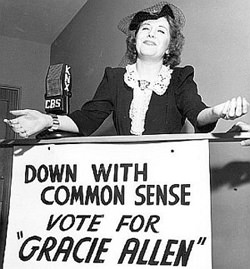 As a comedianne, Grace Ethel Cecile Rosalie Allen (1895-1964), Gracie Allen, was internationally famous
as the partner and comic foil of husband George Burns. They appeared on radio, television, and in film
as the duo Burns and Allen. Although she played a scatterbrain character, Allen was in fact
very shrewd in her marketing efforts for the duo. For example, as a 14-episode publicity stunt for the
Burns and Allen Show, Feb. 28-May 29, Gracie ran for president in the 1940 election, as the
"Surprise Party." She included her campaign skits in other appearances as well and actually received a
few write in votes. This episode, "Surprise Party Platform," was broadcast 27 March 1940. Listen and
enjoy, especially "The Campaign Song" at the end. Allen's campaign is just what we need today!
As a comedianne, Grace Ethel Cecile Rosalie Allen (1895-1964), Gracie Allen, was internationally famous
as the partner and comic foil of husband George Burns. They appeared on radio, television, and in film
as the duo Burns and Allen. Although she played a scatterbrain character, Allen was in fact
very shrewd in her marketing efforts for the duo. For example, as a 14-episode publicity stunt for the
Burns and Allen Show, Feb. 28-May 29, Gracie ran for president in the 1940 election, as the
"Surprise Party." She included her campaign skits in other appearances as well and actually received a
few write in votes. This episode, "Surprise Party Platform," was broadcast 27 March 1940. Listen and
enjoy, especially "The Campaign Song" at the end. Allen's campaign is just what we need today!
Women in the Making of America
1939
Women in the Making of America was one of the earliest radio documentary series to examine
women's history from a feminist perspective. Episodes dramatized the cultural and social contributions
that women have made throughout the history of the United States and featured programs on suffragists
including Lucy Stone (1818-1893), Julia Ward Howe (1819-1910), Angelina Grimké (1805-1879), and
Lucretia Mott (1793-1880). The thirteen week radio series premiered 18 May 1939. Created by Eva vom Baur
Hansl (1889-1978), a long-time advocate of women's rights with thousands of publications to her credit,
and scriptwriter Jane Ashman, Women in the Making of America was a project of the Federal
Radio Theatre, a unit The Federal Theatre Project, itself a division of the Works Projects
Administration (WPA). Following the initial thirteen episodes, and input from hundreds of professional
women across America, Women in the Making of America was re-conceptualized and
re-introduced as Gallant American Women in October 1939.
Resources
Eva vom Baur Hansl Papers at
Syracuse University Libraris Special Collections.
The Library of Congress holds
all the surviving scripts of the Federal Radio Division, a unit of The Federal Theatre Project.
Surviving recordings of programs are available at the Library of Congress and at the National Archives'
Motion Picture, Sound, and Video Records LICON, Special Media Archives Services Division, College Park,
MD.
Rouse, Morleen Getz. Daytime Radio Programming for
the Homemaker 1926-1956. Journal of Popular Culture, ***date?***, pp. 315-327.
Gallant American Women
1939
Gallant American Women grew from the success of Women in the Making of
America. The series was produced by the Works Projects Administration (WPA), the United
States Office of Education, the Federal Security Agency, and the American Association of University
Women. Episodes were thirty minutes in length, each conceived around a topical focus, for example women
as teachers, pioneer women, ladies of the press, mothers of presidents, women of letters, and women in
medicine, science, nursing, aviation, and more. Dramatizations and historical vignettes highlighted each
episode's focus and cited women and their accomplishments in that sector of society or history.
Contemporary women often spoke about the topic of focus at the end of episodes. The first episode of
Gallant American Women was broadcast 31 October 1939. Listen to "Women Building our
Heritage of Freedom" below.
Resources
Digital Deli
Gallant American Woman website.
Listen to and download
episodes of Gallant American Women at the Old Time Radio website.
Candy Matson
1949-1951
Crime and detective radio series were popular from the 1940s to the 1950s, perhaps due to rising
concerns for emerging criminal activities at all levels. Candy Matson (1949-1951) was a
weekly radio drama series noted for its strong, intelligent, no-nonsense female protagonist. She is
driven, relentless, and disarming, a compelling alternative to the popular male detective radio genre,
and the best of the popular female detective programs.
Candy Matson runs her private investigation business from a penthouse atop Telegraph Hill in San Francisco, California. Sidekicks Rembrandt Watson (Jack Thomas voices the eccentric photographer) and Lieutenant Ray Mallard (Henry Leff voices the San Francisco Police detective and love interest) assist as she solves murders and mysteries in her own intelligent and witty style.
Candy Matson was developed by husband and wife Monte and Natalie Masters. They planned their radio series with a male lead, but Natalie's mother persuaded them to cast Natalie as the female protagonist. The series was changed to highlight Candy Matson as a strong lead character, driven, relentless, and disarming. Monte wrote, produced, and directed each episode. Natalie voiced the role of Candy Matson.
Guest spots were cast by the Masters from professional San Francisco actors. Sometimes they used local musicians. Episodes featured references to local streets, buildings, events, or culture. The series also featured gay and Asian characters. These local associations, along with quick and creative scripts, made Candy Matson an audience favorite.
Listen to the audition episode for the series, "The Donna Dunham Case."
Re-Imagined Radio offered a tribute to the Candy Matson series, November 15, 2021. Learn more and Listen here→.
Production
Contents
This episode samples radio storytelling by Lucille Fletcher, Edith Meiser, Ruth Woodman, Mary MacBride, Jean King, Cathy Lewis, Margaret Lynch, and Gracie Allen, along with the Women in the Making of America, Gallant American Women, and Candy Matson radio series.
Credits
Written, Produced, and Hosted by John F. Barber
Sound Design, Music, and Post Production by Marc Rose
Promotional Graphics by Holly Slocum with Sydney Nguyen
Significance
In the 1920s and 1930s, following World War I, more and more radio stations began operating across sthe country. These radio stations needed content to fill the increasing number of broadcast hours. Women developed their experience in theater, music, literature, community service, home economics, politics, news, even sports into creative ideas for radio programs. At first, content created by women was classified as "women's shows." But the imagination and creative ideas of women went far beyond this narrow programming category. And this episode of Re-Imagined Radio celebrates Women's History Month with a tribute to eight radio women, and three signature radio series, who made significant and pioneering contributions to radio storytelling.
Producer's Notes
Our early research suggested a low knowledge of early radio storytelling by women writers, producers,
and directors. In fact there were significant numbers of women involved in all aspects of radio's
development during its first two decades, the 1920s and the 1930s. It's a great pleasure then to offer
this episode celebrating pioneering women radio storytellers and their radio series. Enjoy listening and
learning.
— John F. Barber
Promotion
Press
Graphics

Looking for other graphics to promote this episode?