Ensérné Media
Cinematic Radio Storytelling
Shared information
Tales from the Multiverse
Re-Imagined Radio presents MORE information about Ensérné (en-SAIR-nay) Media. Our partnership with Ensérné Media allows us the privilage of offering episodes of cinematic radio storytelling. Written and produced by Jerrel McQuen and Marc Rose, these Ensérné episodes combine fantasy, science fiction, and lots of creative imagination. Use these links for more information and listening opportunities for each episode.
Background
Jerrel McQuen and Marc Rose tell cinematic sound-based stories accompanied by jewel-like illustrations. Their stories are about imaginary worlds. People. Adventures. Their stories are engaging. Immersive. Believable. There are stories behind these stories. We share a few here.
McQuen and Rose met in St. Petersburg, Florida. That was 1974. Senior Year at Largo High School. Introduced by their Humanities teacher, Patricia Looney, they immediatley began creating stories in various media forms. Soon after, they created Ensérné Media, a company to focus their efforts.
Painting and Music
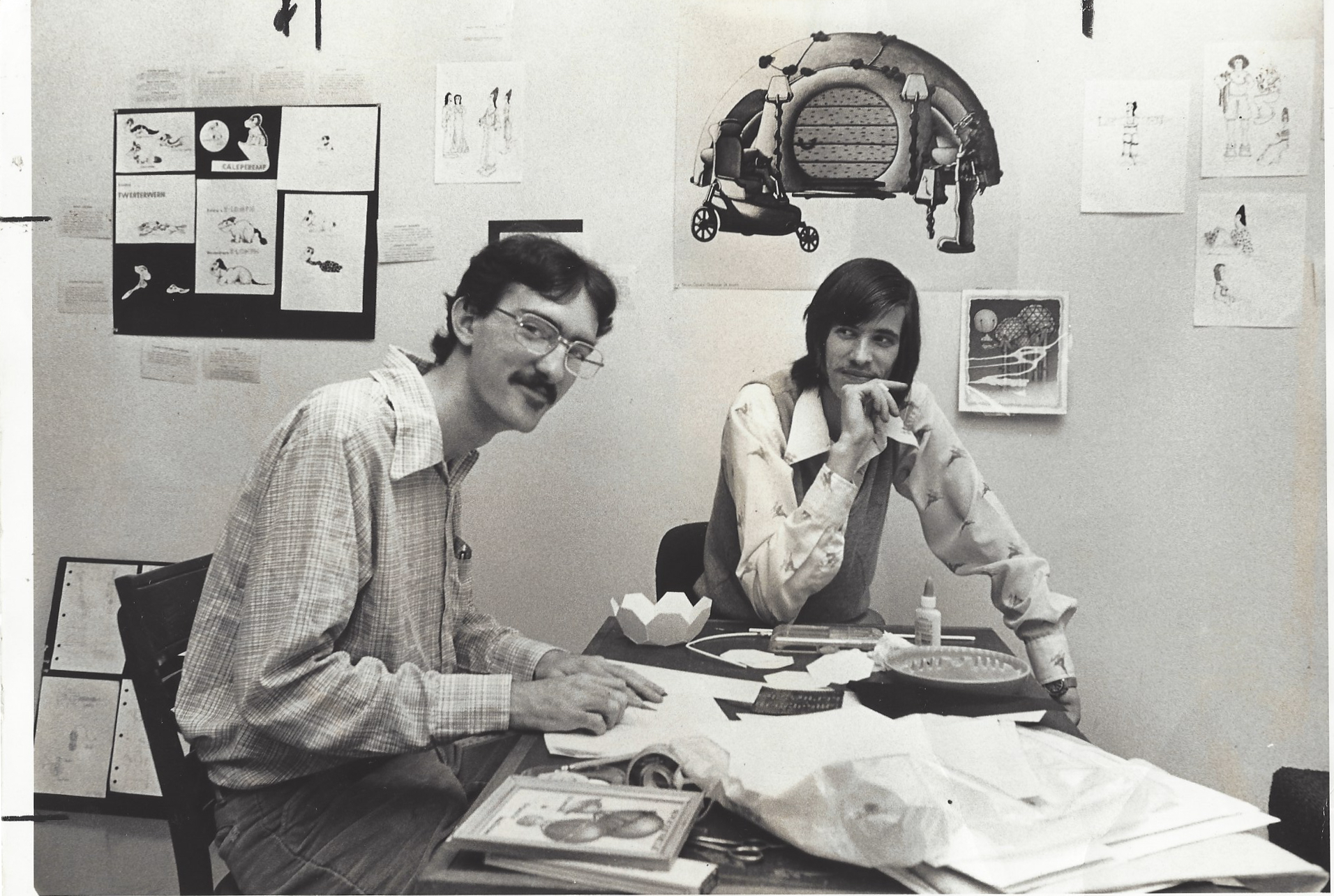
When they met in high school, McQuen and Rose, pictured above in this 1978 photograph from the Evening Independent (St. Petersburg, Florida), were imagining strange, interesting worlds. And ways to be in those worlds.
What happened when these two very creative young men met? "It was prophetic," says Rose. "Literally from day one we shared a mission to unearth the places we were seeing in our imaginations. Kind of an intellectual excavation as it were."
"we were looking for ways to visualize these worlds," says Rose. "Jerrel is a really skilled graphic designer and so that became his challenge. I was into music."
"I started with painting," says McQuen, "with acrylic paints. When I discovered I was physically allergic to metal elements in the acrylics, I switched to Photoshop and used only a mouse, no Wacom. I've been refining my techniques for nearly thirty years. All of the art featured in our projects is painted entirely in Photoshop using this technique. I can’t imagine doing it any other way."
One example of McQuen's artwork is "Sage of K-Toor." Jerrel describes the scene from Tales of
Farwan, as "the gateway to a sacred monastery. A mountain resort called Ahm Rahn K-Toor. A
Sage with his pet is taking a walk up on the winding cliffsides just before dawn, as new arrivals are
flying in via balloon."
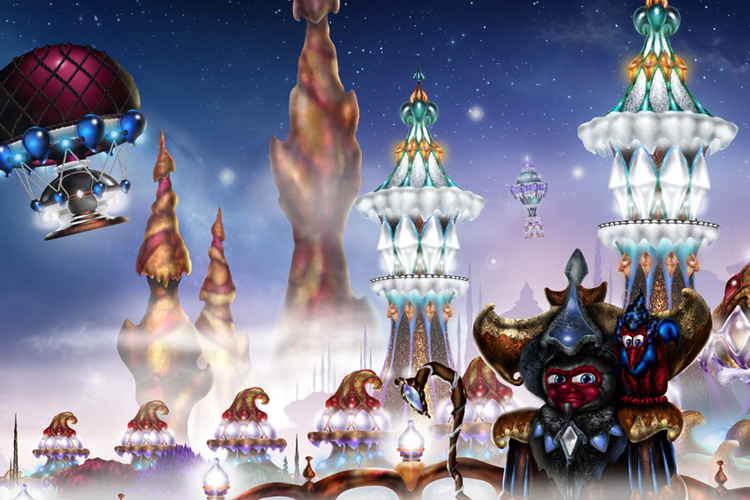
While McQuen explored and developed a jewel-like illustration style, Rose pursued music. "I was listening to Frank Zappa, Joe Zawinule, and John McLaughlin," he says. "The places Jerrel and I imagined were often suggested by music I was composing at the time. Like Dry Smoke & Whispers which came from a suite I was writing for slide 12 string guitar and big band."
"Beyond these major interests, our imaginations were fueled from a number of creative directions," Rose continues. "Starting with the writings of Harlan Ellison, who we actually met and collaborated with on an early Dry Smoke & Whispers story in 1983. He was also instrumental in getting us on KPFK radio in Los Angeles, California." (More about this shortly.)
Rose also credits the writings of Carlos Castenada, "particularly his first three books, when they were still considered anthropology. Those were huge influences."
"And I responded to old radio shows like Inner Sanctum, The Black Museum, and Harry Lime," said Rose. "X Minus One and Dimension X were great sources of inspiration as well."
Farwan Was First
"The very first thing Jerrel and I worked on, right out of the gate, was a 'story' about a place called Farwan," recalls Rose.
McQuen and Rose imagine Farwan as part of The Multiverse. A cosmic helix. Five spirals above Earth is Dry Smoke. Nine spirals up is Farwan. Professor Thedgar Rhedlington, an eccentric scientist from the Dry Smoke continuum, bridges all three. Any major event can ripple up and down the helix. Nothing is isolated or walled off from anything and parallel events are born.
"Multiverse" . . . speaks to a hypothetical group of multiple universes which comprise the entirety of space, time, matter, energy, information and the physical laws and constraints that describe them. The idea of multiverse, also called "parallel universe," can be traced back the to the Ancient Greek philosophy of Atomism which proposed the creation of infinite parallel worlds resulting from the collision of atoms. The idea of multiple universes was further defined during the Middle Ages. The term was first used in its current science fiction and physics context by Michael Moorcock in his science fiction novella The Sundered Worlds, 1963. Debate for and against the existence of multiverse continues today.
"With the arrival of layers in Photoshop, I finally had a way to create the sheer complexity of texture and detail that makes Farwan a reality unto itself," says McQuen. "In the future, CGI will take the trail I blazed and get it as close to the actual place as possible, considering the physics are at once denser and more transparent, as strange as that sounds. We can only hint at the silvery energy that exists in that realm. It's truly an elevated vibrational level."
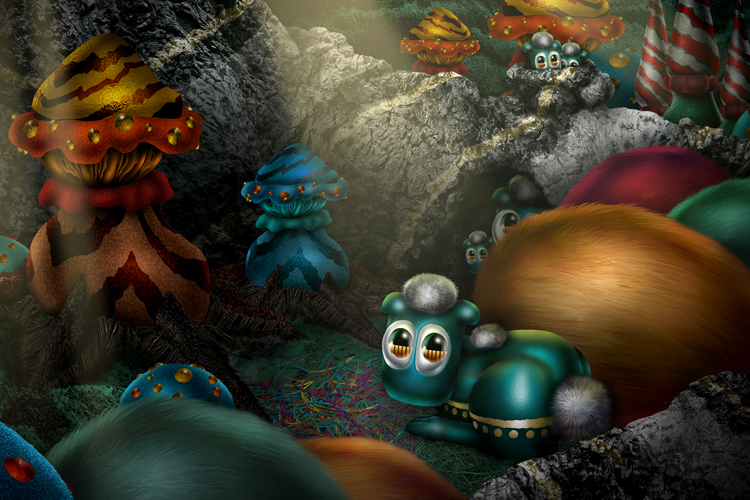
Another of McQuen's illustrations, "D-Rellian Squanchlings," also from Tales of Farwan. As
described by McQuen, this one "is set in the D•Rellian Forest. A family of little amphibians called
Squanchlings, peeking out from their home in the roots of a Togglebont tree."
Other examples of McQuen's illustrations are available at the Ensérné Media website.
Farwan is represented in the Nirvana & Gehenna episode of Re-Imagined Radio. "There's an audio version of one of the Farwanese Fables, the one about a chap named Faberus Borendon and how he created a power source from the sound of children's laughter," Rose notes.
First Book Project
In the late 1970s, McQuen and Rose were poised to publish a book about their imaginary world, Tales of Farwan. "That was our first book venture," says Rose. "Alfred Knopf was ready to publish it but a regime change brought in new folks who didn't see the potential in our work. That proved to be a bad decision for them later, as the market for alternate worlds and adventures exploded."
Dry Smoke & Whispers
"After problems getting Tales of Farwan published we pivoted to radio," recalls Rose. "WMNF-FM, a new community radio station in Tampa, gave us a green light to produce our own half-hour series, Dry Smoke and Whispers Radio Theatre," adds McQuen.
"We produced twenty-four episodes over the next five years, and syndicated them across the country, along with specials, news and programming anthologies, original music, and a limited run horror anthology, Anomaly Calling," says Rose.
"I was mostly a musican at the time, so the switch to music and sound made sense to me. Jerrel based Dry Smoke & Whispers Radio Theatre on his drawings and some of my musical compositions."
"We set Dry Smoke & Whispers Radio Theatre in a galactic civilization," McQuen describes. "A melding of a technologically advanced Victorian England and the Middle East." McQuen wrote the episodes. Rose composed and produced the music and sound design.
They imagined stories in another dimension. On a planet called Quaymet. Their stories moved between the glittering spires of mega-city Etherboro, a hub for the rich and powerful of this world, and the "Neon Bowery" just across the river, where shady deals and nefarious characters plotted all manner of dangerous exploits. As heard on radio, each episode presented a very strong visual style: futuristic scenes crossed with the ethnicity of a 1930s Moroccan "Interzone" designed by William Burroughs. Their main characters were a Telepathic Special Detective, Emile Song, and his Forensic Expert sidekick, Professor Durrick Henchard. There were other characters and Rose voiced many of them.
Dry Smoke & Whispers Radio Theatre—the tag line calls it "A Mystery SF Cinema in Sound Adventure"—launched January 18, 1980, broadcast by WMNF. The series premier episode was called "The Riddle." Nobody knew where it would go. The series went on until 1985 and was heard on public radio stations in sixty markets and three countries and received grants from The National Endowment For The Arts and the Florida Fine Arts Council. The series also won a few Communicator Awards and a Mark Time Award for The Shadow Man, an episode of Dry Smoke & Whispers, in 2003.
Blessed by Harlan Ellison
Dry Smoke & Whispers also attracted attention. Harlan Ellison, author of 40 books and prolific columns of iridescent insight for Future Life and L.A. Weekly, visited the Rose family home, in March 1982. Writing about his visit, Ellison said, "I am amused and captivated at the professional quality and the depth of imagination. Rose tells me he's done over 145 different voices for the show; he writes all the music; every bit of sound effects and editing is done right here, [in his home]" (Ellison 334).
When he returned to Los Angeles, Ellison carried with him taped episodes of Dry Smoke & Whispers, which he arranged to be broadcast as part of Mike Hodel's Hour 25, a radio program focusing on science fiction, fantasy, and science, heard on KPFK-FM, 1972-2000.
Paused to do real work
"We stopped production in 1985 mostly to do 'real world' work—and by that I mean 'make a living'—which required more time from both of us" says Rose. "We set Dry Smoke & Whispers aside."
For his real world job, McQuen continued working in graphic design. Rose stuck with audio production and found work with a company called Radio Cinema, an audio production and publishing company, in St. Petersburg. But, even in real life, creativity will not be denied and McQuen and Rose found ways to continue their radio storytelling.
Anomaly Calling, for example, was a limited run series, designed to be the "summer replacement" for Dry Smoke & Whispers. According to Rose, "It was an anthological series of ironic fiction."
There was also ShreekShow, a commercial radio series which sported the fun tagline, If you can hear it, it can SEE you. Produced in 1988, the half-hour anthology series leaned towards science fiction and horror themed stories. McQuen wrote the episodes. Rose worked with colleagues at Radio Cinema, Tim Greenwood (director of product development), Tony Panaccio (artistic director), and Linda Stroh (public relations), to produce the episodes. For them, Shreek Show was a labor of love. Greenwood and Stroh worked as hosts on the Home Shopping Network television show. Panaccio, a newspaper night police reporter, wrote crime mysteries during the day. They all acted in Shreek Show episodes, contributed to the scripts, made coffee, and answered the telephones in their creative workspace.
"Shreek Show," said Rose in a 1988 Tampa Tribune interview, "is a mixture of horror, humor and terror. We're trying to scare people while they're laughing. And things move fast. We're not going to put you to sleep" (Hill 6F).
The projected 13-week series was introduced at Halloween, 1988. The first two episodes, "Character Assassination" and "Knudsen's Corner," both began with appropriate music and screaming, followed by a voice intoning, "Shreek Show is a fever-dream hallucination made real. . . . Listeners will be driven headlong down into an ever-tightening tunnel of absolute terror. Now you're in the crawl space between sanity and madness. This is Shreek Show."
Four more episodes were in production. McQuen and Rose hoped other stations would pick up Shreek Show in March. Eventually, the Shreek Show series ran for about a year and was heard worldwide on commercial radio stations, including in the United Kingdom. In the end, "Shreek Show had only seven episodes," according to Rose. "I believe it ran in maybe ten markets but the writing was on the wall that radio was not paying for content and was no longer interested in half hour slots, unless you were buying the airtime."
Another side project for commercial radio was Bobb Sledd . . . Not a Private Eye which, says Rose, "was a hoot to produce but each two minute episode required far more than that in time and effort. Bobb Sled ran multiple times on syndicated air—meaning a group of shows emanating from all over the place—beamed across the country from a central location."
Even without new episodes, Dry Smoke & Whispers Radio Theatre endured. The series won a few Communicator Awards and later, a Mark Time Award for the episode "The Shadow Man," a follow-up episode released in 2003, featuring voice artists McQuen and Rose met in Portland. See "Move to Portland, Oregon," below, for more information.
A Move to Post Production Brings Awards
When Rose switched his focus to audio post production, "It meant I didn't really have the time to develop shows," he says. The time and effort Rose put into audio post production paid off. He won two Emmy Awards—awards that recognize achievements in particular sectors of the television industry, in this case "Best Daytime Educational Series"—for Shamu TV, a series produced in cooperation with Sea World that ran on NBC daytime television, 2005 and 2006. "I handled sound design, music, wrote the theme music and did the character voice of "Sonar" for that show," said Rose. The other Emmy Award—yes Marc Rose has won three Emmys!—was for Jack Hanna's Animal Adventures, a nature-related show about animal predators, in 2006.
"I've been at it ever since," says Rose. "Never been bored."
Move to Portland, Oregon
Both McQuen and Rose are now based in Portland, Oregon. McQuen relocated to Portland, Oregon, first, in 1996. He pursued graphic illustration, advertising, and marketing while working at DHX Advertising. Now retired, McQuen works for himself, under the name JTM Graffitone, freelancing entertainment packaging and illustrating science fiction and fantasy book covers.
Rose followed in 1999, after wrapping up his connections with Radio Cinema. He started his own company, Fuse Audio Design, and found work soundtracking independent movies, documentaries, and commercials.
Rose and McQuen continue to collaborate, producing cinematic radio storytelling. McQuen writes and develops graphic designs. Rose takes care of sound design and other production. "We've collaborated like this for decades now," says Rose.
In Portland, Rose and McQuen quickly engaged with the local audio drama/radio storytelling community. They rebooted Dry Smoke & Whispers in 2004, says Rose, "for then XM Satellite Radio. That ran for two years." They began with The Shadowman Saga. The Phantom of Delguire Manor followed in 2008. LEARN more at the Dry Smoke & Whispers website.
The lead voice for The Shadowman Saga was Sam A. Mowry, founder and director of The Willamette Radio Workshop, in Portland. Other members of Willamette Radio Workshop voiced other parts. That relationship worked both ways. "I've contributed music and sound design wherever possible since 2005," says Rose.
The Re-Imagined Radio episode "WRW Retrospective" explores how McQuen and Rose met members of The Willamette Radio Workshop and worked with them to produce "The Shadow Man." LEARN more and listen at the episode archival webpage.
Other Projects
Rose and McQuen have an evolving project underway, called Graphaphone, which has "a lot of potential," says Rose. An example episode is on the Ensérné Media website.
McQuen says he is about to turn his graphic design attention to the Dry Smoke & Whispers website. "I'm going to put the full Art Deco spin on Dry Smoke & Whispers. A new site will be arriving soon, with cinematic art and a more sophisticated site design that will rival the Farwan galleries."
Rose also has several interesting individual projects underway. "During my last days in Florida I worked with noted brain scientist Dr. Ted Geislin on transferring shamanic sounds of healing into digital equivalents. Shamanic medicine utilizes many 'tools' that are aural in nature and Dr. Geislin was curious to find a digital version and see what the brain responses would be. He was a fascinating guy," says Rose.
Rose currently works with psychologist Thomas Doherty on a podcast called Climate change and . . .. "The blank space is a placeholder for whatever the topic of the show might be for that episode. Happiness, the economy, fear, etc.," says Rose.
Rose also produces The Fusebox Show—the show for everyone . . . but not everyone will like it! But, with years worth of quirky conversation and comedy as content, everyone, anyone, should find something they like. LEARN more and listen at The Fusebox Show website.
Works Cited
Booth, Philip. "New Tampa Radio Series Is A Read Scream." The Tampa Bay Times. Oct. 28,
1988.
Harlan Ellison. An Edge in My Voice: Essays. Donning Books, 1985, pp. 333-336.
Hill, Judy. "'Shreek' Radio Show Aims at Horror, Humor." The Tampa Tribune. Dec. 5, 1988,
1F, 6F.
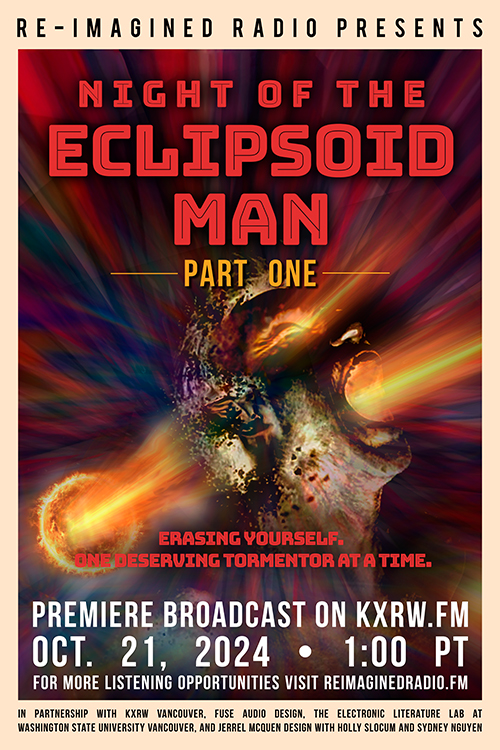
Night of The Eclipsoid Man
Night of The Eclipsoid Man
A two-part cinematic radio story
October 21 and November 18, 2024
Season 12, Episodes 10 and 11
The third episode of cinematic radio storytelling Ensérné Media shared with Re-Imagined Radio.
A story so sweeping it must be told in two parts. In Part 1, Spencer Knightbridge is transformed into a quixotic one-man holocaust, bent on avenging horrible wrongs done him while growing up in Quayment's Neon Bowery. In Part 2, Knightbridge discovers that the brutal ghosts of his past have robbed him of all that he hoped to be or love. Will it be Vengeance? Retribution? Or, Epiphany, when an atrocity bomb from Quaymet’s ancient past redefines the meaning of fallout?
Asezhia

Asezhia
The demon is loose. The legend is real.
October 16, 2023
Season 11, Episode 10
The second episode of cinematic radio storytelling Ensérné Media shared with Re-Imagined
Radio.
The demon is loose. The legend is real. An ancient jewel, stolen from Asezhia, a planet of great beauty and dark history, transforms into a hellish denizen with an insatiable hunger for death and blood. Even Emile Song, the telepathic Special Detective from Quaymet, the capitol of a galactic civilization, may be out of his reckoning as he goes up against a skeletal fiend that can vanish in a ruby mist.
Nivanna & Gehenna

Nirvana & Gehenna
Three Worlds. Three Dimensions. One Future.
August 16, 2021
Season 09, Episode 08
The first episode of cinematic radio storytelling Ensérné Media shared with Re-Imagined Radio.
The Multiverse is a helix. Two strands spiraling around each other. Five spirals above Earth is the region of Dry Smoke. Nine spirals up is Farwan. Professor Thedgar Rhedlington, eccentric scientist from Dry Smoke, devises a way to bridge all three. Major events ripple up and down the helix, and parallel events are born.
This dimension-spanning documentary ties Dry Smoke & Whispers and Tales of Farwan to Earth by exploring creativity and philosophy, and, according to McQuen, "where civilization is going and will we survive long enough to know why we were so driven to get there?" Heady indeed. But, oh so interesting storytelling.
Graphics