William Conrad Tribute
RiR #46, Season 10, Episode 05, June 20, 2022
Tribute to a great radio voice
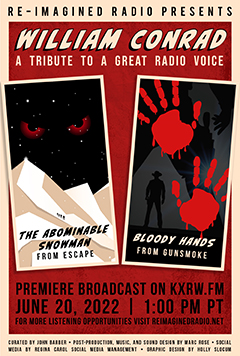
Re-Imagined Radio pays tribute to William Conrad's iconic radio voice which was heard in thousands of supporting roles and literally defined two radio drama series, Escape and Gunsmoke. We sample "The Abominable Snowman" from Escape and "Bloody Hands" from Gunsmoke.
Download Links
Download episode to your
device→
Download episode media
kit→
Download episode script

Background
William Conrad and Escape
William Conrad estimated that he voiced more than 7,500 roles in his radio career. Many of these were solid supporting roles, but Conrad literally defined two radio programs with his distinctive voice: Gunsmoke and Escape.
Escape was a radio adventure series featuring a wide range of stories adapted from classic and contemporary stories by well-known writers—from science fiction to horror to murder mysteries—and was radio's leading anthology of adventure drama from 1947 to 1954. The cast changed with each episode, and frequently included well known actors. Escape is significant for exposing listeners to a variety of literary experiences and its frequent citation as the finest radio adventure series ever broadcast.
The Columbia Broadcast System (CBS) first considered an adventure series to be called Out of This World. The audition, with the same title, was broadcast 28 February 1947, but the proposed series never materialized.
A second audition was broadcast March 24, 1947. Based on "The Ventriloquist's Dummy" in the British horror anthology movie Dead of Night (1945), this episode was titled "Dead of Night."
With a name change, CBS launched Escape. The first episode was Rudyard Kipling's "The Man Who Would Be King," July 7, 1947. The last episode was a science fiction drama, "Heart of Kali," September 25, 1954. All together, there were 228 episodes (230 counting the two auditions; 237 counting East Coast versions of seven shows). Surviving Episodes: perhaps 227 (several episodes redone for Suspense).
Each episode began with a distinctive opening invitation from Conrad:
"Tired of the every day grind?
Ever dream of a life of . . . romantic adventure?
Want to get away for it all?
We offer you—ESCAPE!
Escape! Designed to free you from the four walls of today for a half-hour of high adventure!"
Conrad's voice blended perfectly with the drum rolls and other accents of Modest Petrovich Mussorgsky's "Night on Bald Mountain," the show's theme music. And then the episode was underway, with Conrad unfolding its tale of life and death situations and violent twists of fate.
The formula behind each episode of Escape was to place its actors in physical, psychological, or emotional situations from which there seemed to be no escape. The conflicts were carefully crafted and made for compelling, visceral drama that could be felt and internalized by listeners. Radio historians estimate that more than two hundred fifty episodes of Escape were produced. Conrad hosted and/or starred in 90 of those episodes.
Resources
Episodes at Internet Archives website
OTRR certified episodes at Internet
Archive website
Escape! Radio Logs at Jerry Haendiges Vintage
Radio Logs website
Plot summaries and credits at Radio Gold Index website
Escape at Digital Deli Too
website
Scripts available for some episodes of
Escape!
William Conrad and Gunsmoke
Conrad's contribution to the Gunsmoke radio series is equally impressive. Gunsmoke is set in Dodge City, Kansas, often called the "Queen of the Cow Towns," the "Wicked Little City," the "Gomorrah of the Plains." By any name, Dodge City had a reputation as a hostile, lawless town where the "fastest gun" ruled during the settlement of the American West. Cowboys herding cattle up from Texas, drifters, criminals, psychopaths—the mix was volatile. U.S. Deputy Marshal Wyatt Earp (1848-1929), Sheriff Bat Masterson (1856-1921), Sheriff Bill Tilghman (1854-1924), and Sheriff Charlie Bassett (c. 1847-1869), all real lawmen, worked to keep Dodge City under control until civilization could take hold. Marshal Matt Dillon (voiced by William Conrad, already known for narrating Escape) is modeled after these lawmen. He is hard as worn leather saddle. A loner. Isolated.
Re-Imagined Radio's "Gunsmoke Compilation" episode offers deeper details about Conrad's background and contributions to this landmark radio series. Learn more and listen here→
Production
Contents
"The Abominable Snowman"
Escape
September 13, 1953, Episode #200
"The Abominable Snowman" was written and directed by Antony Ellis for Escape and was first broadcast September 13, 1953. In this episode Conrad leads an expedition from Darjeeling, India, up the slopes of Mount Everest searching for the legendary Metoh-Kangmi, a mysterious half-man, half-ape creature reported by mountain climbing parties. Conrad and his partners find themselves in a situation from which there seems no escape. Listening to Conrad's distinctive radio voice build and sustain the storytelling we can imagine being there on the mountain, pursued by the legendary and dangerous creature.
Cast and Credits
The Abominable Snowman
Escape,
William Conrad as Paul Lane
Anthony Berrett as Allen Ferris
Hy Averback as Frank Davis
Jack Kruschen as Nassang
Edgar Barrier as The Lama
"Bloody Hands"
Gunsmoke
April 2, 1955, Episode #155
The violence Marshal Dillon encounters daily must be met with violence, and this is destroying his soul. He is scared that everyday could be his last. In "Bloody Hands," Conrad, as Marshal Dillon, speaks of his angst. Faced with too much killing and fearing he has lost his edge, he quits his job and tries to lead a normal life. But when a murderer comes to Dodge City, who will save its citizens?
Cast and Credits
William Conrad as Marshall Matt Dillon
Parley Baer as Chester Wesley Proudfoot
Howard McNear as Charles "Doc" Adams
Georgia Ellis as Kitty Russell
John Dehner
Lawrence Dobkin
Written by John Meston
Credits
Curated, Produced, and Hosted by John F. Barber
Sound Design and Music Composition by Marc Rose
Social Media by Regina Carol Social Media Management
Promotional Graphics by Holly Slocum Design
Producer's Notes
***
Promotion
Press
Trailer
"William Conrad Tribute" trailer by Holly Slocum, Marc Rose, and John F. Barber
Graphics
Looking for other graphics to promote this episode?