The War of the Worlds
RiR #50, Season 10, Episode 09, October 17, 2022
Possible Influences
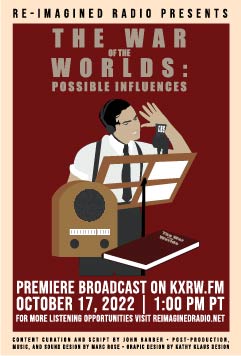
Re-Imagined Radio celebrates the 84th anniversary of "The War of the Worlds," the most (in)famous radio story ever by exploring earlier experiments with "break in" news announcements and suggest their impact on Orson Welles's radio adaptation of the 1898 novel by H. G. Wells. Interviews with Welles provide additional insight. The conceptual framework and script follows a documentary radio performance style that combines art production and scholarship. Enjoy "The War of the Worlds: Possible Influences."
Download Links
Download episode to your
device→
Download episode media
kit→
Download episode script

Background
Inspiration(s)
On October 30, 1938, Howard E. Koch, writer, Orson Welles, director then age twenty-three, ten actors of The Mercury Theatre on the Air, and a twenty-seven-piece studio orchestra, adapted the novel The War of the Worlds by British author H.G. Wells for radio. Their adaptation used a series of "break in" news announcements to portray live events unfolding around the country as Martian metal cylinders fell to Earth and a group of tripod-like fighting machines wreaked havoc in New Jersey and New York City.
Allegedly, "The War of the Worlds" broadcast caused mass confusion (panic?) among its listeners through its use of realistic sounding news bulletins and other narrative techniques, introduced by Koch and Welles.
But, although "The War of the Worlds" is considered the most (in)famous radio broadcast of all time, and continues to provoke interest and inspiration, it is not the first radio story to create confusion among listeners by using unusual narrative techniques. Earlier experiments with radio storytelling may have influenced Orson Welles and his adaptation.
For this episode, we explore five earlier experiments with radio storytelling that may have influenced Welles and his radio storytelling: "The Fall of the City," "Air Raid," "The Crimson Wizard," "The Minister Is Murdered," and "Broadcasting the Barricades." And, we include interviews with Welles to provide additional insight.
"Fall of the City"
"The Fall of the City" and "Air Raid," were both written by Pulitzer Prize-winning poet and Librarian of Congress Archibald MacLeish. Both used a radio reporter describing events as they unfolded. Welles was that reporter in "The Fall of the City" and he described everything he saw and heard in the central plaza of an unnamed city where thousands of citizens awaited the arrival of an unnamed dictator. Inspired in part by the growing fascism in Germany and Italy just before the start of World War II, and broadcast 11 April 1937, "The Fall of the City" is often cited as the best example of the artistic potential of radio broadcasting in terms of both stylistic innovation and social power.
"Air Raid"
MacLeish's second radio play was "Air Raid." Inspired by the attack on Guernica, Spain, by German airplanes during the Spanish Civil War, "Air Raid" was broadcast on The Columbia Workshop, 27 October 1938, just 3 DAYS before "The War of the Worlds." MacLeish wanted Orson Welles to read the part of the location reporter. But, citing his full schedule with The Mercury Theatre on the Air, Welles declined. However, MacLeish worked on "Air Raid" seven months prior to its debut, and a photograph shows Welles talking with writer MacLeish, actor Ray Collins, and director William N. Robson during a rehearsal for "Air Raid."
Surely Welles was certainly familiar with the production, and these experiences could have provided Welles ideas about what was possible with the new medium of radio, then just a decade old. And, possibly they influenced his production of "The War of the Worlds." For example, Welles used reporter Carl Phillips as a major narrator for his adaptation of "The War of the Worlds."
The Crimson Wizard
The Crimson Wizard is another possible influence. Broadcast by WGN, Chicago, Illinois, every Friday beginning 30 September 1938, the month before Welles's own "The War of the Worlds," episodes of the adventure series were extensively transcribed in the color graphics section of The Sunday Tribune. The title character was a hunchback scientist named Peter Quill pursued by a Communist spy ring called The Red Circle.
There is no direct evidence that Welles was influenced in any way by "The Crimson Wizard" radio series in his own adaptation of "The War of the Worlds." But, it's possible that he knew of this radio drama series which would have hinted again at the potential for different approaches to radio storytelling.
"The Minister Is Murdered!"
"Der Minister ist ermordet! (The Minister Is Murdered!)," a two-hour radio play by Erich Ebermeyer was broadcast from Berlin, at 8:00 PM, 25 September 1930, eight years prior to the "War of the Worlds" broadcast. According to newspaper reports, soon after its beginning, "The Minister Is Murdered!" was interrupted by a break in news bulletin about the assassination of the German foreign minister, returning from a visit abroad.
"Broadcasting the Barricades"
"Broadcasting the Barricades" was broadcast by the British Broadcasting Company (BBC) twelve years before "The War of the Worlds," on a snowy Saturday night, January 16, 1926. Written and performed by Father Ronald Arbuthnott Knox (1888-1957), an English theologian, Catholic priest, and mystery writer, "Broadcasting the Barricades" is perhaps more correctly cited as the first radio hoax.
Welles, in a recorded interview with film director Peter Bogdanovich, says "Broadcasting the Barricades" gave him the idea for and influenced his production of "The War of the Worlds" in 1938 with The Mercury Theatre on the Air. "I got the idea from a BBC show that had gone on the year before [sic], when a Catholic priest told how some Communists had seized London and a lot of people in London believed it. And I thought that'd be fun to do on a big scale, let's have it from outer space—that's how I got the idea."
Production
Contents
Samples from and dramatizations of earlier uses of "break in" news announcements to illustrate how they might have influenced Orson Welles and The Mercury Theatre on the Air in their 1938 radio adaptation of The War of the Worlds by H.G. Wells.
Credits
Curated, Produced, and Hosted by John F. Barber
Sound Design, Music, and Post Production by Marc Rose of Fuse Audio Design
Promotional Graphics by Kathy Klaus
Producer's Notes
Our fourth performance of this classic radio drama!
The focus is possible influences on its making.
— John F. Barber
Promotion
Press
Spykerman, Monika. "Try This: 'Murder on the Orient Express,' music and 'War of the Worlds'." The Columbian, 13 Oct. 2022.
Ward, Jack J. Sonic Society #747—Red Riots→. The Sonic Society, 30 Oct. 2021.
Ward, Jack J. Sonic Speaks 0602: Re-Imagined Radio→. The Sonic Society, 7 Nov. 2021.
Graphics
Looking for other graphics to promote this episode?