Frequency 43
RiR #89, Season 13, Episode 10, October 20, 2025
Can dreams connect us with the Great Unknown?
Re-Imagined Radio presents "Frequency 43" by Jerrel McQuen and Marc Rose. Just in time for Halloween. A suitable taste of terror with a side of science fiction adventure. A researcher discovers a parallel universe where the morphing liquidity of dream and nightmare questions the rules of reality. Can dreams connect us with the Great Unknown? If so, how much connection would we truly want? McQuen and Rose hint at answers. From our Guest Producer and Science Fiction series.
Access the episode script

Background
History
In a parallel universe, is connection with the Great Unknown possible through dreams? If so, how much of that giant universe would we truly want to contact? Answers are hinted in "Frequency 43," an original radio story by Jerrel McQuen and Marc Rose, first broadcast in 1980. Now re-titled. Re-booted. Re-wrapped in trademark cinematic sound. Re-broadcast by Re-Imagined Radio.
The original Outer Limits television series from 1963 and its emphasis on science fictiion was the inspiration for this radio story about a solo researcher who invents a Gigeresque chair to augment and record dreams. Why? To learn what's on the other side. Do we connect with something greater than ourselves when we encounter the strange morphing liquidity of dream or nightmare?
The original radio story by Jerrel McQuen and Marc Rose, founders of Ensérné Media, aired in the late spring of 1980 on WMNF Community Radio in Tampa, Florida, and was then syndicated to about fifty other community stations across the United States. "We got some very cool feedback at the time. And some much needed encouragement to continue our productions," recalls McQuen, writer and graphic artist.
"It was called "Transformer" in that time frame, before the birth of a self-regenerating world-wide franchise of mutating robo-vehicles. It's taken forty years to come up with a new title that felt right. But this time the story told us what everything was about, which is always the best way to go about anything creative. The lasting stories demand you follow them along for the ride."
"So for this revisit, my goal was to create a feeling of dark sets, like a one-stage play," says McQuen. "Essential elements key-lighted. Everything else in shadow. Most of the action takes place at night. Because our new protagonist, Nala, is a natural sensitive as well as a researcher, and is more receptive to traveling in the REM state at night."
Production
Contents
"Frequency 43" written and produced by Jerrel McQuen and Marc Rose
Originally broadcast as "Transformer," 1980, WMNF-FM, Tampa, Florida, then syndicated.
Planned as Episode One of the Extremities series, but this series was not realized.
Re-written, re-produced, and re-named, Frequency 43 enjoys its premiere radio re-broadcast
on Re-Imagined Radio.
Cast
Bobby Bermea as Ben Whitlock
Devin James as Branford Cartier, Austin Caddell, Officer Cadman, Narrator
Jodi Lorimer as Aelinn Guyers (EYE-lin GUY-ERS)
Destinee Love as Nala Kayak (NAH-luh ka-TIE-ya)
Eric Newsome as Major Trent Alarie (uh-LAR-ee)
Lucy Paschal as Dr. Zanders
Kate White as Tarrah Meyers
Announcer
President
NASA official
Credits
Written by Jerrel McQuen for Enserne Media
Produced by Jerrel McQuen and Marc Rose
Sound Design, Music, and Post Production by Marc Rose
Promotional Graphics by Holly Slocum with Claire Leyden. Original art by Jerrel McQuen.
Social Media Strategies by Caitlyn Kruger
YouTube Strategies and announcing by Rylan Eisenhauer
Produced and Hosted by John F. Barber
Significance
Jerrel McQuen and Marc Rose have been telling stories using cinematic sound(s) and other media for more than forty years. Founders of Ensérné Media, they first shared this radio story as "Transformer" in 1980. It was a one-off, the first episode for a planned radio series beyond their Farawan and Dry Smoke & Whispers story worlds. The series was set aside. But "Transformer" kept calling for more. Now, re-conceptualized, re-titled, re-told, and re-broadcast, "Frequency 43" continues McQuen and Rose's re-visiting of their long unavailable radio story.
Producer's Notes
Provided by Jerrel McQuen, writer, producer, graphic artist.
Setting
Earth. About fifty years in the future. An incorporated city on the outer fringe of Los Angeles, City of
the Fractured Reality Construct.
Tone
The original Outer Limits television series is the template for the story’s approach. In
the script, my goal is to create a feeling of dark sets, like a one-stage play; only essential elements
key-lighted, everything else in shadow. Most of the action will take place at night, due to the very
nature of the events.
Genre
Metaphysical Horror. Empirical becomes Quantum. The very rules of what we consider reality are called
into question. Bricks are full of air and empty space, no protection at all, just another Form of Things
Unknown.
Project Dream Catcher > Goals
To further expand knowledge of the inner workings of the mind through researching dreams. What causes
them. Are they merely regurgitated fragments of daily life? Or do we connect with an outer influence of
life and knowledge beyond normal understanding? Perhaps in some cases, of extra-terrestrial or
extra-dimensional origin?
Project Dream Catcher > Technological Application
The Research Team of Nala Kataya and Ben Whitlock have invented a discipline and device that allows a
person to recount what they are seeing, from within the dream itself, based on Castanadean principles of
becoming aware of yourself while in a dream. The device is an enclosed chair in a semi-reclining
position. The subject is sealed inside and sent into REM sleep. What the subject experiences is
broadcast and recorded over a monitor in the Control Ring. After several sessions, Nala and Ben have
defined what appears to be an interstellar, perhaps interdimensional Field of Frequencies. Nala’s mind
has been drawn constantly to one in particular, Frequency 43.
Project Dream Catcher > The Financiers
Researching their options, Nala and Ben were led to the Caddel Foundation. And their think tank: the
Philosophical Science Institute (PSI). The Foundation has many ties to Government, Industry and the
Military. Nala and Ben only agreed to accept grants on the condition that all their results would be
made public to the scientific community on a global basis. This in the hope of avoiding clandestine
organizations using their work to influence humanity through dream coercion. They were perhaps naive
believing they could beat the system.
Project Dream Catcher > The Facility
A small but hi-tech lab, consisting of two circles. The Pit contains the Receptor Chair, a gigeresque,
semi-reclined techno-sarcophagus. One side lowers with steps for access. The subject reclines on a
padded lounger, head in a sculpted receptor unit, arms in glass sleeves. Hands formfit onto palm plates
with receptor finger sockets. Subject is then sealed inside by a lowering glass shield.
A short metal stairway leads to the second level, the right half of which is the Control Ring. A thick glass observation window overlooks the Pit and the Chair. There is one door to the right of the window, pneumatically sealed, a containment precaution in case something hazardous is contacted or brought back by the subject. Panels in the Control Ring activate the system, record the results, in audio and picture, and monitor life signs. A Failsafe System allows total shutdown.
The left half of the second level is a long, curving Conference & Session Analysis area. This also overlooks the Pit, but with one-way glass. This window is black chrome to those in the Pit, so that visitor observation will not distract those in laboratory process.
Cast > Research Team
NALA KATAYA (NAH-luh ka-TIE-ya)
Incredibly intelligent and driven. Doesn’t know it intellectually, but she's a TruthSayer, someone who
instinctively knows when someone is lying. There is much about the universe that disturbs her. Raised in
the church, she rejected organized religion before her teens. But researching the real world has only
increased her dissatisfaction with the gap between survival and awareness — of greater callings
constantly being limited by necessity or avarice. She will not back down from a challenge, even if it
puts her own life in peril.
BEN WHITLOCK
Fiancé of Nala, and her work partner. He too is a TruthSayer and this may be what brought them
together. He is direct, clear-thinking, but definitely has a sensitive side that enables him to suss out
all sides of an issue. He sees himself as a balancer for Nala, who is sometimes too all-in once she
commits. They have big disagreements, because they’re both relentless in what they see as the Path. Both
are really good at intuitive leaps, another bond between them.
TARRAH MYERS (TAR-uh)
Tarrah is an Institute Intern who presents as caring and committed, but her loyalties lie to the Right.
Though both Nala and Ben vetted her, her hidden connections to the Foundation, Austin Caddel and Major
Alarie, go way back through family. She is not a zealot. Just realistically concerned about the modern
world: the threats her country faces, internally, from abroad, and now potentially, from beyond. She is
a spy for Caddel and his concerns, tracking all aspects of the Dream Catcher research.
Cast > Allies > Protagonists
AELINN GYRES (EYE-lin GUY-ers)
Aelinn is a true psychic, or Draoi (pronounces Dree), an Irish term for a Person of Power, or Psi
TeleKinetic. A long-time friend of Ben and Nala. Helped to impel the direction of both researcher’s
studies. After many events involving Frequency 43 and Nala, she intuits there may be very little she can
do to change the course of events. Foresight in this case has failed. People almost always choose their
own course, no matter how direct the warning.
DR. ZANDERS
A dedicated doctor who is overseeing Nala’s recovery, but who soon finds herself fearing for whatever
mutation her patient is undergoing. A contagion that is extraterrestrial in origin? She honestly wants
to protect Nala, but not to the point of letting her become a danger to all humanity.
BRANFORD CARTIé
A lost soul. He fell asleep in Paris, in the 1800's, probably in his 30s, and was taken by the Engineers
of Frequency 43. Transported from Earth in his sleep. Woke up in the Halls of the Biomechanoid.
Genetically altered until he had almost forgotten where he was originally from. When Nala is brought in
contact with him, his origins resurface. Painfully. Through this, Nala learns just what the Engineers
have been doing for literal millennia.
Cast > Antagonists
AUSTIN CADDELL (kuh-DELL)
CEO of the Foundation and a co-founder of the Institute, Austin considers himself a realist. The lines
between country and corporation have blurred and that doesn’t bother him, since he sees purpose as
commerce, commerce as the reason for purpose. Though the Foundation presents as progressive and
genre-blurring, it’s on the hunt for new mind technologies that can further those purposes. And threats
to same.
MAJOR TRENT ALARIE (uh-LAR-ee)
Trent is a military advisor who has been keeping tabs on all the metaphysical grants and projects at the
Institute, hoping for or in fear of significant breakthroughs. He is actually a Directorate of Science
and Technology with the CIA. He likes to work in the field when possible, get an upper hand on anything
that might threaten human superiority. He is the worst kind of elitist, capable of great cruelty. Not a
nice man.
OFFICER CADMAN
A right winger drawn to the covert. Though he started out as truly patriotic, serving under Alarie has
twisted him even more than he was originally twisted. There's something innocent and pure at the core,
but this got buried by years of military paranoia. Leading to a man so deeply damaged that he proclaims
he's not worth saving.
Cast > Aliens
The Architects were an alien race, probably the progenitors of several races, in several phylums: the
primates who terra-formed Earth being only one evolutionary Petri dish. But the Architects either died
out or ascended into non-corporeal form. One Workspace survived them, inhabited by incredibly
sophisticated AIs. But they have no guidance. So for uncounted ages they have abducted sentient beings
through dreams — the resonance of Frequency 43. And have been trying to genetically adapt them
into a superior being — one capable of making new sense out of the current cold, evolutionary
juggernaut of the natural world.
ENGINEERS
These are the voices that we hear chanting the genetic codes and mathematical formulae. I'm thinking
these should be both Selenite with one team, and basso-demonic like your chorus in Halls on another. The
two together, speaking over each other, will make them sound organized, vast and a little too ironically
omnipotent. But they are actually a nightmarish community of out-of-sane-control AI Scientist Programs,
on a never-ending mission.
LIVING MACHINES
These are the Implementers of the Workspace. They do the dirty work, they are the Janitors. Feeding the
inmates. Classifying them for further mutation or discontinuation. They are organic AIs, having
heartbeats and organs, but are nearly immortal, regenerating to carry out the orders of the Engineers.
The Genesis of Frequency 43
As told by Jerrel McQuen . . .
"It was a one-off. A special, to give us the challenge of our first production outside of Dry
Smoke and Whispers.
"Marc had written a 12-string guitar piece ["Halls of the Biomechoid"] inspired by the works of H. R. Giger, [a Swiss painter, sculptor, and designer, is noted for his biomechanical design of the monsters, attire, and aesthetics for the science fiction movie Alien, released in May 1979. Look him up. Learn more]. It was a haunting refrain and a short time after, Marc had the idea of a researcher contacting some unknown force in his dreams. And it started transforming him into living stone. Hence the stories original title: TRANSFORMER. It's feel was probably analogous to early Hammer films."
Listen to "Halls of the Biomechoid" by Marc Rose, remastered in 2025.
NOTES
From Wikipedia . . . Hammer Film
Productions Ltd. is a British film production company based in London . . . best known for a series of
Gothic horror and fantasy films made from the mid-1950s until the 1970s. . . . Hammer also produced
science fiction, thrillers, film noir and comedies, as well as, in later years, television series.
McQuen continues, "It was an hour long and we had interesting response to it. This was 1980, so no emails. People had to sit down and write letters, and send them to our sponsor community radio station, WMNF. A little more effort involved, so we very much appreciated the feedback.
"But time rolls on, and the word Transformer was co-opted by a gigantic franchise. The original was a fine Freshman effort, but by the time we wanted to re-invent it we had access to a small but talented pool of vocal talent. and a larger studio with newer equipment, making possible a wider range of sound effects.
"But we needed a new title. We actually produced a new version for Marc’s original anthology, SHREEK SHOW. That iteration was entitled "Heat Seeker." That was 1989-1990, influenced by such great cult 1980s films as Re-Animator and Basket Case.
"But it still didn't get to the place we had originally envisioned. More decades rolled by. I wrote a treatment introducing a couple engaged (literally) in Dream Research. I struggled for YEARS to find the right title again, to no avail. Titles are important and sometimes contain a clue that serves as a Latchkey for the entire premise.
"Inspiration arrived in the form of presentation on Re-Imagined Radio. And I finished a new hour-long script in a very short period of time. It took shape quickly. The characters and situation finally felt right. Finally felt like the story I had wanted to write from the beginning.
"But that pesky title. Nothing quite fit. It was quite frustrating.
"Then one day, early 2025, I was sketching at home and an instrumental guitar composition came up on Pandora. It had this wobbling high-end guitar feedback drone that was quite pervasive and irritating and I thought, "What a strange frequency to put in an instrumental."
"And that was it.
"'What's the Frequency, Kenneth?' And I thought of the Castanadean premise that our entire reality is a particular frequency we are tuned to, and that altering our internal "assemblage point" to any other frequency seriously distorts our perception. So what if, in our dreams, we do tune in to alien frequencies, and what if a researcher contacted an alien intelligence. and it didn't want to let go.
"And that’s how we arrived at FREQUENCY 43.
"We hope you enjoy our latest iteration. Only forty years in the making!"
NOTE: "What's the Frequency, Kenneth" is the title and first line of a 1994 song by R.E.M. based on the 1986 mugging of CBS journalist Dan Rather, who, in telling of the incident said one of the two attackers kept repeating, "Kenneth, what is the frequency." This Wikipedia page tells the story in greater detail.
Promotion
Press
Graphics
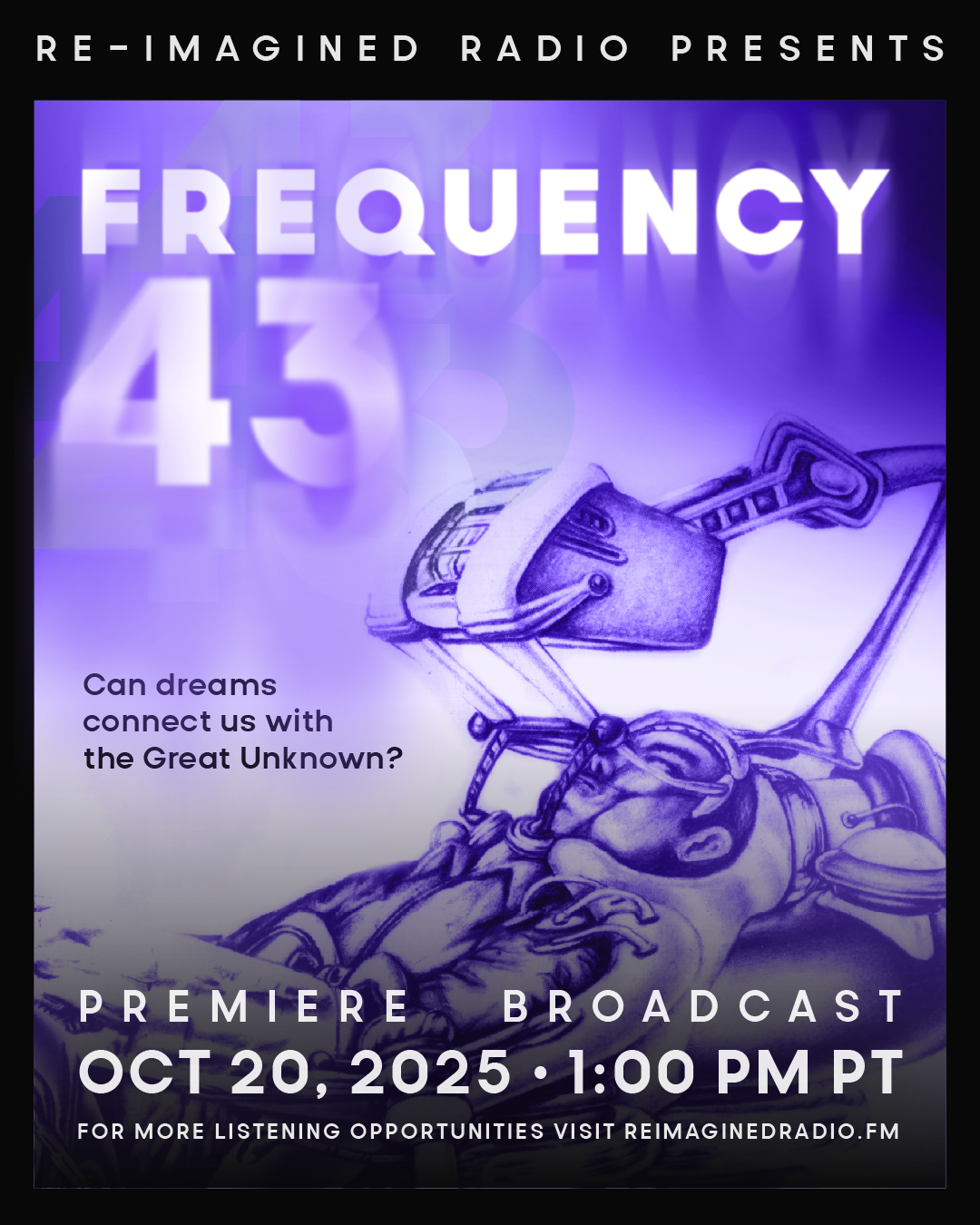
Looking for other graphics to promote this episode?