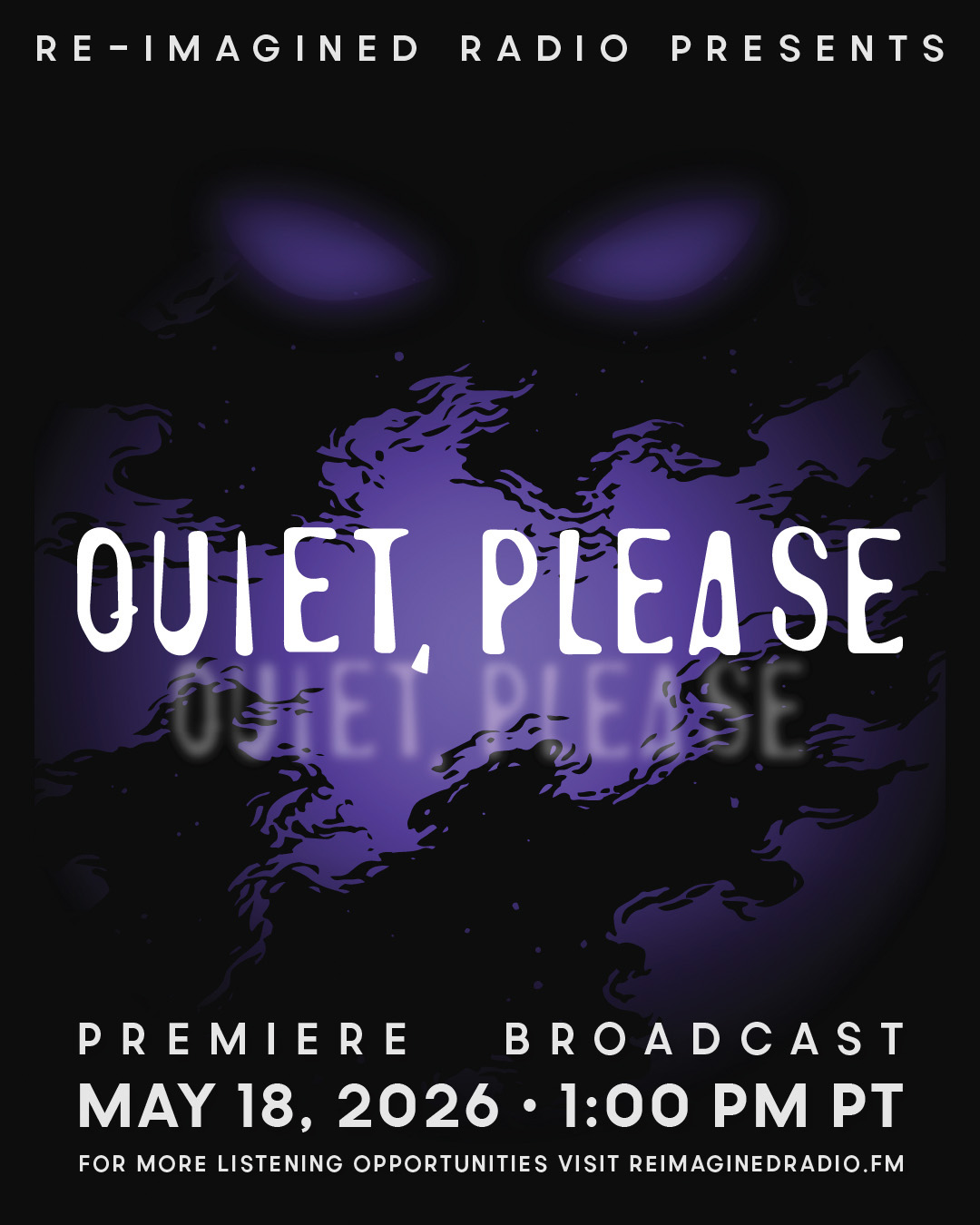
Quiet, Please
RiR #97, Season 14, Episode 05, May 18, 2026
Immersive listening experiences
Re-Imagined Radio curates two landmark episodes from the classic radio drama series, Quiet, Please, often noted as the most creative in history. The two episodes, "Nothing Behind the Door" (the first episode of the series) and "The Thing on the Forble Board" (the most highly regarded of the series) showcase the series' distinctive approach to storytelling, one that relies on quiet narration, psychological tension, and the dramatic power of silence.
Download Links
Download episode to your
device→
Download episode media
kit→
Download episode script

Background
Quick Info
OTR adult drama series
June 8, 1947-September 13, 1948, from WOR, New York, Mutual Broadcasting System (MBS); then until June
25
1949, American Broadcast Corporation (ABC)
30-minute episodes
Total Episodes: 106
Surviving Episodes: 89
Quiet, Please is often noted as radio's most creative radio drama series for its surrealistic yet immersive quality, its depth of characterization, and its challenge to the traditional formula of entertainment.
Episodes of Quiet, Please pushed the boundaries of traditional radio drama by blending the supernatural, fantasy, horror, or suspense. Often listeners were introduced to immersive dream worlds where things were not as they seemed. Few happenings were explained or justified, they just happened. Many events had no reason or logic but were more terrifying than the gory stories and sound effects of Cooper's earlier Lights Out series. Rather than relying on overt sound effects or conventional plot structures, Quiet, Please emphasized mood, character depth, and the unsettling impact of the unknown.
Quiet, Please was written and directed by Wyllis Cooper and dramatically narrated by Ernest Chappell.
Episodes Written For Ernest Chappell
Cooper wrote each episode of Quiet Please for
Ernest Chappell, as narrator and lead actor, described in the credits as "the man who spoke to you."
Chappell, a former newsman and former announcer for The Campbell Playhouse, spoke slowly, calmly, directly to the audience in a quiet, conversational tone, befitting the character he portrayed.
MUCH more information about Cooper's radio and television work available at the A Wyllis Cooper Chronology website.
Chappell's Narrative Style
Listen to this introduction from the "Northern Lights" episode (30 January 1949).
Chappell usually narrated each episode in first person, sometimes in present tense, and often in flashbacks. New characters (usually no more than three) were introduced without dialog, leaving listener to fill in the details. This gave listeners an immersive role in the unfolding drama.
Opening
Each episode began with Chappell intoning the show's title twice, with a long pause between. "Quiet
please . . . Quiet please . . ."
Then a dirge-like organ and piano rendition of the second movement of César Franck's 1899 Symphony in D Minor. Albert Berman performs on the organ. Beyond the opening, Berman uses the organ in innovative, atmospheric, ways, sometimes inserting it into the storylines.
Chappell began his first person narration. Here is a sample, from "Clarissa" (Episode 46, April 19, 1948).
Chappell
No, he was dead before the fire started, I've told you that a dozen times! No, I can't prove it, of
course not. You'll just have to believe me, take my word for it. I can't prove he was dead, you can't
prove he wasn't! Anyway, what difference does it make . . . now? I'm sorry, I, I can't hear you very
well. Yes, well, alright . . .
It was an old black shell of a house. A house that has lived too long. A house where the floors groaned in pain at night and windows shuttered at the gentlest touch of the wind. The door latches suddenly gave up their grip and let the night come snipping into the house to paw at your eyes and wake you to the other silences that lay around you. It was never warm there. In the winter old Heinz kept a fire going in the fireplace in the old sitting room, but the logs were scrawny and the draft was bad. And the flames seemed to grudge us their warmth so that we shivered all through the day. We were glad when night came and we could escape to the meager comfort of the drafty bedrooms. And in the summer, there was a dampness about the place. An unhealthy clamminess drifted from the walls and stirred uneasily among the ancient smells of decay that clung to the place . . .
Compared with other radio drama series, Quiet, Please used fewer sound effects and less dialogue. Following the lead of Chappell's introduction, each episode was frequently punctuated with long, silent pauses, or innovative utilization of organ music. The result was a sparse, understated, often languid tone that demonstrates the narrative power of silence to evoke suspense and horror in a way unmatched by sound effects (Dunning)
The stream of consciousness narrative, written by Cooper and spoken by Chappell, examined a world convincingly similar to that of the listeners, but not quite real, touched in some way by the supernatural, fantasy, horror, or suspense. Frequently, the dream-like, surreal quality of this world, complete with odd or paranormal events, was not explained. Cooper's experiments with stream of consciousness and first person narration were incorporated widely in radio drama years later (Hand).
A sense of indescribable emotion concluded each episode. Franck's Symphony in D Minor faded up, and then down into the background. Chappell provided the credits, and introduced the writer/director, Wyllis Cooper, who provided an often ad-libbed teaser for the next week's episode. Chappell provided a consistent closing. Again, from the episode "Clarissa."
Chappell
I lifted him to the bed. I bent over him, I listened for his heart. There was no sound. Heinz was dead.
Yes, just as I told you before, he died, there in my room, yes. What? Oh, yes. In the little half light,
I found the kerosene lamp and I lit it. I took the key from the floor where he dropped it. No, I found
the room very easily. It was at the far end of the hall. I called, 'Clarissa?... Clarissa?!' ... and
there was no answer. So I unlocked the door. And holding the light above my head I walked over to the
bed. And there, lying on the bed, dressed in a pinafore that might have come out of a ten-year-old
drawing of Alice in Wonderland, clutching a little woolly lamb to her breast . . . there lay a tiny,
old, old woman with long white hair braided into pig tails . . . Clarissa. And I knew why I hadn't heard
the little song for two days. And so when the lamp fell out of my hand and the flames started licking
around the dry-as-dust draperies, and the fragile old oaken boards in the floor, I turned and went out
of the house. (VOICE CRACKS.) For what else was there to do? The house had lived too long, and so had
the father and daughter who dwelt there.
Music: Piano. 2nd Movement form Franck's Symphony in D Minor. Music fades into background.
Announcer (Chappell)
Quiet, Please for tonight was called "Clarissa." The man who spoke to you was Ernest
Chappell. (Reads credits.) And now a word from our writer/ director, Wyllis Cooper.
Cooper
The characters in tonight's Quiet, Please are neither living nor dead. They enjoy neither
of these interesting conditions because they are solely the invention of my own imagination intended to
represent nobody at all. Quiet, Please for next week is called "13 and 8."
Chappell
And so until next week at this same time, I'm quietly yours, Ernest Chappell.
Curated Episodes
"Nothing Behind the Door"
Episode 01, June 8, 1947
Three men rob a Los Angeles, California, bank and plan to hide the money in a strange house atop Mt.
Wilson, at the observatory. The little house is surrounded by a fence. This the men figure will keep
others away, and their loot safe.
It's an intriquing, quiet, perhaps bizarre horror story, and most certainly a classic radio suspense story as the men learn that not every closed door hides a secret. Sometimes nothing at all is to be found.
Interestingly, "The Other Side of the Stars" (episode #99, May 8, 1949) connects back to "Nothing Behind the Door." Both mention the Mt. Wilson Observatory, where Chappell, as the character Ross, sees a "black cloud" in the emptiness of space and for unspecified reasons, is deeply shaken. "The Other Side of the Stars," reveals the "black cloud" is a conscious menace from Alpha Centauri coming to take over Earth.
Connected by shared lore, the two episodes complete thoughts about what exists beyond the stars, or in the empty, black spaces of nothing, that exists between them. Bizarre. Metaphysical. Yes. But powerful.
"The Thing on the Fourble Board"
Episode 60, August 9, 1948
Arguably, this is the most highly regarded episode of the Quiet, Please series, which
itself is often noted as the most creative radio drama series in history. Narrated by Ernest Chappell,
who portrays an oilfield roughneck. He recounts a mysterious subterranean being, part human, part
spider, brought to the surface by the oil drilling operation and hiding high up on the oil derrick.
Richard J. Hand calls "The Thing on the Fourble Board" the finest example of both radio horror and radio
drama as a whole (Unsettling Universe 145-166, A
Wyllis Cooper Chronology).
Resources/Works Cited
A Wyllis Cooper Chronology
Dunning, John. On the Air: The Encyclopedia of Old-Time Radio. Oxford University Press,
1998, pp. 399-401.
Hand, Richard J. "The Unsettling Universe of Wyllis Cooper and Ernest Chappell: Quiet, Please
(1947-1949)." Terror on the Air!: Horror Radio in America, 1931-1952. McFarland, 2006, pp.
145-166.
Single episodes at Internet Archive
Quiet Please website
Quiet, Please Radio Logs at Jerry Haendiges
Vintage Radio Logs website
Plot summaries and credits at Radio Gold Index website
The Definitive Quiet,
Please at Digital Deli Too website
Radio History of Quiet, Please and Ernest
Chappel at Radio Horror Hosts website
Production
Contents
"Nothing Behind the Door"
Quiet, Please
June 8, 1947, episode #01
Martin Lawrence, James Van Dyk, Pat O'Malley, Gene Parazzo (organist), Wyllis Cooper (host, writer,
director), Ernest Chappell ("the man who spoke to you").
"The Thing on the Fourble Board"
Quiet, Please
August 9, 1948, episode #60
Arguably, this is the most highly regarded episode of the Quiet Please series.
Cast
"Nothing Behind the Door"
Ernest Chappell as Russ
"The Thing on the Fourble Board"
Ernest Chappell as Porky
Credits
Written by Wyllis Cooper
Narrated by Ernest Chappell
Significance
The Quiet, Please series was consistently creative. Listeners found familiar elements from one episode to the next. But Cooper's writing and Chappell's stream of consciousness narration, both convincingly believable but with a touch of supernatural and sense of emotion, could always bring a surprise new world.
Listens were asked shut off outside stimuli, and concentrate fully on the dramatic storytelling.
Silence and a slow pace function as a dramatic power, attracting audience attention, or establishing a tone.
For these reasons, Quiet, Please is often cited as a unique radio drama series, one that challenges the traditional formula of entertainment. Characters are presented and portrayed, both in Cooper's writing and Chappell's narration and acting, as members of believable, deep, complex, rich, and immersive worlds.
"Nothing Behind the Door" is the pilot episode for the Quiet, Please series. It sets the tone, mood, and previews the styles of Cooper and Chappell. A later episode, "The Other Side of the Stars" refers back to "Nothing Behind the Door" and connects with several ideas from this first epiode.
"The Thing on the Forble Board"
Episode #60, September 8, 1948
A mysterious, and dangerous, creature is brought up from miles underground by an oil drilling crew in
Texas.
A crew member, Porky, voiced by Chappell, tells the story to a listener who does not realize his part in
the
story. Listen to "The Thing on the Forble Board"
Producer's Notes
Quiet, Please demonstrates how radio can create deeply immersive worlds using minimal sound and maximum imagination. Cooper's writing and Chappell's intimate, stream-of-consciousness narration challenge traditional storytelling and show how pace and tone can become a powerful dramatic force.
"Nothing Behind the Door" slowly introduces a reality where the ordinary becomes quietly unsettling.
"The Thing on the Forble Board" is also unsettling as the story of a mysterious and dangerous creature, recounted by a narrator whose role in the events becomes clear at episode's end.
I hope these two episodes track as a cohesive listening experience, highlighting the creative risks and narrative innovations that have led Quiet, Please to be widely regarded as one of radio's most originally creative drama series.
It's a pleasure to share this storytelling on Re-Imagined Radio.
— John F. Barber
Promotion
Press
Graphics
Looking for other graphics to promote this episode?