Lights Out
RIR #98, Season 14, Episode 06, June 15, 2026
Listen in the dark, if you dare
LIGHTS OUT, EVERYBODY!
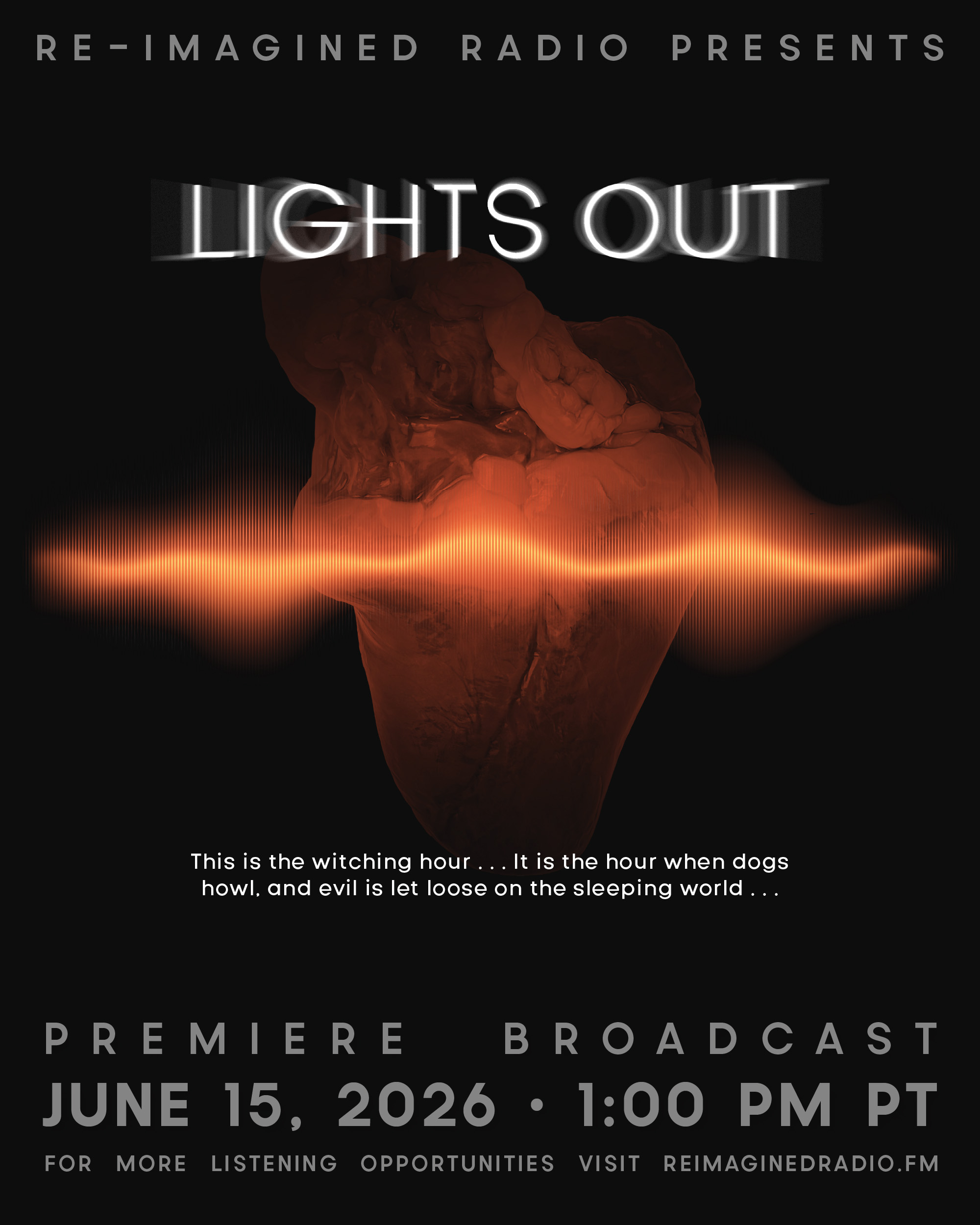
This is the witching hour . . . It is the hour when dogs howl, and evil is let loose on the sleeping
world . . . Want to hear about it? . . . Then turn out your lights!
Download Links
Download episode to your
device→
Download episode media
kit→
Download episode script

Background
Lights Out is one of radio's most influential horror programs. Created and written by Wyllis Cooper (1934-1936) and later expanded by his successor, Arch Oboler (1936-1938), episodes focused on crime, fantasy, horror, and supernatural thrillers. Actors varied with notable appearances by Boris Karloff. Lights Out is known for its unsettling stories, experimental storytelling techniques, and immersive sound design that invites listeners to imagine terror for themselves.
Quick Info
Lights Out is divided into two distinct eras, each distinguished by its two writers and directors, Wyllis Cooper and Arch Oboler.
1934-1939
Total Episodes (Cooper era): 128
Surviving Episodes: 0
1939-1943
Total Episodes (Oboler era): 211
Surviving Episodes: 57
Background > Cooper Era
Wyllis Oswald Cooper (1899-1955) wrote scripts for Lights Out (1934-1936), the NBC series Immortal Dramas, the third and fourth seasons of The Campbell Playhouse (29 November 1940-13 June 1941—formally the The Mercury Theatre on the Air which broadcast its last episode on December 4, 1938)— Quiet, Please (1947-1948), and Whitehall 1212 (1951-1952).
Lights Out, WENR, January 1, 1934-April 10, 1934
Cooper, a staff writer at NBC's Chicago, Illinois, studios, created Lights Out as a
Wednesday night radio, 12 midnight, program focusing on horror and supernatural thrillers.
The first episode was broadcast on WENR, Chicago, a National Broadcast Company (NBC) affiliate, January 1, 1934. Cooper was creator and writer. Ted Sherdemen, who later wrote and produced Latitude Zero, helped.
The early 15-minute episodes were full of vampires, invisible monsters, evil beings, and survivors of an atomic apocalypse. They were imaginative, and often included gruesome, gory sound effects. And, They were very popular with listeners for their frightening imagery.
Episodes included a foreboding opening ...
SFX: Gongs and churchbells, slow tolling of twelve chimes, at the eleventh, a wind comes up
ANNOUNCER: LIGHTS OUT, EVERYBODY!
This is the witching hour . . . It is the hour when dogs howl, and evil is let loose on the sleeping
world . . . Want to hear about it? . . . Then turn out your lights!
No scripts or recordings of these early episodes are known to survive. Episodes were syndicated by WENR.
Cancelled in 1935
In January 1935, Lights Out was cancelled to allow Cooper to catch up with other work and
assignments. The Capital Times, of Madison, Wisconsin, reports Lights Out
cancelled for "a
few weeks" in 1935, but "had to be brought back because of the clamor set up by its hardy, ghost story
loving audience ("Listeners Win").
NBC, April 17, 1935-August 17, 1939
National Broadcasting Company, April 17, 1935-August 17, 1939
Lights Out goes national. On April 17, 1935, NBC reintroduced Lights Out with
a national broadcast schedule. Episodes
were 30-minutes in length, and featured tamer fantasy and ghost stories, with less emphasis on gore.
Cooper continued as creator and writer. This run ended on August 17, 1939.
Cooper left in 1936
Cooper left Lights Out August 16, 1936, to work in Hollywood, writing motion picture
scripts. He left a
legacy of one hundred twenty eight episodes of Lights Out. Apparently none survive. Titles
are unknown. Arch Oboler took over writing and directing the series.
Background > Oboler era, 1936-1939
Cooper passed the writing and directing duties for Lights Out to Arch Oboler in June 1936. Oboler was a 26-year old radio writer in Chicago, known for his work with Rudy Vallee and Grand Hotel.
Although Oboler credited Cooper as the first person to understand that radio drama is an art form, he established himself as a master as well. Moving in a highly creative, surreal direction, writing outstanding horror stories, often punctuated by horrific sound effects, Oboler turned Lights Out into a nationally renowned series and fixed its focus on the macabre (Lau).
He had 128 episodes from Wyllis Cooper with which to work. He recycled many, often with changed titles and/or storylines.
One episode is said to survive from this period, "Nobody Died" (December 09, 1936), written and hosted by Arch Oboler. Stars Myron McCormick and Anne Seymour.
Canceled in June 1937(?)
Lights Out cancelled, but returns in September, after a successful letter writing campaign
by listeners.
"Scores of petitions, bearing from five to 50 signatures, and hundreds of letters from individual listeners, have ressurrected the horror drama program Lights Out for the second time in its three year history. After an absence of two months the program will return over WIBA at 11:30 Wednesday night, and will be heard weekly thereafter. ... [L]isteners proved loyal as ever, and vehemently demanded its return, with the result that it is now being reinstated" ("Listeners Win").
Boris Karloff, Spring 1938
Boris
Karloff appeared in seven episodes of Lights
Out.
"The Dream," Episode 83, March 23, 1938
"Valse Trieste," Episode 84, March 30, 1938
"Cat Wife," Episode 85, April 6, 1938
"Three Matches," Episode 86, April 13, 1938
"Night on the Mountain," Episode 87, April 20, 1938
"Death Robbery," Episode 2, Ever-Sharp series, July 16, 1947
"The Ring," Episode 4, Ever-Sharp series, July 30, 1947
Oboler quits, 1939
Two years after taking over Lights Out, Oboler, now famous and in demand, quits to pursue
his famous plays series, Arch Oboler's Plays (1939), retitled as Everyman's
Theater, which lasted until 1941, and
Plays for Americans, World War II propaganda, each half-hour story taught a lesson about
wartime responsibility.
Lights Out continues, with scripting and directing done by staffers in the NBC Chicago studios.
Cancelled in 1939
The series is cancelled again, following the August 16, 1939 episode, "The Day of the Four."
1942 Revival
Oboler revived Lights Out on October 6, 1942, revising previous scripts and acting as
the show's host. Fifty two 30-minute episodes were broadcast from New York every Tuesday night on the
National Broadcasting System (NBC), until September 28, 1943. Forty three survive.
Episodes of this series began with a lighter gong ... with each chime the announcer spoke one word ...
SFX: Gong
ANNOUNCER: It ... is ... later ... than ... you ... think!
1945 Revival
Oboler organized a seven-episode revival, July 14-September 1, 1945. The series, broadcast on NBC, was
called
Fantasies from Lights Out. Episodes were based
on revisions of Cooper's original 1930s scripts. Titles unknown.
1946 Revival
Oboler organizes an eight-episode revival, July 6-August 24, 1946, again using mostly revised
Cooper scripts.
Fifteen episodes were produced for these two revivals. Eight survive.
1947 Revival
A third revival was scheduled for summer 1947, sponsored by Ever-Sharp, broadcast by the Mutual
Broadcasting System
(MBS). Wyllis Cooper, mostly forgotten as the creator of the series, returned, as writer, along with
Paul Pierce.
The premiere, "Death Robbery," July 16, 1947, starred Boris Karloff as a scientist who brings his wife (played by Lurene Tuttle) back from the dead. Unfortunately, she's become a gibbering homicidal maniac.
This episode is one of the few surviving Cooper episodes and illustrates the explicit horror of the original series (Lights Out. Digital Deli).
The revised series was cancelled by its sponsor within a month of its premiere broadcast. Five episodes were produced. Two survive, "Death Robbery" and "The Ring," episode 4, July 30, 1947. Karloff appeared in the first half only.
Moves to television, 1949
Lights Out moved to television in 1949, and ran until 1952, without achieving the
popularity of the original radio show.
Returns to radio, 1970-1973
The show returned a final time, 1970-1973, as The Devil and Mr. O, with Oboler as narrator.
Episodes were based on Oboler's scripts from 1942-1943.
Because more episodes and scripts survive from the Oboler era, they tend to represent Lights Out.
Works Cited and Resources
A Wyllis Cooper Chronology
Dunning, John. On the Air: The Ultimate Encyclopedia of Old-Time Radio 1925-1976. Prentice-Hall, 1976, pp. 399-401.
Dunning, John. Tune In Yesterday: The Ultimate Encyclopedia of Old-Time Radio, 1925-1976. Prentice-Hall, 1976, pp. 362-363.
Lights Out. Digital Deli.
Lau, Andrew K. Drop Dead! An Exercise In Horror! No Recess!. Apr. 12, 2017.
Listeners Win, "Lights Out" Is Back on WIBA. The Capital Times. Sep. 26, 1937, p. 21.
Production
Contents
"The Man in the Middle"
Episode 07, 25 August 1945
This episode was written by Wyllis Cooper. Titled "After Five O'Clock," it was first broadcast March 6,
1935.
The story follows the stream of consciousness thoughts of John Phillips, a businessman having an affair with his secretary. She is becoming more infatuated. Her brother is threatening a good thrashing. And his is wife coming to the office. John's guilt and suppressed feelings lead him to a desperate solution.
It's an excellent example of Cooper's experiments with stream of consciousness and internal monologue.
Arch Oboler retitled the Cooper script as "Man in the Middle," and featured it in one of his Lights Out revivals, August 25, 1945. We sample from this episode.
"Chicken Heart"
Three iterations are known
Episode 40, March 10, 1937
Episode 80, February 23, 1938, Script
available here
Episode 08, November 24, 1942
While the story and script survive, no recordings are known. So, we have no idea of how these broadcasts sounded.
Four recreations are also known
1962, Oboler recorded a 7 minute 46 seconds version for his 36-minute record album, Drop Dead! An
Exercise in Horror (Capital ST1763). Seven abridged Ob0ler tales, each with introductions,
plus, an overall introduction where Oboler described the goal as "recreating the madness and the mystery
on
the wide screen of your own mind."
Side 1
"I'm Hungry," stars Peter Lorre
"Taking Papa Home"
"The Dark"
Side 2
"A Day at the Dentist's"
"Posse"
"Chicken Heart"
"Laughing Man"
Cast
Edgar Barrier, Bea Benadaret, Larry Dobkin, Sam Edwards, Virginia Gregg, Jerry Hausner, Jack Johnstone,
Jack Kruschen, Forrest Lewis, Junius Matthews, Ralph Moody, Mercedes McCambridge, Harold Peary, Barney
Philips, Olan Soule, and Chet Straton.
Learn more about Oboler's Drop Dead! record album.
Scripts for all seven available here.
1999, October 31, Gotham Radio Players, using the 1937 script(?), offered a performance on WBAI, New York City (Haendiges).
2005, the Post-Meridian Radio Players offered a recreation as a fundraiser.
2019, October 30, Re-Imagined Radio and Metropolitan Performing Arts offered a live recreation based on the 1938 script.
Oboler often insisted on specific, gruesome sounds for his episodes of Lights Out! Noteable examples on this record album include "A Day at the Dentist's" and "The Dark" where a strange fog turns humans inside out. In "Chicken Heart," the sound of a beating chicken heart, the product of a flawed scientific experiment, threatening the world with its uncontrolled growth, provides the background.
Written and introduced by Arch Oboler, "Chicken Heart" was inspired by research of French surgeon Dr. Alexis Carrel, 1912 to 1946 at at the Rockefeller Institute in New York City. Carrel successfuflly kept samples of chicken embryo heart tissue alive and dividing, thus promoting the idea of intrinsic cellular immortality. Carrel's work was reported in scientific and medical reports, popular magazines, and newspapers, like "Isolated Tissue Holds Life 12 Years in Test," (New York Tribune, January 6, 1924). Oboler took the idea of "science-forced immortality" to an extreme by imagining what would happen if that heart tissue never stopped growing and consumed the world. "Chicken Heart" is a bit of American pop culture history that just won't die.
"The State Executioner"
Episode 41, 17 March 1937
First broadcast 17 March 1937 and again August 17, 1943 (Episode 46). King George III's state
executioner
revels in putting criminals to their death at the gallows. When he withholds evidence about the
innocence of one victim his life quickly changes.
Cast
Episode cast members were often uncredited. Sidney Ellstrom, Art Jacobson, Don Briggs, Bernardine Flynn, Betty Lou Gerson, and Betty Winkler all participated regularly in episodes of the Wyllis Cooper era.
Harold Peary, Willard Waterman, Mercedes McCambridge, Arthur Peterson, Macdonald Carey appeared in multiple episodes.
Boris Karloff appeared in seven episodes.
Royal Dano, Helene Dumas, Dolores Badaloni, Jack Hartley, James van Dyke, Arnold Moss, and Donald Hammer also had roles.
Credits
Written by Wyllis Cooper and Arch Oboler. Both also directed many episodes.
The announcer during the Oboler era was Frank Martin.
Oboler's favorite actors included Lou Merrill, Bea Benaderet (who later voiced "Betty Rubble" on The Flintstones), Joseph Kearns, Mercedes McCambridge, and Hans Conried.
Significance
Providing immersive listening experiences, described by Oboler in his introduction to his record album,
Drop Dead! An Exercise in Horror, "recreating the madness and the mystery on the wide
screen of your own mind."
Expecting listeners to shut off
distracting stimuli (like the lights)
Expecting listeners to concentrate on the story. (Listen in the dark, if you dare.)
Works Cited and Resources
Columbia
Workshop Man with a Gun/Fall of Jerico. Old Time Radio Downloads
Columbia Workshop Program Overview. [Scribd]
Columbia Workshop. Radio Gold Index
Producer's Notes
This is the final of a three-part tribute to the radio storytelling of Wyllis Cooper. It's not nearly enough to cover Cooper's body of work. But it does provide opportunity to explore three great radio series he created, wrote, and sometimes directed.
We began with Whitehall 1212, part of our The Black Museum episode, offering looks and listens of four different radio series, each focused on a collection of ordinary objects, each touched by crime or murder. Called "The Black Museum," this collection is housed at Scotland Yard, headquarters for London's Metropolitan Police.
Each episode of Whitehall 1212 followed the police perspective as they worked to solve the crime associated with objects housed in The Black Museum. We sampled the first episode, "Tan Shoe, Left Foot."
We followed with Quiet, Please. Written by Wyllis Cooper, narrated and starring Ernest Chappell, this series is often noted as the most creative in the crowded field of thriller mysteries. We curated two episodes, "Nothing Behind the Door" (the first episode of the series) and "The Thing on the Fourble Board" (among the most notable of the series). Together, they showcase the series' quiet, slow, suspenseful, and engaging storytelling.
And this episode focuses on Lights Out. Created by Cooper, who contributed one hundred and twenty eight original episodes before leaving the series after two years, Lights Out is more closely associated with Cooper's, Arch Oboler.
Oboler quickly made Lights Out his own. His episode "Chicken Heart," for example, rivals the recognition of "The War of the Worlds" by Orson Welles.
Oboler reworked, retitled, and reused many earlier episodes written by Cooper. "The Man in the Middle" is a good example. Written originally by Cooper, titled "After Five O'Clock," it was first broadcast March 6, 1935.
Cooper and Oboler together produced three hundred thirty nine episodes of Lights Out. Fifty seven survive from the Oboler era. None from the Cooper era. Fortunately, Oboler reused many of Cooper's scipts, allowing us some insight into Cooper's radio storytelling.
Lights Out transformed radio storytelling by asking audiences to actively participate with their imaginations. They were encouraged to turn off distractions (like lights), sit in the dark, and fully concentrate on the stories unfolding in their minds. That immersive approach helped establish techniques still used in radio drama and audio storytelling today.
The intent of this episode is to present the stories and storytelling techniques of a pioneering radio
writer, Wyllis Cooper, who
wrote some of the most memorable stories to which you may have never listened. Cooper's stories are
worthy of consideration for their legacy storytelling power. Thank you for listening.
— John F. Barber
Promotion
Press
Graphics
Looking for other graphics to promote this episode?