The Immortal Sherlock Holmes
RiR #33, Season 09, Episode 04, May 10, 2021
The detective's detective
Re-Imagined Radio presents Metropolitan Performing Arts and other community volunteers performing The Immortal Sherlock Holmes. Adapted from a stage play by William Gillette, itself adapted from one by Arthur Conan Doyle, we celebrate the greatest detective who never lived, yet will always be immortal, the detective's detective, Sherlock Holmes.
Download Links
Download episode to your
device→
Download episode media
kit→
Download episode script
The script for "The Immortal Sherlock Holmes" is being digitized. Available soon. Thank you for your
patience.
Background
Literary History
Fictional detectives, stories about their exploits, and the detective fiction genre in general are very popular and have a long history.
Some scholars suggest ancient religious documents include questioning and cross-examination, puzzles, mysteries surrounding murders, a closed circle of suspects, and the gradual uncovering of the truth, all elements that might be seen as the beginning of detective fiction.
The Arabic literary work One Thousand and One Nights contains the oldest known example of a detective story, "The Three Apples," which creates suspense from its multiple plot twists. Two other stories in this collection, "The Merchant and the Thief" and "Ali Khwaja," introduce the earliest fictional detectives who uncover clues and present evidence to catch or convict criminals.
We can point to "The Murders in the Rue Morgue" by Edgar Allan Poe as introducing the detective fiction genre to the English-speaking world in 1841. Poe's fictional detective C. Auguste Dupin, was both eccentric and brilliant. When Dupin appeared in literature the word "detective" was not known in the English language, but his name was derived from the English words "dupe" and "deception." Two other stories by Poe, "The Mystery of Marie Roget" (1842) and "The Purloined Letter" (1844) provided further tales of detective Dupin.
Wilkie Collins, a protege of Charles Dickens, is said to have invented the modern English detective novel with publication of The Moonstone in 1868. Collins' novel introduced now familiar detective narrative elements like the red herring, the inside job, the skilled, professional investigator, the large number of suspects, the reconstruction of a crime, and the final plot twist.
Also in 1868, Monsieur Lecoq, a novel by Emile Gaboriau, established the detective fiction genre in France. Lecoq was adept at disguise, which became a key characteristic for other fictional detectives.
Appearance of Sherlock Holmes
The most famous of all fictional detectives is Sherlock Holmes, consulting detective. Stories about his exploits are considered some of the finest of the detective fiction genre.
Sherlock Holmes first appeared in "A Study in Scarlett," a story by Scottish physican and author Arthur Conan Doyle published in 1887. A series of stories, beginning with "A Scandal in Bohemia," appeared in The Strand Magazine in 1891 and continued until 1927. Doyle based his character Holmes on Poe's Dupin, Gaboriau's Lecoq, and Dr. Joseph Bell for whom Doyle had worked as a clerk while a medical student at the Edinburgh Royal Infirmary. From Bell, Doyle drew Sherlock Holmes' acute observation, deductive reasoning, and forensic skills. LEARN more about this backstory.
First Radio Appearance
The first radio adaptation of a Holmes story by Conan Doyle, "The Sign of the Four," was broadcast on WGY radio, Schenectady, New York, 9 November 1922, as the twelfth episode of the weekly (Friday nights) WGY Players series featuring actors from a Troy, New York community theater group calling themselves The Masque. Edward H. Smith, director of the group, read the part of Sherlock Holmes.
WGY Players is thought to be America's first weekly radio drama series. Announcing the
upcoming performance of "The Sign of the Four," the Indianapolis Star said,
"One of the features of the program for the week of Nov. 6 from WGY in Schenectady, N.Y., will be the
production of 'The Sign of the Four,' a Sherlock Holmes play from the pen of Sir Arthur Conan Doyle. The
WGY Players will be cast in the play with Edward H. Smith in the part of the famous detective of
fiction, and F. H. Oliver as Dr. Watson. Musical numbers will be played between the episodes or acts by
the WGY orchestra."
— Indianapolis Star. 6 November 1922.
The Hartford Courant listed the cast of the 7:45 PM performance as
Sherlock Holmes (Edward H. Smith)
Dr. John Watson (F. H. Oliver)
Mary Morstan (Viola Karwowska)
Major Sholto (James S. B. Mullarkey)
Jonathan Small (Frank Finch)
Mrs. Mordecai Smith (Ida Myreck)
Wiggins (Henry Miller).
— Hartford Courant. "Radio Radiations: WGY, Schenectady," November 9, 1922, p. 14.
Poughkeepsie Eagle-News, "In the Air Today," November 9, 1928, Case Six.
WGY (AM). WikiZer. https://www.wikizero.com/en/WGY_(AM)#cite_note-21
R.R. King. The Adventure of Sherlock Holmes and the
1920s Radio Drama Radio Recall. June 2008.
The same night, WLW radio, in Cincinnati, Ohio, offered a one-act play, "A Fan and Two Candlesticks" by Mary MacMillan. The next week was the balcony scene from Romeo and Juliet, and the following week was "Matinata" by Lawrence Langner. On 3 April, WLW broadcast When Love Wakens by station manager Fred Smith, possibly the first play written for American radio (*** Lichty. The Nation's Station, ***, pp. 120-123, qtd. in Barnouw, Erk. A Tower in Babel: A History of Broadcasting in the United States to 1933, New York: Oxford University Press, 1966, p. 238.)
In 1929, National Broadcasting System (NBC) broadcast an anthology drama series called Retold
Tales. According to listings published in The New York Times, Hartford
Courant, and other newspapers, Conan Doyle's "The Sign of the Four" was to be offered in
three parts: 30 May, 6 June, and 13 June. "A Study in Scarlet," another Conan Doyle story was offered in
four parts: 20 June, 27 June, 4 July, and 14 July.
R.R. King. The Adventure of Sherlock Holmes and the
1920s Radio Drama. Radio Recall. June 2008.
Edith Meiser Introduces Holmes to American Radio Audiences
Edith Meiser (1898-1993), Broadway actress, novelist, writer of mysteries and radio dramas, introduced Sherlock Holmes, the detective's detective, to American radio audiences and established him as a permanent part of our lexicon, popular culture, and mythology. She began by persuading National Broadcasting Corporation (NBC) executives to offer a series of radio dramas about Sherlock Holmes that she would adopt from Conan Doyle's original stories. NBC executvies agreed, if she found a sponsor. Meiser found George Washington, creator of the first instant coffee, and also a Holmes fan.
The first episode was broadcast 20 October 1930, and is often considered the first appearance of a Sherlock Holmes radio drama in America. But, as noted above, this may not be the case. Nevertheless, success was immediate and the series was broadcast on NBC until May 1935, and then moved to Mutual Broadcasting System (MBS).
The radio series ran four seasons, 1930-1936, and was called Sherlock Holmes, Sherlock Holmes Stories, and The Adventures of Sherlock Holmes in different radio listings. Meiser adapted or wrote all 179 episodes, and adapted 59 of the 60 Sherlock Holmes stories by Arthur Conan Doyle.
Season 1
National Broadcasting Corporation (NBC)
October 20, 1930 - June 15, 1931, Weekly
Radio adaptations by Edith Meier of original Sherlock Holmes stories by Arthur Conan Doyle.
Sponsored by George Washington Coffee
30 minute episodes
35 episodes produced, 0 survive
Episodes were broadcast live. None were recorded.
Cast
Sherlock Holmes = William Gillette (Episode #1), Clive Brook (Episode #2 and #3), Richard Gordon (all
remaining episodes)
Leigh Lovel as Dr. John Watson
Joseph Bell as Announcer
Credits
All episodes adapted by Edith Meiser
William Gillette as Sherlock Holmes
The first episode was Meiser's adaptation of "The Adventure of the Speckled Band," 20 October 1930, starring William Gillette as Holmes. Gillette created the first stage adaptation of the writings of Conan Doyle in 1899, and the first American film, both under the title Sherlock Holmes.
Gillette, then 82 years old, also led a 50-minute performance (9:00-10:00 pm) of his own Sherlock Holmes for Lux Radio Theatre, broadcast by WABC in New York, 18 November 1935 (episode #55, no surviving recording known).
Lux Radio Theatre was, and still is, noted as a classic radio series, offering radio adaptations of plays and movies, often using the original stars reading their parts. The script was written by Edith Meiser. The cast included Gillette as Holmes, Betty Hanna as Alice Faulkner, Reginald Mason as Dr. Watson, and Charles Bryant as Professor Moriarty. Gillette's performance marked the sixtieth anniversary of his first appearance on stage, the thirty-sixth year since he had first played Sherlock Holmes, and his last appearance before a radio microphone (Los Angeles Times. "Famed Star Due on Air," November 18, 1935, p. A14.; see also Zecher, Henry. William Gillette, America's Sherlock Holmes, Xlibris, 2011, pp. 555-557.).
At the end of the first season, radio editors across the country voted The Adventures of Sherlock Holmes the best radio program in the country (Boström, Mattias. From Holmes to Sherlock. 2018, Mysterious Press, p. 196-199).
Season 2
National Broadcasting Corporation (NBC)
September 17, 1931 - June 23, 1932, Weekly
Radio adaptations by Edith Meier of original Sherlock Holmes stories by Arthur Conan Doyle, and original
stories by Meiser (Eyles, Allen. Sherlock Holmes: A Centenary Celebration. Harper &
Row, 1986, p. 133).
Sponsored by George Washington Coffee
30 minute episodes
33 episodes produced, 0 survive
Episodes were broadcast live. None were recorded.
Cast
Richard Gordon as Sherlock Holmes
Leigh Lovel as Dr. John Watson
Joseph Bell as Announcer
Credits
All episodes adapted or written by Edith Meiser
Season 3
National Broadcasting Corporation (NBC)
October 5, 1932 - May 31, 1933, Weekly
Radio adaptations by Edith Meiser of original Sherlock Holmes stories by Arthur Conan Doyle, and
original stories by Meiser (Eyles, Allen. Sherlock Holmes: A Centenary Celebration. Harper
& Row, 1986, p. 81).
Sponsored by George Washington Coffee
30 minute episodes
34 episodes produced, 0 survive
Episodes were broadcast live. None were recorded.
Cast
Richard Gordon as Sherlock Holmes
Leigh Lovel as Dr. John Watson
Joseph Bell as Announcer
Credits
All episodes adapted or written by Edith Meiser
Season 4
National Broadcasting Corporation (NBC)
November 11, 1934 - May 26, 1935, Weekly
Mostly original stories by Meiser (Eyles, Allen. Sherlock Holmes: A Centenary Celebration.
Harper & Row, 1986, p. 81).
Sponsored by George Washington Coffee
30 minute episodes
29 episodes produced, allegedly 1 survives
Episodes were broadcast live. None were recorded.
Cast
Louis Hector as Sherlock Holmes
Leigh Lovel as Dr. John Watson =
Joseph Bell as Announcer
Credits
All episodes adapted or written by Edith Meiser
Season 5
Mutual Broadcasting System (MBS)
February 1, 1936 - December 24, 1936, Weekly
Radio adaptations by Edith Meiser of original Sherlock Holmes stories by Arthur Conan Doyle. All used in
previous seasons.
Sponsored by Household Finance
30 minute episodes
48 episodes produced, 4 possibly survive
Cast
Louis Hector as Sherlock Holmes
Leigh Lovel as Dr. John Watson
Joseph Bell as Announcer
Credits
All episodes adapted or written by Edith Meiser
The New Adventures of Sherlock Holmes: Rathbone-Bruce Era
In 1939, Basil Rathbone and Nigel Bruce began a series of Hollywood motion pictures based on Conan
Doyle's stories. Rathbone played Holmes. Bruce was Watson. These films were made through 1946.
NBC contracted Rathbone and Bruce to bring their characters to The New Adventures of Sherlock Holmes, the most notable of several radio revivals for the famous detective. The New Adventures of Sherlock Holmes ran for 220 episodes, 2 October 1939-7 May 1943, when the series was taken by Mutual Broadcasting System (MBS), where it remained until its final episode, 27 May 1946.
Meiser wrote all the episodes until 1943 when she left the series. Holmes uses his amazing powers of deduction to solve mysteries, murders, and other crimes. Dr. Watson chronicles Holmes exploits, and adds his own formidable intelligence to each case. Most all stories are narrated by Watson. Two are narrated by Holmes himself ("The Adventure of the Blanched Soldier" and "The Adventure of the Lion's Mane").
Episodes began with series spokesperson, Knox Manning, Harry Bartell, or Joseph Bell, visiting Watson, retired and living in California. Sitting by the fire, enjoying a glass of Petri wine (one of the series sponsors), Watson recalled an adventure with Holmes. Other characters sometimes contributed to the narrative, and Watson summarized or added tidbits at the end. He also talked about his dogs.
With episodes adapted from the original stories by Sir Arthur Conan Doyle, and starring Basil Rathbone and Nigel Bruce, the series is considered a high point of radio drama and the most notable radio series about the famous detective.
Cast
Recurring cast included
Basil Rathbone as Sherlock Holmes
Nigel Bruce as Dr. John Watson
Luis Hector as Professor James Moriarty
Knox Manning, Harry Bartell as Announcer
Credits
Harold Kemp and Russell Seeds as Producer
Edith Meiser, Dennis Green, Bruce Taylor [pen name for Leslie Charteris], Anthony Boucher as Writers
Lou Coslowe, Dean Fosler as Music Composer and Conductor
Supporting
cast information here.
Episodes
Total Episodes: 220
Surviving Episodes: 62 (7 incomplete)
Circulating Episodes: 55 episodes circulate (53 complete; 2 incomplete)
Inventory of Episodes
Exemplary Episodes
The first three known surviving episodes, and the last three surviving episodes.
"The Bruce Partington Plans"
Episode 6, 6 November 1939
The first episode with Basil Rathbone. The body of a worker at the Woolwich arsenal, found by the side
of a railroad track, provides the clue to missing secret submarine plans.
Repeated as episode 93 10 September 1943
"The Case of the Retired Coulorman"
Episode 26, 25 March 1940, available
The story of a miser's wife and money that has mysteriously disappeared.
Repeated as episode 92 3 September 1943
"The Copper Beeches"
Episode 28, 6 October 1940, available
Holmes solves the strange mystery of the governess paid double wages to work for a couple in a rural
setting. However, her suspicions are aroused when she is forced to cut off her beautiful hair. Why?
Repeated as episode 75, 7 May 1943
"The Strange Adventure of the Uneasy Easy Chair"
Episode 218, 13 May 1946, available
Holmes works on a murder in which the murder weapon is a diabolical chair. Inspector Lestrade has the
last laugh! Based on "The Musgrave Ritual" by Arthur Conan Doyle.
"The Haunting of Sherlock Holmes"
Episode 219, 20 May 1946, available
Holmes and Watson undertake the defense of a beautiful singer accused of espionage against the Balkan
country of Grosnia. This is Holmes' first ghostly client! Joseph Kearnes plays Dr. Watson. Based on "The
Sussex Vampire" by Arthur Conan Doyle.
"The Singular Affair of the Baconian Cipher"
Episode 220, 27 May 1946, available
The final show of the season. The final episode with Basil Rathbone. A notice in an "agony column" leads
Holmes to a crippled Shakespearean scholar and a case of murder. Based on "The Sign of Four" by Arthur
Conan Doyle. Gale Gordon as "Gregory Hood" visits the program after the story to promote The
Casebook of Gregory Hood which replaces The New Adventures of Sherlock Holmes
next week.
Legacy of Sherlock Holmes
Sherlock Holmes was not the first fictional detective, but he is perhaps the best known. Doyle was prolific, authoring four novels and fifty-six short stories about his fictional detective. This body of work are considered milestones in the literary genre of crime fiction.
The world-wide popularity and impact of Sherlock Holmes has profound effect on mystery and detective writing and popular culture with thousands of stories written by authors other than Conan Doyle being turned into films, television programs, stage and radio plays, video games, and other media for more than 100 years. Examples include Agatha Christie's fictional detective Hercule Poirot, as well as antihero gentlemen thiefs like A.J. Raffles and Arsene Lupin. Film adaptations starring Robert Downey, Jr. and Jude Law, the BBC One TV series Sherlock starring Benedict Cumberbatch, and Elementary, set in contemporary New York starring Johnny Miller and Lucy Liu as a female Dr. Watson are other examples. In all, Holmes' popularity and his fame as a detective makes it easy for members of literary and fan societies to believe him real.
Arthur Conan Doyle grew tired of Sherlock Holmes and wanted to shift his writing focus to other stories. So, he killed off Holmes in "The Final Problem," first published in 1893. Holmesian fans would have nothing to do with this and Doyle was forced to bring his fictional detective back from the dead in The Hound of the Baskervilles, a novel published in The Strand Magazine between 1901 and 1902. Cleverly, Doyle set the time frame before Holmes' death, and so his character continued to live.
Sir Arthur Conan Doyle's stage play Sherlock Holmes, 1897
In 1897, Doyle finished a script for a stage play entitled Sherlock Holmes. Doyle's literary agent, A.P. Wyatt, mailed the script to Charles Froham, in New York. Froham requested literary rights for dramatic use of the Holmes character and introduced Doyle to American playwright and actor William Hooker Gillette (1853-1937), suggesting Gillette would be perfect to rewrite Doyle's original stage play for American audiences who wanted melodramatic stories about stoic, strong heroes keeping their wits about them in both dangerous and romantic situations. Doyle agreed to allow Gillette to adapt his play any way he liked, with one stipulation. Wishing Sherlock Holmes on stage to model his demeanor in print, Doyle insisted that there would be no romance.
William Gillette's Sherlock Holmes, 1898
Gillette rewrote Doyle's original play, combining elements from Doyle's stories "A Study in Scarlet" (1887), "A Scandal in Bohemia" (1891), "The Boscombe Valley Mystery" (1891), and "The Adventure of the Final Problem" (1893) and retaining only five characters, Holmes, Watson, Professor Moriarty, Mrs. Hudson, and a young boy, whom Gillette named Billy. Gillete introduced several new elements, like the Stepney Gas Chamber, which became the melodrama's most exciting scene.
And then there was the romance. Gillette communicated often with Doyle as he wrote his stage play. At one point he asked if Holmes might marry. The reason is unclear, but Doyle agreed to set aside his stipulation of no romance. So, Gillette, with Doyle's permission, did the one thing Doyle never did: he had Sherlock Holmes fall in love. Doyle's story "A Scandal in Bohemia" introduced Irene Adler, a talented young opera singer, who began a brief affair with the prince and future King of Bohemia, in Warsaw, Poland. The prince sent Adler compromising letters and a photograph of them together. The prince returned to Prague and prepared to become King. Adler moved to London, with the letters and the photograph. The future King of Bohemia hired Holmes to acquire the compromising materials. Adler outsmarted Holmes and escaped, leaving behind a note and a photograph of herself for Holmes to find. He did, and ever after admired Adler for her wit and cunning. Interestingly, in the story "The Five Orange Pips" Holmes comments to a client that he has been defeated on only a few occasions and only once by a woman. Perhaps this is a reference to Adler?
Gillette reprises this incident in his play, and introduces Miss Alice Faulkner, sister of Irene Adler, recently deceased. Faulkner has the package of papers, letters, and photographs and a desire for revenge against the prince of Bohemia. Holmes recognizes Miss Faulkner as Adler's sister. They embrace and fall in love. Doyle was uncomfortable with the romance, but he allowed it to proceed. Gillette and Doyle shared equal credits as the authors of Sherlock Holmes, or The Strange Case of Miss Faulkner.
Gillette's Contributions
Gillette's four-act play is noted for its technical achievements. Hidden elevators, trap doors, secret passageways, the famous fog of London, and special lighting effects, Gillette used them all to the best effect(s) possible. Gillette, in the leading role as Sherlock Holmes, is also noted for bringing the fictional character to life through his careful and conscientious appearance, economy of movement, and voice. Portrayed by Gillette, Holmes was quietly in command, graceful under pressure, even while struggling with his own boredom with life.
Gillette also introduced several props now considered Sherlock Holmes icons, including his curved pipe (easier to hold in the mouth while speaking and did not obstruct the audience's view of the actor's mouth), a splendid dressing gown, the violin, the magnifying glass, the Scottish deerstalker cap, and the phrase "Oh, this is elementary my dear fellow," later changed by the popular press to "Elementary, my dear Watson." Interesting trivia fact: Sir Arthur Conan Doyle never used the phrase "elementary, my dear fellow" in his novels or stories about Holmes.
First Performance
Gillette gave a copyright performance of his play on 12 June 1899, at the Duke of York's Theatre in London, to establish his right to perform his play and protect its contents from being used by others. He returned to America where his play was first seen at the Star Theatre in Buffalo, New York, 23 October 1899. The cast included Gillette as Holmes, Bruce McRae as Dr. Watson, George Wessells as Professor Moriarity, Henry McArdle as Billy the pageboy, Katherine Florence as Alice Faulkner, and Judith Berolde as Madge Larrabee.
Further performances were offered in Rochester and Syracuse, New York, and Scranton and Wilkes-Barre, Pennsylvania. All were well received. Sherlock Holmes then moved to New York, where it opened 6 November 1899, at the Garrick Theatre, and ran for 236 performances, closing 16 June 1900.
At the turn of the century, America was just getting to know Sherlock Holmes. Gillette's melodrama, at three hours in length, gave audiences ample opportunities to steep themselves in the exploits, threats of death, thrilling escapes, and associations with all manner of criminals that made Holmes such a fascinating character.
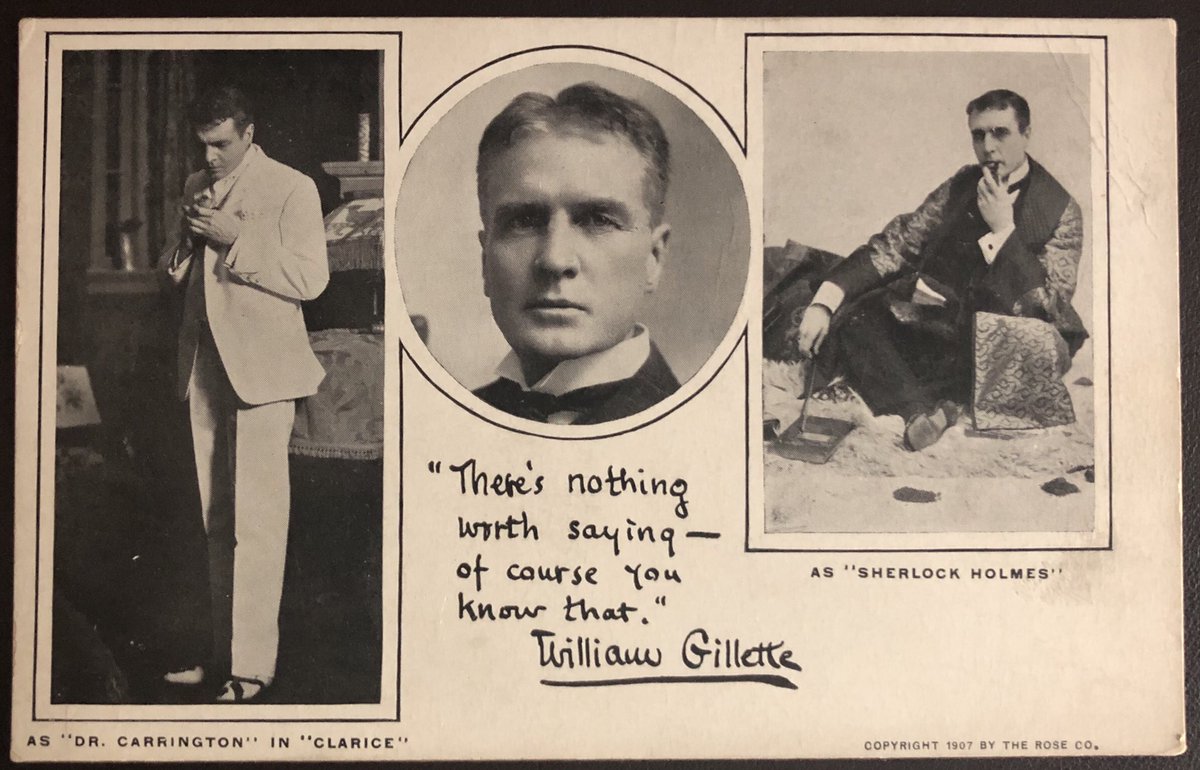
After closing in New York, Sherlock Holmes toured theatres in the Eastern United States from 8 October 1900 to 30 March 1901. Gillette and other cast members moved to England where Sherlock Holmes premiered at the Shakespeare Theatre, Liverpool, 2 September. On 9 September, Sherlock Holmes opened at London's Lyceum Theatre where it ran for 200 performances, ending 12 April 1902.
Film Adaptions
In 1916, Sherlock Holmes was adapted as a silent film with the same title staring Gillette as the detective with whom he was so directly identified. One of the earliest American film adaptations of the famous fictional detective, the film was long thought lost, but was discovered in The Cinémathèque Française, Paris, in 2014, where it had been archived but incorrectly labeled. Gillette's play was adapted as a film again in 1922 with John Barrymore as Holmes. Another film adaptation of the same title, in 1932, by Paramount, starred Clive Brook, and was the first all talking Holmes film. Brooks was the first to speak the phrase, "Elementary, my dear Watson" now part of both the British and American English lexicons.
Radio Adaptions
Gillette appeared in two radio adaptations of Sherlock Holmes stories. The first was "The Adventure of the Speckled Band," the premiere episode of a series titled The Adventures of Sherlock Holmes broadcast by WEAF radio, New York, 20 October 1930 (30:00, episode 1, no surviving recording known). Gillette read the part of Sherlock Holmes. This was the first time Holmes was portrayed on radio as part of a continuing series. The script was adapted by Edith Meiser from the original stage play version of the story by Conan Doyle.
The second radio adaptation was also by Gillette, then 82 years old, who led a 50-minute performance (9:00-10:00 pm) of his own Sherlock Holmes for Lux Radio Theatre, broadcast by WABC in New York, 18 November 1935 (episode #55, no surviving recording known). Lux Radio Theatre was, and still is, noted as a classic radio series, offering radio adaptations of plays and movies, often using the original stars reading their parts. The script was written by Edith Meiser. The cast included Gillette as Holmes, Betty Hanna as Alice Faulkner, Reginald Mason as Dr. Watson, and Charles Bryant as Professor Moriarty. Gillette's performance marked the sixtieth anniversary of his first appearance on stage, the thirty-sixth year since he had first played Sherlock Holmes, and his last appearance before a radio microphone (Los Angeles Times. "Famed Star Due on Air," November 18, 1935, p. A14.; see also Zecher, Henry. William Gillette, America's Sherlock Holmes, Xlibris, 2011, pp. 555-557.).
The Mercury Theatre on the Air's Sherlock Holmes, 1938
In 1938, The Mercury Theatre on the Air adapted Gillette's four-act, three-hour theatrical melodrama as
a one-hour radio episode staring Orson Welles (1915-1985) as Sherlock Holmes. The Immortal
Sherlock Holmes was broadcast 25 September 1938 as episode #12 of The Mercury Theatre
on the Air. The cast included Orson Welles
(Sherlock Holmes), Ray Collins (Dr. Watson), Mary Taylor (Alice Faulkner), Brenda Forbes (Madge
Larrabee), Edgar Barrier (James Larrabee), Morgan Farley (Inspector Forman), Richard Wilson (Jim
Craigin), and Eustace Wyatt (Professor Moriarty). Listen to a recording of this broadcast.
Re-Imagined Radio's The Immortal Sherlock Holmes, 2021
From this lineage Re-Imagined Radio crafted its own adaptation of the Holmesian legacy as
The Immortal Sherlock Holmes. We retained the suspenseful conflict between Sherlock Holmes
and Professor James Moriarity from the original Gillette-Doyle melodrama. And, we added some other
changes.
For example, all but four of Doyle's novels and stories featured John Watson as the narrator. Our celebration gives this role over to Mary Watson, wife of Dr. Watson.
Additional inspiration comes from The Painful Predicament of Sherlock Holmes: A Fantasy in One Act by William Gillette (Ben Abramson, Chicago, 1955), and Sherlock Holmes: The Painful Predicament of Alice Faulkner, a graphic novel by Bret M. Herholz (Alterna Comics, 2009) based on William Gillette's melodrama. A particularly strong reference source was William Gillette, America's Sherlock Holmes by Henry Zecher (Xlibris, 2011).
Works Cited and Resources
Episodes→ at
Internet Archive
website
Episodes→
at Old Time Radio Researchers Group Library website
New Adventures of Sherlock Holmes radio
logs→ at
Jerry Haendiges Vintage Radio Logs website
Zecher, Henry. William Gillette, America's Sherlock Holmes. Xlibris, 2011.
Production
Contents
***
Cast
William Johnson as Sherlock Holmes
Consulting detective, the detective's detective, the best-loved character in detective fiction.
Sebasitian Hauskins as Dr. John H. Watson
Friend and colleague to Holmes, and his biographer
Kristin Heller as Mary Watson
Wife of John Watson, narrator
Holland Huaskins as Billy
Holmes' employee
Greg Shilling as Inspector John Forman
A competent officer from Scotland Yard
Nick D'Ettorre as James Larrabee
A blackmailer
Laura Harris as Miss Alice Faulkner
A young and beautiful lady who was planning to avenge her sister's murder
Derek Nolan as Professor James Moriarty
The Napoleon of Crime
Greg Shilling as Alfred Bassick
One of Moriarty's top agents
Credits
Directed by Barbara Richardson
Viola music by Michael Burris
Sound Design and Post Production by Marc Rose
Social Media by Regina Carol Social Media Management and Photography
Graphic Design by Holly Slocum Design
Produced and Hosted by John F. Barber
Significance
***
Producer's Notes
***
Promotion
Press
Graphics

Looking for other graphics to promote this episode?