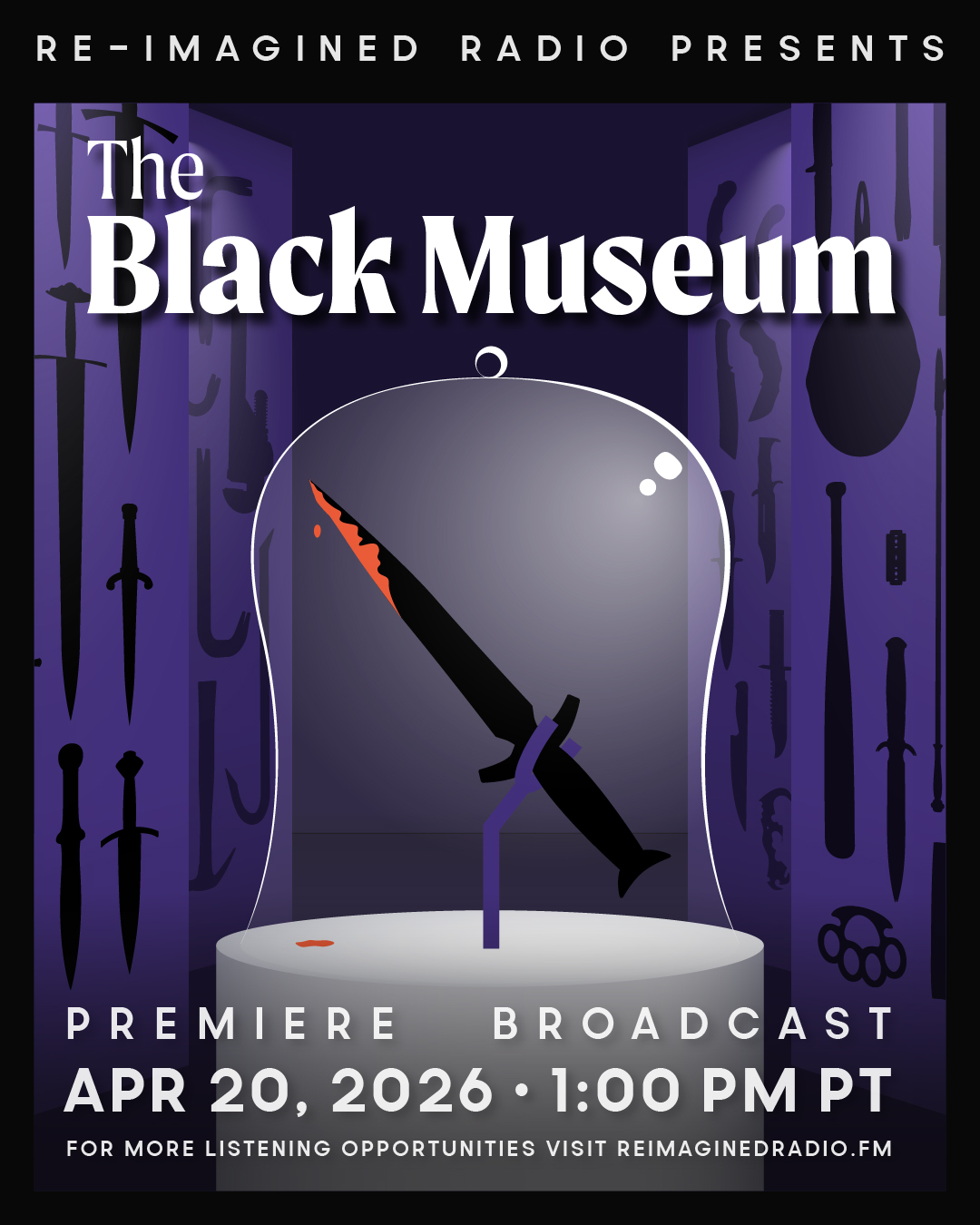
The Black Museum
RiR #96, Season 14, Episode 04, April 20, 2026
A warehouse of homicide ...
where everyday objects are touched by murder
Re-Imagined Radio samples from four radio drama series about "The Black Museum," a collection of ordinary objects, each associated with crime and murder, held at Scotland Yard, London, England, to explore how this unusual collection is portrayed through radio storytelling. From our Documentary series.
Established in 1874, The Black Museum provides training opportunities for those investigating murders and other crimes. Closed to the public, The Black Museum inspires a sense of mystery which has played out in numerous crime novels and four radio series.
Download Links
Download episode to your
device→
Download episode media
kit→
Download episode script

Background
Overview
The Black Museum began formally in 1875 as "The Crime Museum." Everyday items used in various crimes and
murders where kept by Metropolitan Police of London, commonly called Scotland Yard, as instructional
tools for police officers.
No visitors were allowed. This created a sense of mystery around the collection. People began calling it "The Black Museum." An article published in The Observer, Sunday, 8 April 1877 formalized the name. Mystery and reputation fostered the chronicling of hundreds of Scotland Yard's cases worldwide in popular crime novels and pulp fiction, as well as four radio series, 1948 to 1952.
Radio crime and police-detective stories were very popular from the 1940s-1950s. This popularity coincided with rising concerns for emerging criminal activities, especially organized crime, and containment efforts at all levels.
The four radio series are the subject of this episode, "The Black Museum." Stories told by each dramatize crimes and murders associated with The Black Museum's collection.
Origin
The origin of The Black Museum can be traced to 1870. Prior to that date, property and goods of those
convicted of treason or felony in the United Kingdom were automatically and permanently forfeited to The
Crown.
The Forfeiture Act 1870, an act of the Parliament of the United Kingdom, abolished this practice everywhere except in Scotland. Instead of forfeiting properties of prisoners to The Crown, their custody and management were vested in an administrator who would return it at the end of a prisoner's sentence. In England this administrator was Metropolitan Police of London, popularly known for the address of their headquarters, Scotland Yard.
The Crime Museum
The Central Prisoners' Property Store was established to house the prisoner artifacts held by Scotland
Yard. Police Inspector Percy George Neame advanced the idea of using items associated with various
crimes as instructional tools for police officers (Schulz, et.al 348).
On April 12, 1875, Neame and Police Constable [first name unknown] Randall were permanently appointed to curate the growing collection of crime artifacts (Waddell 5-6). The name, The Central Prisoner's Property Store, was changed to The Crime Museum of Scotland Yard. The new museum, a two-room house in the courtyard of Scotland Yard, was to be used for practical training of police officers, giving instructions on the detection and prevention of crime.
Renamed "The Black Museum"
The Crime Museum was closed to the public. In the April 8, 1877 issue of The Observer, a
reporter—some say denied entry by Inspector Neame—writing under the name
"Our Special Reporter," implied the term the "Black
Museum" was already in use to describe the collection of crime and murder artifacts curated at Scotland
Yard. Special Correspondent formalized its use by writing, "[It] is, indeed, as it is called, a
Black Museum, for it is associated with
whatever is
darkest in human nature and human destiny" (Special Reporter 3).
Special Correspondent continues, "The whole collection ... is such that only the villaneous records of a teeming city like London could produce. There are many things also there which do not even begin alluding to; but we have said enough to show that the whole is in truth a Black Museum" (2)
This article, titled "The Black Museum," was reprinted in the April 24 and 28 editions of The Sussex Advertiser, with a slightly changed title, "The Black Museum of Scotland Yard". The original and reprints introduced a mistaken date into the Black Museum's history by incorrectly citing the passage of The Forfeiture Act 1870 as 1869.
"Formerly all property of any kind belonging to convicted felons went to the Crown, but by an Act
passed, we believe, in 1869, this was altered, and whatever is found on them now is
retained
till
their sentences have been completed, when they can come back to this house [i.e. the Museum] and
claim their own. This law does not, of course, apply to cases of unlawful possession, such as tools
for burglary, which are never given up, or see the light again" (Special Reporter 3).
— "The Black Museum at Scotland Yard."
NOTE: This article is reproduced as the textual content for The Black Museum at Scotland Yard, part of the Jack the Ripper Tour website.
The name, "The Black Museum," stuck. As did the no vistors policy. A sense of mystery surrounding the collection, a growing interest in crime and police stories, and the reputation of Scotland Yard fostered the chronicling of hundreds of Scotland Yard's cases worldwide in popular crime novels and pulp fiction, as well as four radio series.
Four Radio Series
Four radio drama series focused on the collection of crime and murder artifacts held at The Black Museum.
Secrets of Scotland Yard (1949-1951) Focus: Noteable crime cases
investigated by Scotland Yard.
The Black Museum (1947) Focus: Individual objects in the
Museum's collection.
Whitehall 1212 (1951-1952) Focus: Crime investigation from the
police perspective.
Fabian of The Yard (1952-1953) Focus: Memoirs of former Scotland Yard
Chief Inspector Robert Fabian.
Whitehall 1212 was written and directed by Wyllis Cooper and broadcast by the National Broadcasting Company (NBC). The other three series were produced and syndicated by Harry Alan Towers, Towers of London, London, England.
Listen to our episode Syndication for more infomation about this form of radio production and distribution. Listen also to Bogart and Bacall, Part 2, a syndicated radio series starring Humphrey Bogart and Lauren Bacall.
Why four radio series?
Mystery surrounding The Black Museum
Interest in true crime and police stories
Storytelling opportunities provided by artifacts collected and curated in The Black Museum
Power of radio storytelling to spark listeners' imaginations.
The four series dramatize crimes and murders associated with The Black Museum's collection.
Works Cited
Our Special Reporter. The
Black Museum. The Observer. Sunday, 8 Apr. 1877, p. 3.
Reprinted:
The
Black Museum at Scotland Yard. The Sussex Advertiser, 24 April 1877, p. 2.
The Black Museum at Scotland Yard. The Sussex Advertiser, 28 April 1877, p. 4.
Schulz, Dorothy Moses M.; Haberfeld, Dr. Maria (Maki) R.; Sullivan, Larry E.; Rosen, Marie Simonetti. Encyclopedia of Law Enforcement. Sage Publications, 2005, p. 348
Waddell, Bill. The Black Museum: New Scotland Yard. Little, Brown, 1993.
Secrets of Scotland Yard
The first of four radio series to focus on Scotland Yard's "Black Museum" was Secrets of Scotland Yard, produced by Harry Allen Towers, and syndicated internationally as early as 1948 by his company, Towersof London.
Quick Info
Secrets of Scotland Yard
Recorded/Produced/Syndicated, 1947-1948
Produced by Harry Alan Towers, London, England
Hosted by Clive Brook, and then an unknown actor called "Superintendent X"
Episodic radio series
Crime, detective, Black Museum
30-minute episodes
110 episodes produced, 72 survive
57-58 episodes, approximately 2 years of episodes, featuring Brook as narrator are known to survive
Focus: Dramatizations about investigations of true crime or murder
Background
During World War II, Towers repackaged and distributed radio broadcasts via electrical transcriptions
(ETs; record albums) to British military forces overseas. After the war, he developed a successful
career as an independent radio, television, and film producer in London. Towers saw economic
opportunities in a radio series focusing on the largely unknown Black Museum collection of objects
associated with various crimes, housed at Scotland Yard, headquarters of the London Metropolitan Police.
A syndicated radio series, he reasoned, could give a hint of these secrets. He
created episodes from real-life Scotland Yard case files. Episodes often included the
evidence that led to the arrest of criminals.
Secrets of Scotland Yard was hosted and narrated initially by American actor Clive Brook, who starred as Holmes in the 1932 Fox Film motion picture Sherlock Holmes, based on the stage play Sherlock Holmes by William Gillette, which was based on the Sherlock Holmes character and stories by Arthur Conan Doyle. After Brook left, host duties fell to "Superintendent X," an unnamed actor.
Percy Hoskins, consulted and is credited with writing most of the stories and scripts for the 110 episodes. Hoskins, a crime journalist for London's Daily Express and one of the founders of the Saints and Sinners Club of London, an educational organization dedicated to true crime investigation methods and results, later consulted with Wyliss Cooper, who wrote the Whitehall 1212 series for the National Broadcasting Company (NBC) in the United States.
One episode, "The Bone From A Voice Box," apparently "served as the prototype" for The Black Museum, another Towers Of London dramatic series.
Exemplary episode
"The Bank of England Robbery" narrated by Clive Brook.
Summary
The episode dramatizes the investigation of the 1873 Bank of England robbery by George Bidwell and
George MacDonald, who
forged
promissory notes to defraud the bank of about £100,000. The criminals used genuine
bills to build trust and forged others to extract money, which they laundered through various means.
Their downfall came from small errors, including an undated bill and a forgotten scarf. Bidwell fled
through Ireland and Scotland but was captured; MacDonald escaped to France and then the U.S., where he
was arrested. The stolen bonds worth nearly $300,000 were found in New York. The trial ended with life
sentences, underscoring that even near-perfect crimes fail due to minor mistakes. The story highlights
the vigilance of Scotland Yard and Pinkerton in resolving the case.
Listen to "The Bank of England Robbery"
Distribution
Episodes of Secrets of Scotland Yard were produced in 1947. Distribution was hampered by
the state-owned British Broadcasting Corporation's (BBC) ban
against commercial broadcasts throughout the British Empire. Towers turned to his war-time network of ET
pressing operations and broadcast outlets around the world as a way to distribute his program without
violating BBC rules.
As early as December 1948, episodes were broadcast by Lourenço Marques Radio (LM Radio), a "pirate" radio station located in the Portuguese colony of Mozambique. South Africa was the intended audience, and Secrets of Scotland Yard was introduced to English-speaking listeners over the next two years (if the entire series of 110 episodes was aired). Selected episodes were briefly broadcast by Mutual Broadcasting System, 1957-1959.
Resources
The Definitive
Secrets of Scotland Yard→
Available through the Internet Archive's "Wayback Machine"
Secrets of Scotland
Yard→
at Archive.org website
Secrets of Scotland
Yard→
at Radio Horror Hosts website
The Black Museum
The second of four radio series about Scotland Yard's "Black Museum," produced and syndicated internationally by Harry Alan Towers, London, England. Narrated by Orsen Welles.
The Black Museum (1952-1954), a weekly OTR dramatic murder-crime anthology series. Each episode dramatized a crime or murder associated with artifacts in The Black Museum, called by narrator Orson Welles, "Scotland Yard's warehouse of homicide where everyday objects . . . all are touched by murder."
Quick Info
The Black Museum
Recorded/Produced, 1947, Syndicated, 1952
Produced and syndicated by Harry Alan Towers, London, England
Orson Welles as Narrator/Host
Episodic/serial radio series
Crime, detective, police procedural, Black Museum
30-minute episodes, weekly
51 episodes produced, 51 survive
Focus: Objects used in crimes or murder, held in the Museum
Black Museum Episode Inventory
Background
Harry Alan Towers owned the rights to the character Harry Lime, from the very successful British noir
film The Third Man. He wanted to make a radio series but had no ideas and no star. Then Orson Welles, American radio actor and motion picture
director, walked into the room.
Welles was in Europe to escape a listless Hollywood career and studio interference. He wanted to make money, to finance his motion pictures. Towers wanted to make radio drama he could sell around the world. So, Towers and Welles struck an agreement. Welles would star in the 52-episode series The Lives of Harry Lime planned by Towers. Additionally, he would host Tower's new series about Scotland Yard's "The Black Museum," and appear as Dr. Moriarity in The Final Problem episode for the The Adventures of Sherlock Holmes series, produced by Towers, 1954-1955.
Work on The Black Museum, began as early as 1947. Since The Secrets of Scotland Yard had already covered most of Scotland Yard's most famous cases, The Black Museum would be a direct competitor. Towers and Welles agreed to take a different approach, focusing on Scotland Yard's collection of ordinary objects associated with crime and murder, rather than the crimes themselves.
Each episode began . . .
This is Orson Welles, speaking from London.
(Sound of Big Ben chimes)
The Black Museum . . . a repository of death. Here in the grim stone structure on the Thames which
houses Scotland Yard is a warehouse of homicide, where everyday objects . . . [Welles names 3-4
different] . . . all are touched by murder.
(Dramatic music)
Following this episode opening, Welles described a specific artifact found in The Black Museum. His description led to a dramatization of a true crime or murder. At the episode's conclusion, Welles entoned . . .
Now until we meet again in the same place and I tell you another tale of the Black Museum, I remain, as always, obediently yours.
Credits
Produced in London, England, by Harry Alan Towers (1920-2009).
Recorded
at IBC Studios→.
Orson Welles narrated each episode, and also contributed
to the writing and production.
Ira Marion, writer
Music composer / director, Sidney Torch
Distribution
As with Secrets of Scotland Yard and The Adventures/Lives of Harry Lime, Towers used
broadcast outlets around the world to distribute The Black Museum without violating BBC
rules. Perhaps the earliest broadcast was by Radio Luxembourg, a "pirate" radio station, beginning in
August 1951. This provided exposure for the series in Europe and England. Order of episodes unknown.
1 January-24 June 1951 and 30 September 1951-30 December 1952
Thirty nine episodes broadcast in the United States via the Mutual Broadcasting System (MBS). Order of
episodes unknown.
28 September 1952-28 June 1953
Thirty eight (or thirty nine) episodes broadcast via Canadian Broadcast Corporation (CBC). Order of
episodes unknown.
An unknown number of episodes were broadcast via Armed Forces Radio and Television Services (AFRTS). Dates of broadcast(s) and order of episodes unknown.
Exemplary Episodes
"A Tan Shoe, Left Foot"
E.T. #14, 15 January 1952
Summary
Wallace Bennett, a paymaster traveling with a
large sum of cash, is found dead on a train, with his cash bag missing. Despite initial dead ends in the
investigation, a tip-off leads Inspector Morton to John Linkman, who was found with a suspicious amount
of money and a blood-stained shoe. Linkman confesses to the murder after being
confronted with the evidence, and the story concludes with his trial and sentencing for the crime. Orson
Welles narrates.
Listen to "A Tan Shoe, Left Foot"
"The Gas Receipt"
E.T. #39, 29 January 1952
A receipt for ten gallons of petrol is the clue to a murder of a police constable, shot to death by four
bullets.
Significance
The Black Museum is significant as one of three collaborations between Orson Welles and
Harry Alan Towers to produce and syndicate radio programs. The other two are The Lives of Harry Lime and The Final Problem
episode for the The Adventures of Sherlock Holmes series, 1954-1955.
The Black Museum is acknowledged as the best of four radio series focused on The Black Museum, a meticulously cataloged collection of crime items housed at Scotland Yard, London, England. Welles narrated each episode, describing the collection as being "touched by murder," and also contributed to the writing and production.
The creative and acting abilities of Orson Welles, along with dramatizations of morbid and gruesome cases, often told from the criminal's point of view, combined to produce a sensational appeal for the series.
Resources
Black Museum Radio logs→
at Jerry Haendiges Vintage Radio Logs website
Black Museum
episodes→
at Internet Archive website
The Definitive Black
Museum→
at Digital Deli Too website
Whitehall 1212
The third of four radio dramatic murder-crime anthology series focusing on Scotland Yard's "Black Museum."
Quick Info
OTR adult crime, detective, police procedural series
8 November 1951-28 September 1952
Written and directed by Wyllis Oswald Cooper (1899-1955)
Produced and distributed by National Broadcasting Company (NBC), London, England
30-minute episodes, weekly
Total Episodes: 44
Surviving Episodes: 43 (Episode 02 not available)
Focus: A consistent narrative point of view, that of the police investigating each crime. The narrator
is often a police official, the Chief Inspector or Chief Constable.
Whitehall 1212 Episode Inventory
Background
Wyllis Cooper was noted for Lights Out (1934)
and Quiet, Please! (1947-1948).
Percy Hoskins, a crime journalist for London's Daily Express consulted for the series. Each episode was a dramatization of a Scotland Yard case by an all British cast (at Cooper's insistence) and hosted by Chief Superintendent John Davidson, curator of the Black Museum.
Cast
The recurring cast included
Harvey Hayes
Patricia Courtleigh
Horace Braham
Winston Ross
Lester Fletcher
Significance
Whitehall 1212 is significant because of its connection to Wyllis Cooper, a highly regarded
radio writer and director.
Whitehall 1212 took an intellectual approach to solving the mysteries of the crimes, rather than playing up their horrors. It used an all British cast, at Cooper's insistence. And maintained a consistent narrative point of view: that of the police investigating each crime.
Exemplary Episodes
The first three surviving and the last three episodes from the Whitehall 1212 series.
"The Blitz Murder Case"
Episode 01, 18 November 1951
Summary
A true crime case from July 1940 during the London Blitz, involving the triple murder of Mrs. Ames, her
daughter Jessica, and their servant Margaret Evans in Matfield, Kent, England. Chief Superintendent
Carruth and Detective Sergeant Small investigate with local police, uncovering key evidence such as a
fourth teacup, a glove, and shotgun pellets. The motive centers on John Ames, estranged husband of Mrs.
Ames, seeking divorce to marry farm manager Viola Masterson. Although Ames is initially suspected,
forensic evidence and witness accounts implicate Miss Masterson, who is arrested, found criminally
insane, and imprisoned. The case exemplifies Scotland Yard's thorough investigative work amid wartime
challenges.
"The Mrs. Noami Fornier Case"
Episode 03, 2 December 1951
Mrs. Noami Fornier's body is found in an old trunk at the Charing Cross railroad station baggage claim.
Who killed her?
"The Murder of Duncan Frazier"
Episode 04, 9 December 1951
Sidney Patterson's body is found in a burning building. But, he was shot in the back! Mr. Patterson then
turns out to be Duncan Frazier! The teeth tell the story.
"The Case of the Winchester Bottles"
Episode 42, 14 September 1952
A "Winchester bottle" is associated with the murder of a four year old girl. A set of mysterious
fingerprints on the bottle cannot be identified. Scotland Yard decides to fingerprint the entire town of
Blackbourne!
"The Case of the Inoperative Wireless"
Episode 43, 21 September 1952
A wireless set never intended to be operative is involved with the murder of a bartender by strychnine.
"The Case of the Electric Torch"
Episode 44, 28 September 1952
A drunkard is killed by a man in love with his wife. An electric torch makes an excellent weapon.
Resources
Whitehall 1212 episodes→
at Internet Archive website
Whitehall 1212
Episodes→
at Old Time Radio Researchers Group Library website
Whitehall 1212 radio logs→
at Jerry Haendiges Vintage Radio Logs website
The Definitive
Whitehall 1212→
at Digital Deli Too website
Whitehall 1212 plot summaries and credits→ at Radio Gold Index website
Radio History of Whitehall
1212→
at Radio Horror Hosts website
Fabian of The Yard
The fourth series about Scotland Yard's "Black Museum." Produced in 1952-1953 by Towers of London in Sydney, Australia, the series starred Guy Dolman and Ron Roberts. Episodes offered via South African syndication(?).
Quick Info
Recorded/Produced/Syndicated, 1952-1953
Produced and syndicated by Harry Alan Towers, Sydney, Australia
Starring Guy Dolman and Ron Roberts
Theme music composed by Robert Hanmer
Episodic/serial radio series
Crime, detective, police procedural, Black Museum
13-minute episodes
***?*** episodes produced, 4 survive(?)
Focus: Dramatizations of stories from the memoirs of Robert Fabian, former Detective Supintendent,
London Metropolitan Police.
Significance
The series is considered the earliest police procedural made for British television. It shared many
common points with the Dragnet series, produced by and
starring Jack Webb. Bruce Seton played Fabian in every episode. Each episode ended with the real Fabian,
at his desk, describing the crime case on which the television story was based.
Background
Robert Honey Fabian (1901-1978) was a real-life English police officer. He rose to the rank of Detective
Superintendent in the London Metropolitan Police, more commonly known as Scotland Yard. After retirement
in 1949, he published a memoir of his experiences, Fabian of the Yard (Naldrett Press,
1950), which became the basis for the BBC television drama series, also called Fabian of the
Yard, November 1954-February 1956 (2 seasons, 39 episodes total).
The theme music "The Four Horsemen" was composed by Robert Hanmer (1917-1994), a British composer, conductor, and music arranger. Performed by the Harmonic Orchestra conducted by Hans May.
After the opening music, the 13-minute episodes began with an announcer saying . . .
Fabian of The Yard. Stories of the war against crime as told by the Detective of the Century, ex-Superintendent Robert Fabian.
Musical interlude, then . . .
Here is another factual crime detection story drawn from the personal records of ex-Detective Superintendent Fabian of Scotland Yard.
Known surviving episodes
"The Man Who Escaped from Hell"
"Coco Marquess"
"Paul Martin"
"Murder To Music"
"The Man Who Escaped from Hell"
This episode dramatizes the story of [Thomas Edward] "Eddie" Guerin, a bank robber who won noterity
when he
escaped from the French penal colony of Maroni, near Devil's Island, in 1904.
Summary
Guerin spent most of his life as a criminal, and years in French and American prisons, escaping from
several. In this episode Guerin provides some details of his experiences at and escape from Devil's
Island.
In 1928, Fabian, then a detective sergeant, observes Guerin attempting to steal luggage in London
hotels. Upon arrest, Fabian learns of Guerin's infamous past, including a major robbery in Paris and his
brutal imprisonment on Devil's Island. Guerin shares harrowing details of the French penal
system, describing the inhumane conditions of transport, imprisonment, and the harsh environment of the
penal colony. Despite his criminal history, Guerin expresses a desire to reform but feels hopeless due
to his age and lack of prospects. He dies in 1940 in a public institution, a broken man. Fabian uses
Guerin's story to illustrate that crime ultimately leads to tragic ends and is not heroic, especially as
it negatively influences youth. The narrative ends with Fabian hinting at another upcoming story about a
criminal named Coco Marquis.
Background
1888
Guerin is one of the first criminals to achieve international notoriety. He and some cohorts robbed
Crédit Lyonnais in France on July 2, 1888. Stories appeared in New York newspapers the next morning.
Arrested in London, Guerin spent ten years in a French prison. After his release, Guerin and safe-cracker George Miller robbed the American Express office in Paris on April 26, 1901. Now "a hardened criminal," the French authorities sentenced him to life on Devil's Island. From which he escaped.
1905
This The New York Times article provides details about Guerin's escape from the French
penal colony.
"There is an agent of the French Government in town. The tilt of his hippihappa grass hat, the indolent droop of his brown-paper cigarette, the swarth of his face, and the graceful way he has of gliding around street corners would suggest that he is a sleuth of the French penal settlements.
"He is supposed to be anxious to meet Ed Guerin, formerly of Chicago, later of Paris, and latest of Devil's Island. Guerin is also in town, and has been the centre of many gaping, listening circles at the Metropole and other Rialto corners for several nights. He tells a story which would make Dreyfus revise his book, for, after being a prisoner on Devil's Island, he managed to be transferred to the penal colony on the mainland and escaped.
"He was quite a celebrity in his line in Chicago some fifteen years ago. Later, circumstances led him to France, where he distinguished himself by becoming implicated in the robbery of the Bank of Lyons in 1891. The bank suffered to the extent of $50,000.
"Guerin was not arrested until ten years later. In 1901 he was tried for robbing the American Express Company in Paris of $6,000. The French court sentenced him to penal servitude for life on Devil's Island.
"On Devil's Island Guerin began to plan how to escape. The first scheme failed. He got news, however, to his friend, Pat Sheedy, who was then in Europe, that he was in trouble. Sheedy investigated his case; and whether he had anything to do with Guerin's reappearance on the Rialto only Sheedy knows, and he won't tell. But they have been much together since Guerin's arrival.
"About the beginning of May last year Ed Guerin became ill on Devil's Island was removed to the penal settlements in French Guiana. Soon after that his health improved and he took a constitutional walk into the swamps. He gained the jungle and headed for Dutch Guiana (present-day Suriname), which is about 100 miles to the northwest. It was then that Guerin suffered more than he ever did in prison. By the time he got to the Maroni River and crossed into Dutch territory there was little left of him, owing to bad food, jungle life, malaria, and sand flies.
"But he was out of French Guiana and on the road to Paramaribo, the Dutch capital, where he hoped for aid from the American Consul.
"In the last lap, however, his luck deserted him. Just outside of Paramaribo, on the wrong side of the Surinam River, he was attacked by Indians, presumably Arawaks, who, finding that he had nothing worth stealing, beat him into insensibility for spite.
"A few days later, more dead than alive, Guerin was carried into Paramaribo by some "good" Indians. When he was able to tell who he was, he was sent on to Georgetown, British Guiana (now the independent nation of Guyana), whence he shipped for New York.
"When he strolled into the Metropole, George Considine walked to the front door, saw that the Times Building was really on the landscape, then said: "What'll you have, Ed?"
"Guerin has been seen several times around the Hotel Lincoln, Broadway and Fifty-second Street, where
"Pat" Sheedy lives. Guerin does not live there, however, and his address is refused to strangers all
along Broadway on account of the proximity of the man with the drooping cigarette."
(Ed
Guerin Free in Town out of a French Jail; There's an Agent from French Guiana Seeking Him. Hw Wa on
Devil's Island Got Transferred to the Mainland and came Through the Jungle -- Arrived Half Dead.
The New York Times. 5 July 1905, p. 5.)
1928
This The New York Times article supports the dramatization offered by this episode of
Fabian of the Yard.
"Eddie" Guerin, known internationally in police circles many years ago and notorious for his escape from Devil's Island was sentenced to three months' imprisonment, with hard labor here today.
"He was arrested while loitering around one of the big hotels in the neighborhood of Piccadilly Circus with the alleged intention of committing a felony. Guerin, who has lived in England for many years, after successfully resisting extradition to France, protested that he had been leading a straight life in recent years.
"Guerin, who made his headquarters in Chicago back in the '90s was sent to Devil's Island in 1901 for taking $30,000 from the American Express Company in Paris. He served four years and then escaped to the mainland of French Guiana in a canoe. His subsequent return to London, and the renewal of his association with his former pal, the woman known as "Chicago May," [May Churchill] culminated in a quarrel over the woman between Guerin and Charles Smith, an American. Smith shot and wounded Guerin and was sentenced to penal servitude for life, being liberated in 1922 and deported to America.
"At the time of the shooting the French Government demanded that Guerin be extradited, but Great Britain
refused to comply, deciding that he was a British subject.
('Eddie'
Guerin Jailed as London Loiterer; Chicago Crook, Who Escaped From Devil's Island, Gets Three Months'
Sentence. New York Times. 28 May 1928, p. 2.)
1932
In London, Guerin continued his life of crime. This New York Times article provides some
interesting details.
"Eddie Guerin, who escaped from Devil's Island in 1904, was sentenced to one year's imprisonment here today for stealing a woman's handbag on Armistice Day. The presiding judge, Sir Percival Clarke, said that but for Guerin's age his sentence would have been longer.
"Eddie Guerin, known to the police of the United States, Great Britain and Europe as a man who has devoted nearly four-fifths of his seventy-odd years to crime, was born in London in 1860. According to his autobiography, he came to the United States with his parents while a boy, and the family settled in Chicago.
"It was in Chicago that he first turned to theft, as far as the autobiography reveals, and he was sentenced when 15 years old to eight months' imprisonment for stealing from a house he had entered as a messenger boy. Thereafter he pursued a varied criminal career in this country, serving several terms in prison.
"He escaped from the Ohio State Prison and from the Allegheny State Prison, and for a time was forced to hide in Canada. Then, in 1887, he figured in a fight during which he shot a Chicago policeman and was forced to flee to England. The crimes for which he was sent to Devil's Island were the robbery of the American Express Company's Paris office of $30,000 and the earlier looting of the Bank of Lyons of $50,000.
"His escape from the French penal colony is said to have been carried out with the aid of American confederates, who chartered a tramp steamer and held it in readiness for him off shore.
"The news that he has received another sentence in London indicates clemency was extended to him for a
sentence imposed there last year for stealing a book of travelers' checks. At that time London
dispatches said he had been sentenced to serve three years."
(Eddie
Guerin Draws New Prison Sentence; Aged International Criminal Who Fled Devil's Island Goes to
English Penitentiary. The New York Times. 25 Nov. 1932, p. 7.)
The New York Times again recounted the legend of Eddie Guerin in this 1932 obituary. Note that the Fabian of the Yard dramatization give his date of death as 1940.
"The report gained currency in London's underworld tonight that Eddie Guerin, famous for his escape from
Devil's Island, had died here over the weekend. Officers of Scotland Yard heard the rumor and set a
number of inquiries afoot, but at an early hour had been unable to locate Guerin in any of his usual
haunts or obtain definite reports of his death from his former associates. Guerin, who was 72, has been
so well known in the London courts that when he was brought in recently on a minor charge, a court
officer urged him to accept the warrant under an assumed name. Guerin refused and was found not guilty
and discharged. The United States was the scene of the early exploits of Eddie Guerin, who started as a
pickpocket. He has always maintained that he was a native of England. In 1882 he was one of a band that
robbed the Farmers and Mechanics Bank of Galesburg, Ill., of $10,000. All were caught and served prison
terms. After his release Guerin returned to burglary and was sentenced to a prison term in Pennsylvania.
He escaped but was recaptured and served out his term. He was next heard of when he and man known as
"Dago Frank" robbed a bank messenger in Lyons, France, of $50,000. For this they served ten years in a
French prison. On his release Guerin went to Lon- don, where he met "Chicago May" Churchill, known in
World's Fair days as "Queen of the Shoplifters," a woman of more than ordinary beauty. For some years
they lived an apparently respectable life in London. In 1902 Guerin was convicted of a robbery committed
in Paris and was sent to the Devil's Island prison for life. But he escaped, boarded a British vessel in
British Guiana and went back to England. Guerin never fired a gun and served prison terms for most all
the big crimes he committed. His notoriety is due more to his escape from Devil's Island and his
writings. He was more distinguished as an author than as a crook. For years he wrote confession after
confession until he became known as an international criminal of almost superhuman feats. 'Chicago May,'
supposedly reformed, died a few years ago in Detroit."
(Eddie
Guerin, International Crook, Dead, London Hears; Escaped From Devil's Island. The New York
Times. 19 Jan. 1932, p. 11.)
Resources
An
Industrious Thief.; "Eddie" Guerin Works Hard, But Is Unsuccessful. The New York
Times, 26 July 1888, p. 8.
Terrible Criminal Record Recalled. Observer (Adelaide, South Australia). 21 Dec. 1929, p. 29.
Eddie Guerin Freed on Appeal in Britain; Notorious Criminal Absolved of Forgery Charge Because He Has Only Two Fingers. The New York Times. 10 June 1931, p. 3.
Guerin Is Buried in Pauper's Grave; Notorious Criminal Who Had Made Escape From Devil's Island Dies in Poverty HIS EXPLOITS LEGENDARY Earlier Large-Scale Thief Had Sunk to Petty Offenses in His Later Years. The New York Times. 7 Dec. 1940, p. 5.
"Coco Marquess"
Fabin introduces this episode as "the strange story of a man who manages to steal 25,000 pounds and
smuggle himself across the channel without leaving any trace or clue by which we could hope to catch up
with him." But, fate arranged a payoff for Coco Marquess. At episode's conclusion, Fabian announces,
"Next week I will deal with a particularly tragic type of murder case. It is 'The Case of The Black
Butterfly'." (See below)
"Paul Martin"
Paul Martin, a medical student becomes a drug addict after winning the Irish Sweepstakes. At episode's
conclusion, Fabian announces "Next week I will deal with a murder case that had an unusual angle. 'The
Case of the Midget Hercules'." (See below)
"Murder To Music"
A murderer uses the sound of loud radio music to cover his crimes. At episode's conclusion, Fabian
announces, "My story next week will deal with a man who like a lot of other people fancied he would make
some
easy money on a race track, 'A Case of Two Above the Odds'."
"Murder To Music" broadcast on 1ZB, Tuesday, December 30, 1952, 7:30 PM, Dunedin, New Zealand
Broadcast on 3ZB, Tuesday, December 30, 1952, 7:30 PM, Christchurch, New Zealand
New Zealand
Listener, Vol 28, Issue 703, 24 December 1952, p. 25
An unidentified episode of Fabian of the Yard broadcast on 4ZB, Tuesday, December 30, 1952, 7:30 PM, Dunedin, New Zealand. New Zealand Listener, Vol 28, Issue 703, 24 December 1952, p. 25.
Known about episodes
"A Case of Two Above the Odds"
"Under Suspicion"
"The House Spider"
"The Gentleman Thief" (not confirmed)
"The Case of the Midget Hercules"
"The Black Butterfly"
"Under Suspicion"
Broadcast on 2ZB, Tuesday, December 30, 1952, 7:30 PM, Wellington, New Zealand New Zealand
Listener, Vol 28, Issue 703, 24 December 1952, p. 25.
Broadcast on 2ZA, December 30, 1952, 7:45 PM, Palmerston North, New Zealand. Noted as "Final Broadcast." New Zealand Listener, Vol 28, Issue 703, 24 December 1952, p. 25.
"The Case of the Midget Hercules"
Introduced by Fabian at the conclusion of the "Paul Martin" episode. The RadioEchoes.com website offers
free download of an episode titled "The Midget Hercules." This
episode is mislabeled. It is, in fact, the "Murder To Music" episode.
"The Case of The Black Butterfly"
Introduced by Fabian at the conclusion of the "Coco Marquess" episode. A beautiful singer known as The
Black Butterfly is found brutally murdered in her flat. The Police
inspector has no clues except for a shred of black foil and the vague mention of a man in a nightclub
offering the victim drinks. Her killer is still on the loose. The Police detective must act quickly,
before the knife-wielding killer strikes again.
NOTE: The RadioEchoes.com website offers free download of an episode titled "The Case of the Black Butterfly." This episode is mislabeled. It is, in fact, the "Paul Martin" episode.
"The Gentleman Thief" (unverified)
Scotland Yard Detective Robert Fabian pursues Robert Augustus Delaney, a burgler targeting London's
wealthiest homes in the 1920s. His exploits even gained the admiration of the police who were chasing
him. But behind the glamorous exterior of the gentleman thief, lay the secrets of a dark past. Radio
episode, or television episode? Source: Spotify, Scotland Yard Confidential.
Works Cited and Resources
Aus 61 — Fabian Of The
Yard→
at Internet Archive website
Fabian
Of The Yard→
at Radio Echoes website
Robert Fabian→
at Wikipedia website
Fabian of the Yard Television
Episodes→
at epguides & TV Guide.com website
Production
Contents
Samples from each of the four radio series focusing on The Black Museum, a collection of artifacts with connections to crime and murder, housed at Scotland Yard, headquarters for the Metropolitan Police, London, England.
"The Bank of England Robbery" from Secrets of Scotland Yard, Narrated by Clive Brook, London, England
"A Tan Shoe, Left Foot" from The Black Museum
Produced by Harry Alan Towers, Narrated by Orson Welles, London, England
E.T. #14, 15 January 1952
"The Blitz Murder Case" from Whitehall 1212
Written and directed by Wyllis Cooper
Episode 01, 18 November 1951
"The Man Who Escaped from Hell" from Fabian of the Yard
Produced by Harry Alan Towers, Sydney, Australia
Dramatizes the story of [Thomas Edward] "Eddie" Guerin, a bank robber who won noterity when he escaped
from the French penal colony of Maroni, near Devil's Island, in 1904.
No dates for production or broadcast
Cast
See the detailed descriptions for each of the four radio series for information about starring and recurrent cast.
Significance
This episode is significant for its explorations of the four different radio series that portrayed people, cases, and artifacts associated with The Black Museum, a currated collection of artifacts used for crime and murder housed at Scotland Yard, headquarters for the Metropolitan Police, London, England.
Three of these radio series were produced and syndicated by Harry Alan Towers.
One series was written and directed by Wyllis Cooper, noted for Lights Out (1934) and Quiet, Please! (1947-1948)
One series features Orson Welles as the narrator. Welles collaborated with Harry Alan Towers to produce and syndicate The Lives of Harry Lime and The Final Problem, an episode for the The Adventures of Sherlock Holmes series, 1954-1955.
Producer's Notes
This episode is especially interesting, and challenging, for its connections, and overlays. Harry Alan Towers produced three of the four radio series included here. One of which is a collaborated with Orson Welles.
The episodes we sample are all true stories, about real people and real events. Look up The Bank of England Robbery. It actually happened, just as described in the episode we sample.
Look up George Bidwell. He's a real person, who after his release from prison wrote a wonderful autobiography about himself, his life, and his efforts in the bank robbery, Forging His Chains: the autobiography of George Bidwell, his trial and incarceration in English prisons fourteen years on a life sentence for "The $5,000,000 Forgery on the Bank of England", published in 1888.
Look up Eddie Guerin. He's another real person, who is one of the few people to escape the French penal colony of Maroni, near Devil's Island, French Guiana, in 1904. He also wrote an interesting biography I Was A Bandit, published in 1929.
Look up Robert Fabian. A real-life Police Inspector with London's Metropolitan Police. His memoir, Fabian of the Yard, published in 1950, provided true crime stories for both a radio (1952 to 1953), and a BBC television series (1954 to 1956).
— John F. Barber
Promotion
Press
Graphics
Looking for other graphics to promote this episode?